
Available 24/7 at
0755-82798135

TI eFuse vs Hot Swap Controllers: Which Protection Solution Is Better for Data Center Power Designs?
Modern data centers require power architectures that are not only efficient, but also safe, serviceable, and scalable. In server motherboards, accelerator cards, storage systems, and rack-level power paths, protection devices play an important role in limiting startup stress, isolating faults, and helping maintain stable operation under demanding electrical conditions.
Among the most commonly discussed protection solutions in this area are eFuse devices and hot swap controllers. Both can help improve reliability, but they are not the same. They differ in protection scope, startup behavior, flexibility, and typical application position. If you want to explore more electronic components and sourcing support, visit TomatoElec.
What Is an eFuse?
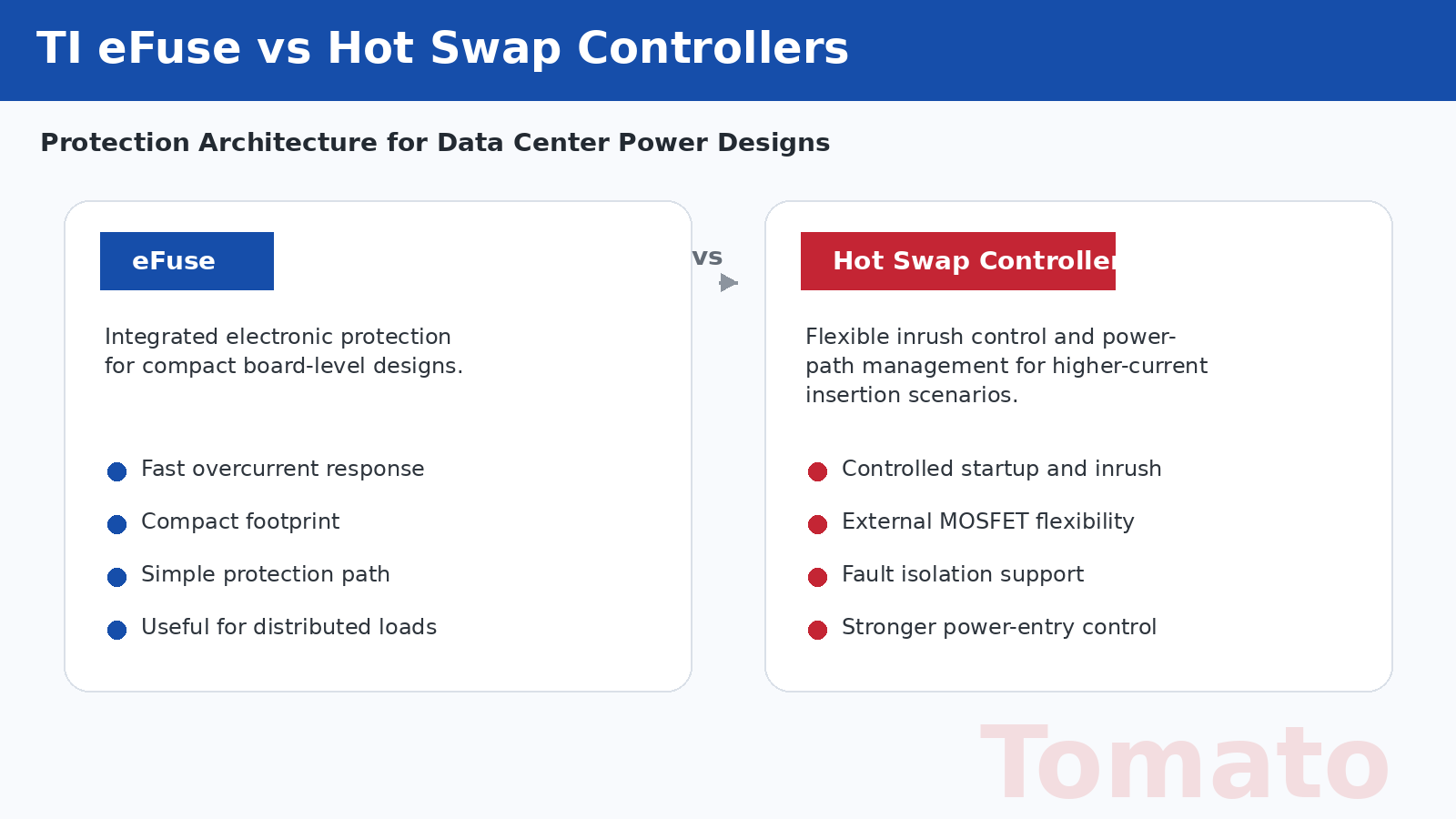
An eFuse is an electronic protection device designed to provide integrated fault protection in a compact form. It is commonly used to protect sensitive loads from overcurrent, short circuits, and abnormal power conditions. In many designs, an eFuse offers a simpler and more integrated protection path than traditional discrete solutions.
For compact server boards and distributed power sections, eFuse devices can be attractive because they reduce design complexity and provide fast electronic protection in a small footprint.
What Is a Hot Swap Controller?
A hot swap controller is designed to manage the safe insertion and startup of boards or subsystems in powered environments. Its role often includes inrush current control, startup ramp management, fault response, and power-path control. In higher-current systems, hot swap controllers are especially useful where designers need more flexibility and stronger control over startup conditions.
In data center power designs, hot swap controllers are often associated with board-level power entry, serviceable modules, and situations where controlled insertion and current limiting are essential.
Key Differences Between TI eFuse and Hot Swap Controllers
1. Integration Level
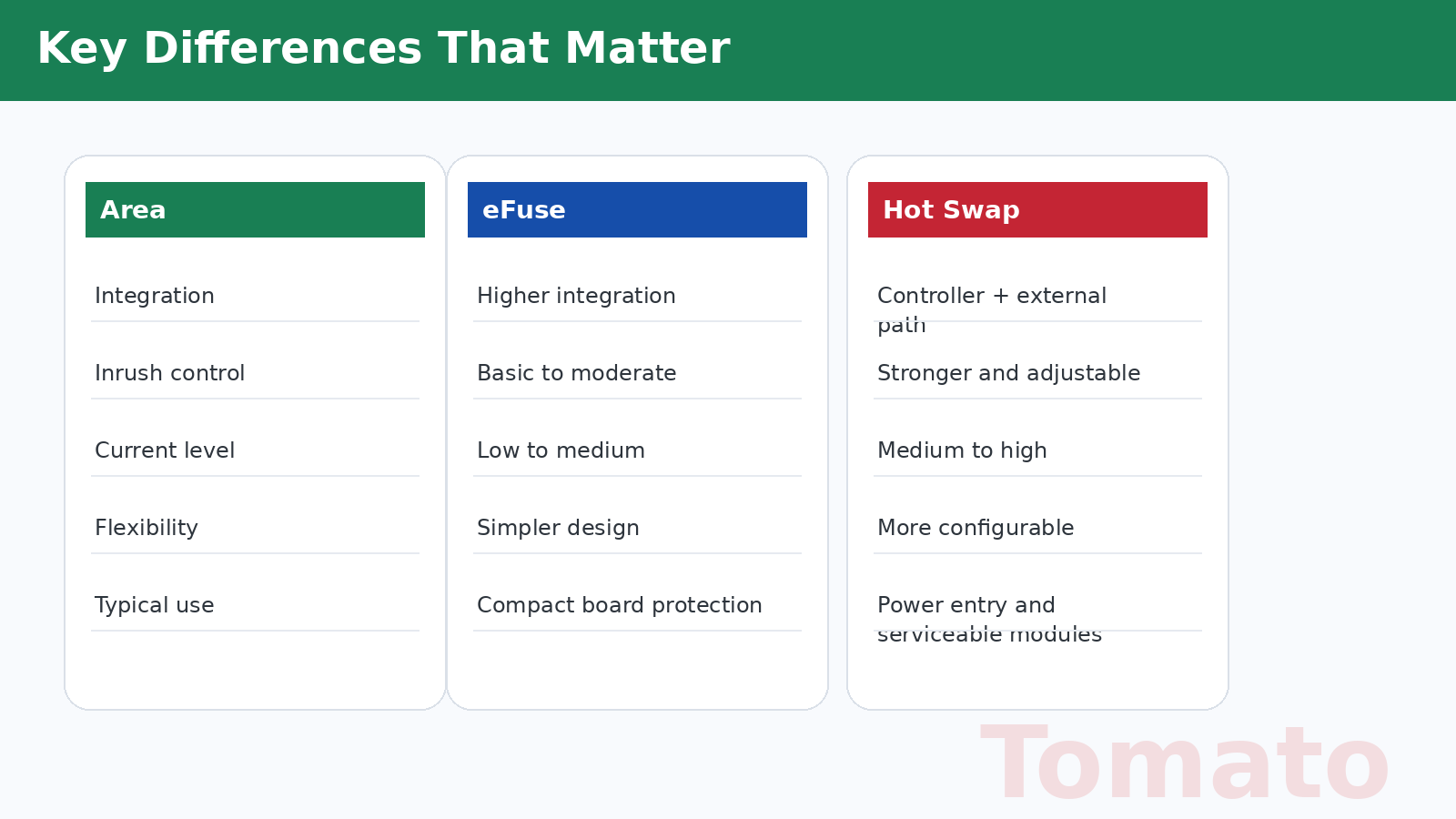
eFuse devices are often chosen for their integrated protection approach. They can simplify board-level protection and reduce the need for more complex external arrangements. Hot swap controllers, by comparison, are usually selected when the design requires more flexible startup behavior and broader power-path control.
2. Inrush Current Handling
Both solutions can contribute to safer startup, but hot swap controllers are generally more closely associated with strong inrush current management in serviceable or higher-current systems. If startup control is a major design concern, hot swap controllers often provide a better fit.
3. Current Range and Application Scale
For compact and moderate protection tasks, eFuse devices can be a practical choice. For more demanding current paths, especially at server power entry or in modular data center hardware, hot swap controllers are often preferred because they provide stronger control and more design flexibility.
4. Design Flexibility
eFuse solutions are often easier to implement in compact designs where integration is important. Hot swap controllers are usually more flexible in higher-current designs and in applications where designers want tighter control over startup, fault isolation, and system-level behavior.
5. Typical Application Position
eFuse devices are often used for local board protection and compact distributed loads. Hot swap controllers are more commonly associated with board insertion, power entry management, and modules that need controlled connection into active systems.
Typical Data Center Use Cases
Server Motherboards
Server motherboards often contain multiple rails and sensitive devices that benefit from reliable fault protection. Depending on current level and design complexity, either eFuse protection or hot swap control may be appropriate.
Accelerator and Compute Cards
Compute-intensive cards can create demanding startup and load conditions. In these cases, designers often need to think carefully about inrush behavior, current margin, and fault handling.
Storage and Networking Modules
Storage and networking platforms also need stable power delivery and good fault isolation. Protection choices should support serviceability without increasing risk to the rest of the system.
Rack-Level Power Paths
At the rack level, higher current, scalability, and maintainability become more important. This is one reason hot swap controllers are often considered for more demanding insertion and power-entry scenarios.
When to Choose eFuse
Compact Board Protection Is the Priority
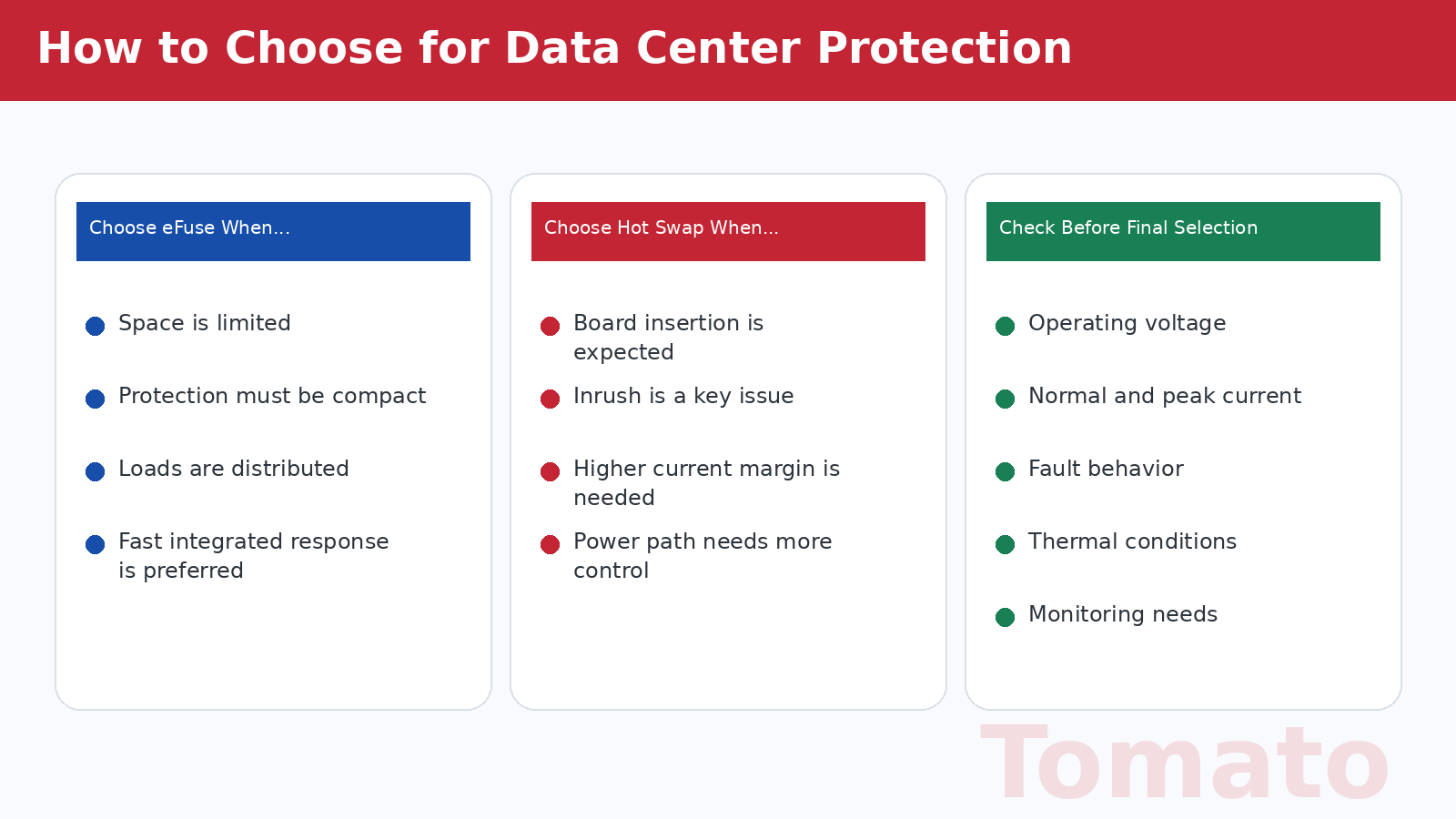
If the design requires integrated protection in a limited space, eFuse devices can be a strong option.
Protection Needs Are Relatively Localized
For distributed loads or local board-level protection, eFuse solutions are often more straightforward to implement.
Fast Integrated Response Is Preferred
Where designers want a compact electronic protection function without building a more flexible startup architecture, eFuse devices may offer a better balance.
When to Choose a Hot Swap Controller
Board Insertion or Live Connection Matters
If the application involves insertion into a powered system, hot swap control becomes much more important.
Inrush Current Is a Major Concern
For startup conditions involving larger input capacitance or stricter power-entry requirements, hot swap controllers are often the better choice.
Higher Current Margin Is Needed
In more demanding server and data center power paths, designers often prefer hot swap controllers for stronger startup and power-path control.
System-Level Flexibility Is Important
If the application needs more control over startup behavior, fault handling, and protection architecture, hot swap controllers usually offer greater design flexibility.
Common Design Mistakes to Avoid
Choosing Only by Current Rating
Current capability matters, but it should not be the only factor. Startup conditions, fault behavior, and thermal limits are also important.
Ignoring Inrush Conditions
Some designs fail not because of steady-state current, but because startup behavior was underestimated.
Overlooking Thermal Reality
Even a good protection choice can perform poorly if board layout and thermal stress are not considered.
Using an Overly Simple Selection Logic
eFuse and hot swap controllers are not direct replacements in every design. The correct choice depends on system architecture, serviceability, startup behavior, and protection goals.
Conclusion
TI eFuse devices and hot swap controllers both have important roles in data center power designs, but they solve different protection problems. eFuse devices are often better for compact, integrated board-level protection, while hot swap controllers are often better for higher-current, insertion-sensitive, and more flexible power-path applications.
For engineers and sourcing teams, the best decision comes from matching the protection method to the actual system condition rather than choosing only by part category. If you are working on server and data center projects, you can also read Key TI Power Management Components Used in Server and Data Center Designs, explore TI Hot Swap and Power Protection Devices for Data Center Applications, check more products under Power Management (PMIC), or contact us through the contact page.