
Available 24/7 at
0755-82798135

High-Voltage MLCC Supply Risk: 100V, 250V, and 500V Sourcing
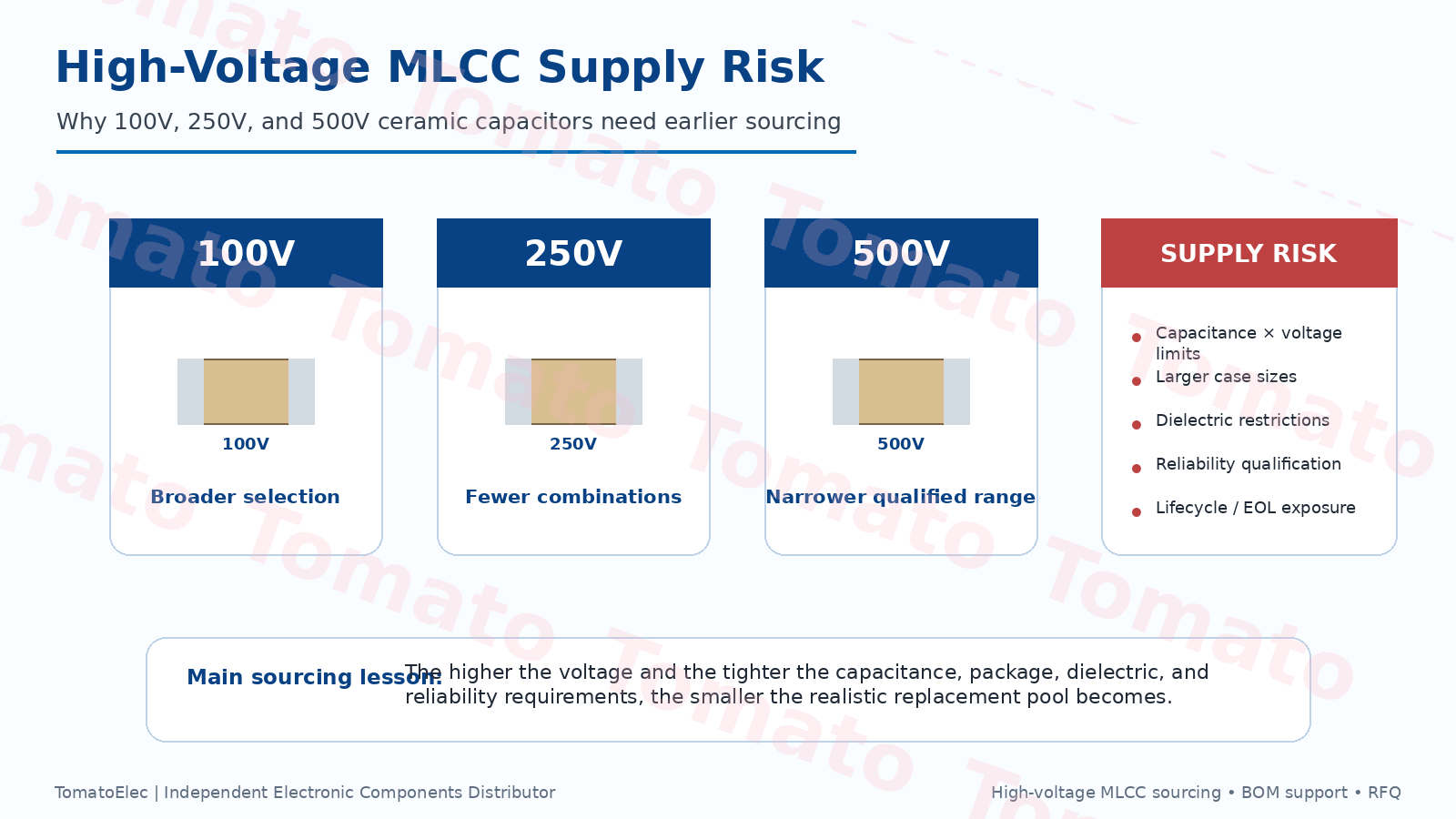
High-voltage MLCCs are not automatically difficult to buy, but they become harder to replace when voltage, capacitance, dielectric, package size, reliability grade, and delivery schedule must all match at the same time.
A standard low-voltage decoupling capacitor may have several practical alternatives across multiple brands. A 250V or 500V MLCC used in a resonant circuit, power converter, industrial controller, or server power system may have a much smaller replacement pool.
That is why 100V, 250V, and 500V ceramic capacitors should be reviewed earlier in the purchasing cycle. Early sourcing gives engineering and procurement teams time to check availability, compare manufacturer series, approve alternative packages, and avoid last-minute redesigns.
Why high-voltage MLCC sourcing needs more time
The sourcing difficulty of an MLCC is not determined by voltage alone. A 500V capacitor with a low capacitance value and a common C0G dielectric may be easier to find than a 100V capacitor requiring high capacitance, a compact package, X7R characteristics, soft termination, and a specific reliability grade.
The problem appears when several requirements overlap. Buyers may need the same capacitance, voltage, tolerance, dielectric, package dimensions, thickness, termination structure, temperature range, qualification level, and manufacturer approval.
Every added restriction reduces the number of realistic alternatives. If the original part becomes constrained, procurement teams may discover that the closest electrical substitute does not fit the PCB, while the closest mechanical substitute does not provide the required capacitance or voltage performance.
Earlier sourcing does not necessarily mean placing a large speculative order. It means confirming the approved part list, checking current availability, reviewing second sources, and identifying which specifications can or cannot change before the requirement becomes urgent.
What makes 100V, 250V, and 500V MLCCs different
As the rated voltage increases, manufacturers generally need to balance dielectric thickness, capacitance, package size, loss characteristics, and reliability. This affects which capacitance and package combinations are available in each voltage class.
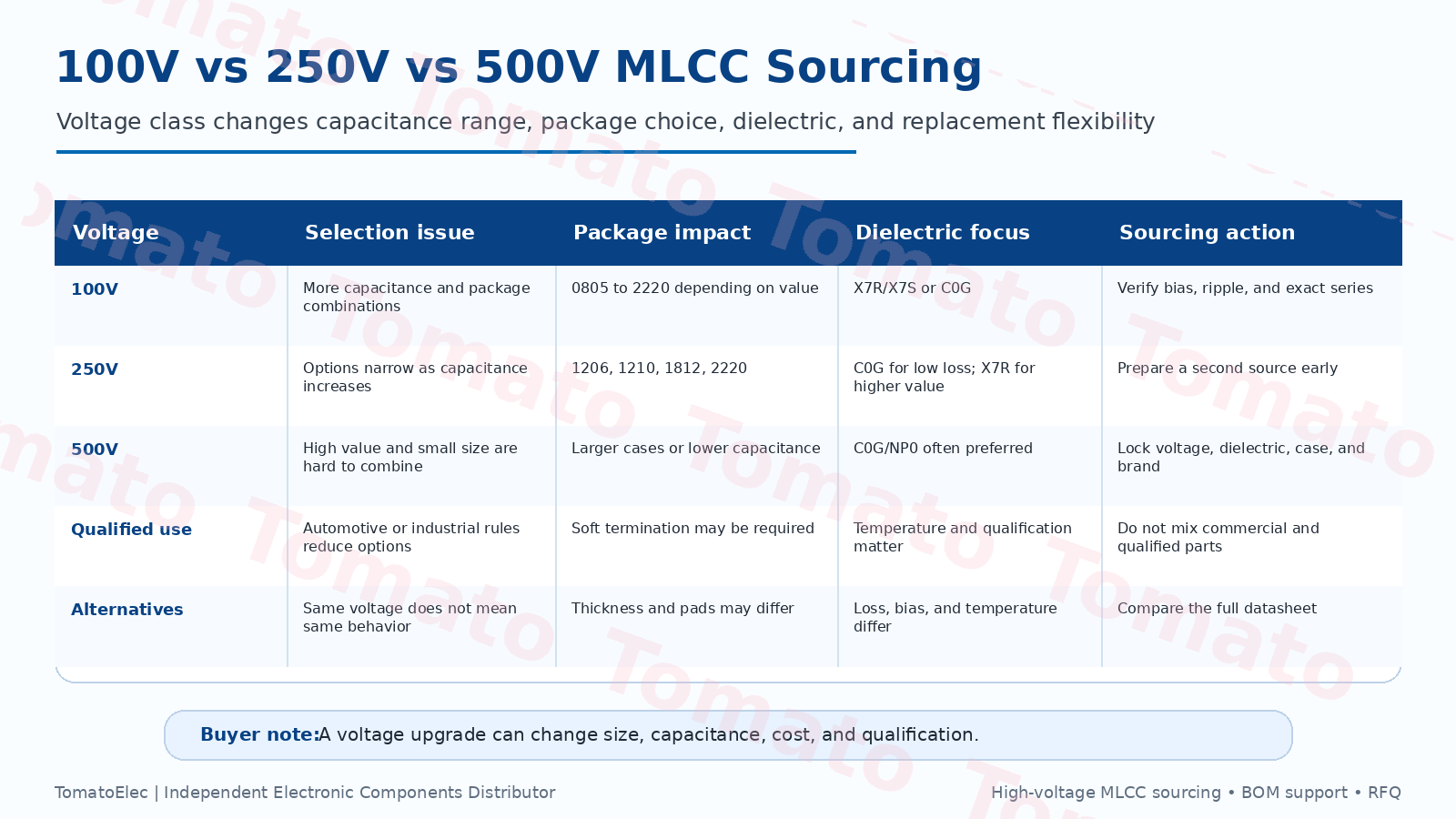
At 100V, buyers may still find a relatively broad selection of X7R, X7S, and C0G parts across common package sizes. At 250V, higher-capacitance options often move toward larger packages. At 500V, stable C0G or NP0 products may be easier to find than compact, high-capacitance Class II alternatives.
These are general sourcing patterns rather than fixed rules. Actual availability depends on the manufacturer series, capacitance, tolerance, package, dielectric, reliability grade, and lifecycle status.
| Voltage class | Typical sourcing issue | What buyers should check |
|---|---|---|
| 100V | High capacitance in a compact package may reduce the number of alternatives. | DC bias, capacitance, package thickness, dielectric, and approved series. |
| 250V | Capacitance and package combinations are usually narrower than at 100V. | Voltage margin, loss, case size, temperature, and mechanical fit. |
| 500V | High capacitance, small size, low loss, and high reliability are difficult to combine. | C0G versus Class II dielectric, package size, ripple, insulation, and qualification. |
Why the replacement pool becomes smaller
Two capacitors can share the same rated voltage and still be unsuitable substitutes. One may use C0G dielectric while the other uses X7R. One may be a standard commercial component while the other uses soft termination or belongs to an automotive or high-reliability series.
A practical replacement must usually match more than the voltage rating. Buyers should compare capacitance, tolerance, dielectric, case size, thickness, terminal structure, rated temperature, insulation resistance, loss characteristics, DC bias behavior, ripple conditions, and lifecycle status.
The approved manufacturer list can reduce the pool further. A design may accept only Murata, Samsung Electro-Mechanics, TDK, Taiyo Yuden, Yageo, KEMET, or KYOCERA AVX. Even when another manufacturer offers a technically similar part, it may require customer or engineering approval before purchase.
This is why a broad internet search can give a misleading impression of availability. Many results may share the same voltage and capacitance, but only a few may fit the complete electrical and mechanical requirement.
100V MLCC sourcing considerations
100V MLCCs are widely used in industrial controls, communication equipment, automotive electronics, power converters, server power circuits, lighting, and general filtering. Compared with higher-voltage classes, the selection is often broader.
However, sourcing risk increases when the design requires high capacitance in 0805, 1206, or another compact package. A nominal value such as 1uF, 2.2uF, 4.7uF, or 10uF may not provide the same effective capacitance under operating voltage across different manufacturer series.
A higher nominal capacitance does not always solve the problem. The alternative part must be reviewed under the actual DC bias, temperature, ripple, and package conditions.
When reviewing 100V alternatives, check whether a larger package, higher voltage rating, different tolerance, or another approved manufacturer series can be accepted. These options should be discussed before the original part becomes urgent.
250V MLCC sourcing considerations
250V MLCCs are common in higher-voltage filtering, industrial power supplies, snubber-related positions, resonant circuits, motor controls, automotive systems, and other applications where 100V does not provide enough margin.
At this voltage class, the combination of high capacitance and a small footprint becomes more difficult. Buyers may see more options in 1206, 1210, 1812, 2220, stacked, metal-frame, or leaded structures than in very small chip sizes.
An engineer may approve a 500V part as an alternative to a 250V part, but that does not make the substitution automatic. The higher-voltage component may have a different capacitance range, dielectric, height, ESR, ESL, price, or PCB footprint.
For production projects, it is safer to prepare at least one approved second source or an approved higher-voltage option while the original 250V part is still available.
500V MLCC sourcing considerations
500V MLCCs are used where circuits need stronger voltage margin, stable high-frequency behavior, low loss, or compact high-voltage filtering. Typical positions can include resonant circuits, snubbers, industrial power converters, automotive power electronics, sensing circuits, and high-voltage power stages.
At 500V, C0G or NP0 products are often attractive for circuits that need low loss and stable capacitance. Their capacitance values are normally lower than high-dielectric-constant Class II products, so several capacitors may be required depending on the design.
If the circuit needs both 500V and relatively high capacitance, the package may become larger or the product structure may change. Buyers should not assume that a compact 100V X7R part has a simple 500V version with the same dimensions and capacitance.
500V sourcing requests should include the exact application, operating voltage, transient level, required capacitance, dielectric, package restrictions, ripple conditions, temperature, and acceptable alternative rules.
Dielectric, capacitance, and DC bias
Dielectric choice is central to high-voltage MLCC selection. C0G and NP0 capacitors offer stable capacitance, low loss, and limited voltage dependence, but they usually provide lower capacitance values.
X7R, X7S, X8R, and related Class II dielectrics offer higher capacitance density. Their effective capacitance can change under DC voltage, temperature, and AC conditions. Two parts with the same nominal capacitance may therefore behave differently in the actual circuit.
For filtering and energy-storage-related positions, engineers should review effective capacitance at the operating voltage instead of relying only on the nominal value printed in the part description.
For resonant, timing, high-frequency, or low-loss positions, dielectric stability and dissipation may be more important than obtaining the largest nominal capacitance.
Package size and mechanical restrictions
Higher-voltage MLCCs may require larger packages, greater thickness, wider terminal spacing, or special structures. This creates mechanical restrictions that are easy to miss during an urgent replacement search.
A proposed alternative may not fit under a heatsink, near a transformer, between connectors, or inside a limited-height power module. It may also require a different land pattern or soldering process.
Mechanical stress should also be considered. Large MLCCs can be more sensitive to PCB bending and thermal expansion. Soft termination, metal-frame, stacked, or leaded structures may be used where board flex and thermal cycling are concerns.
When preparing alternatives, buyers should collect the full length, width, thickness, termination, land pattern, and mounting restrictions, not just the EIA case code.
Common high-voltage MLCC applications
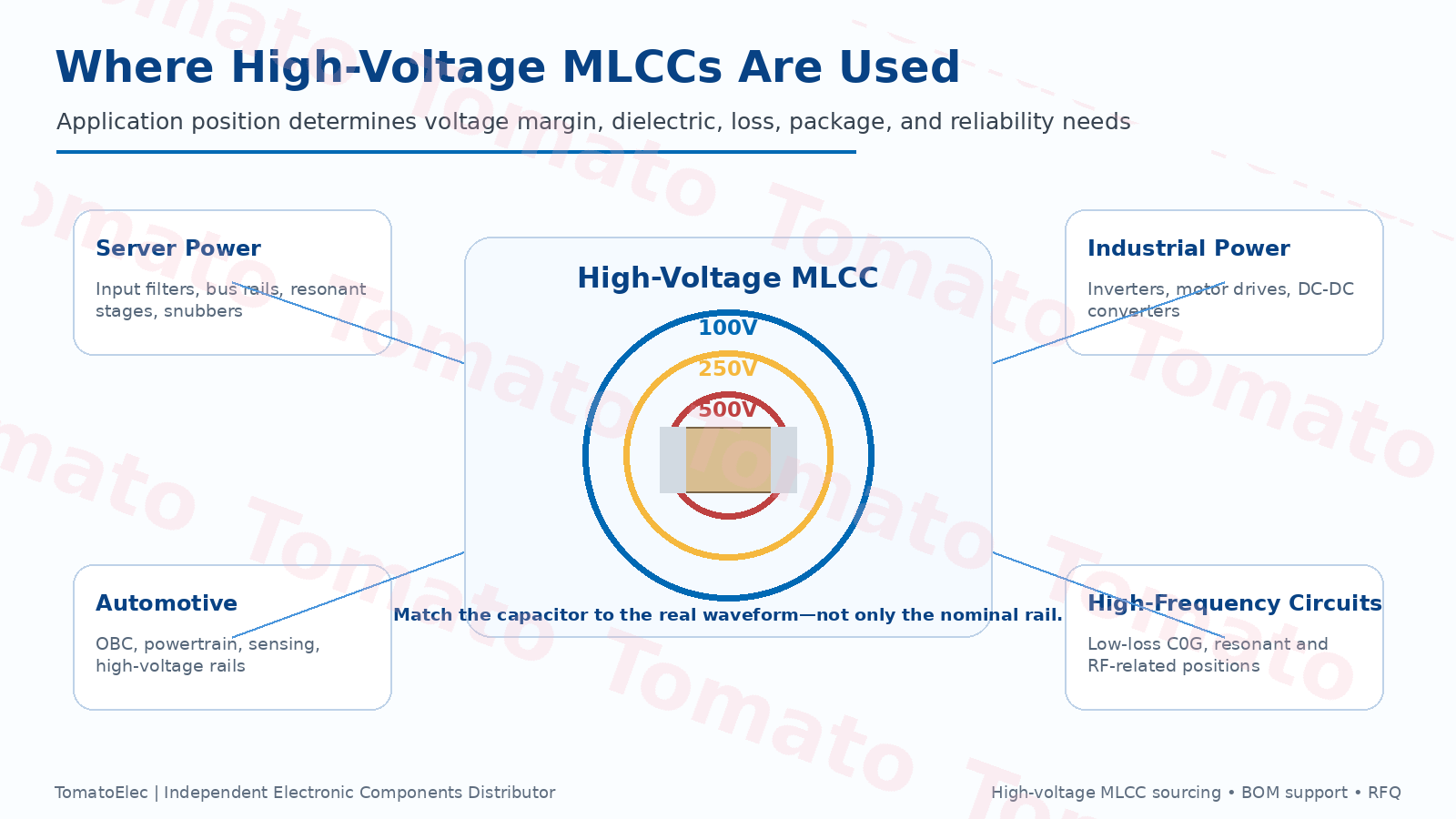
High-voltage MLCCs are used across server power, industrial power, automotive electronics, communication systems, renewable energy equipment, lighting, motor drives, inverters, converters, and high-frequency circuits.
In server and data center power systems, they may be used in input filters, intermediate bus rails, resonant converters, snubbers, auxiliary power supplies, and noise suppression positions.
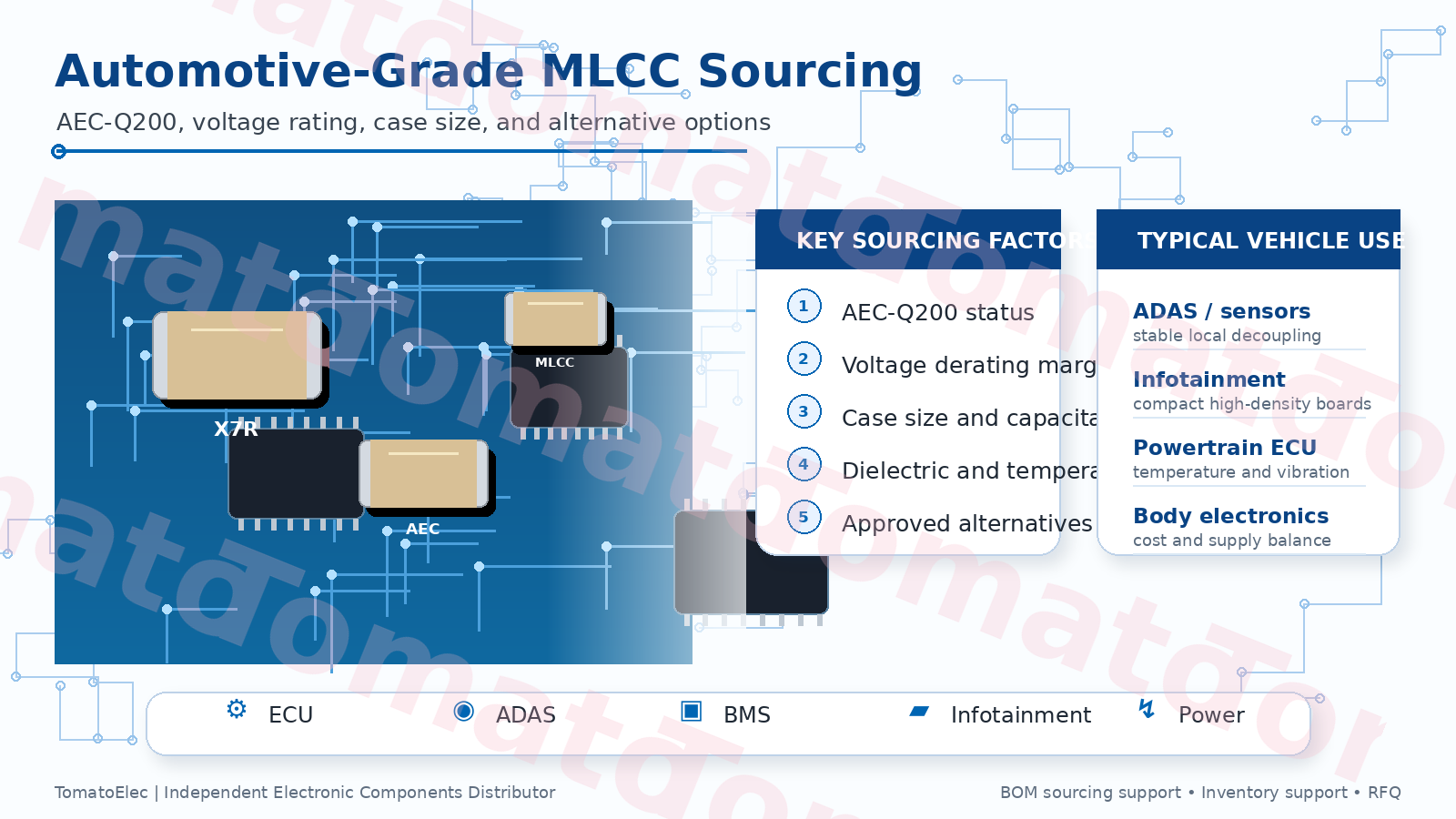
In industrial and automotive applications, the required part may also need soft termination, higher temperature capability, AEC-Q200 qualification, reinforced structures, or stricter reliability controls.
The application position should always be included in an RFQ. A 500V capacitor used in a resonant circuit may have different loss requirements from a 500V capacitor used for general filtering.
How to prepare approved alternatives
The best time to prepare an alternative is before the original part becomes constrained. Start with the exact manufacturer part number and identify which specifications are fixed and which can change.
A proper alternative review should include:
- Rated voltage: Confirm the operating voltage, transient level, and derating policy.
- Capacitance: Check both nominal and effective capacitance.
- Dielectric: Do not replace C0G with X7R, or X7R with C0G, without engineering review.
- Package: Compare length, width, thickness, land pattern, and mounting clearance.
- Termination: Confirm whether standard, soft, metal-frame, stacked, or leaded construction is required.
- Temperature: Match the required operating range and temperature characteristic.
- Reliability grade: Confirm commercial, industrial, automotive, or other qualification requirements.
- Lifecycle: Check active, NRND, obsolete, or limited-availability status.
If cross-brand alternatives are acceptable, prepare them for engineering review in advance. Do not wait until purchasing has only a few days left before production stops.
Early-sourcing checklist
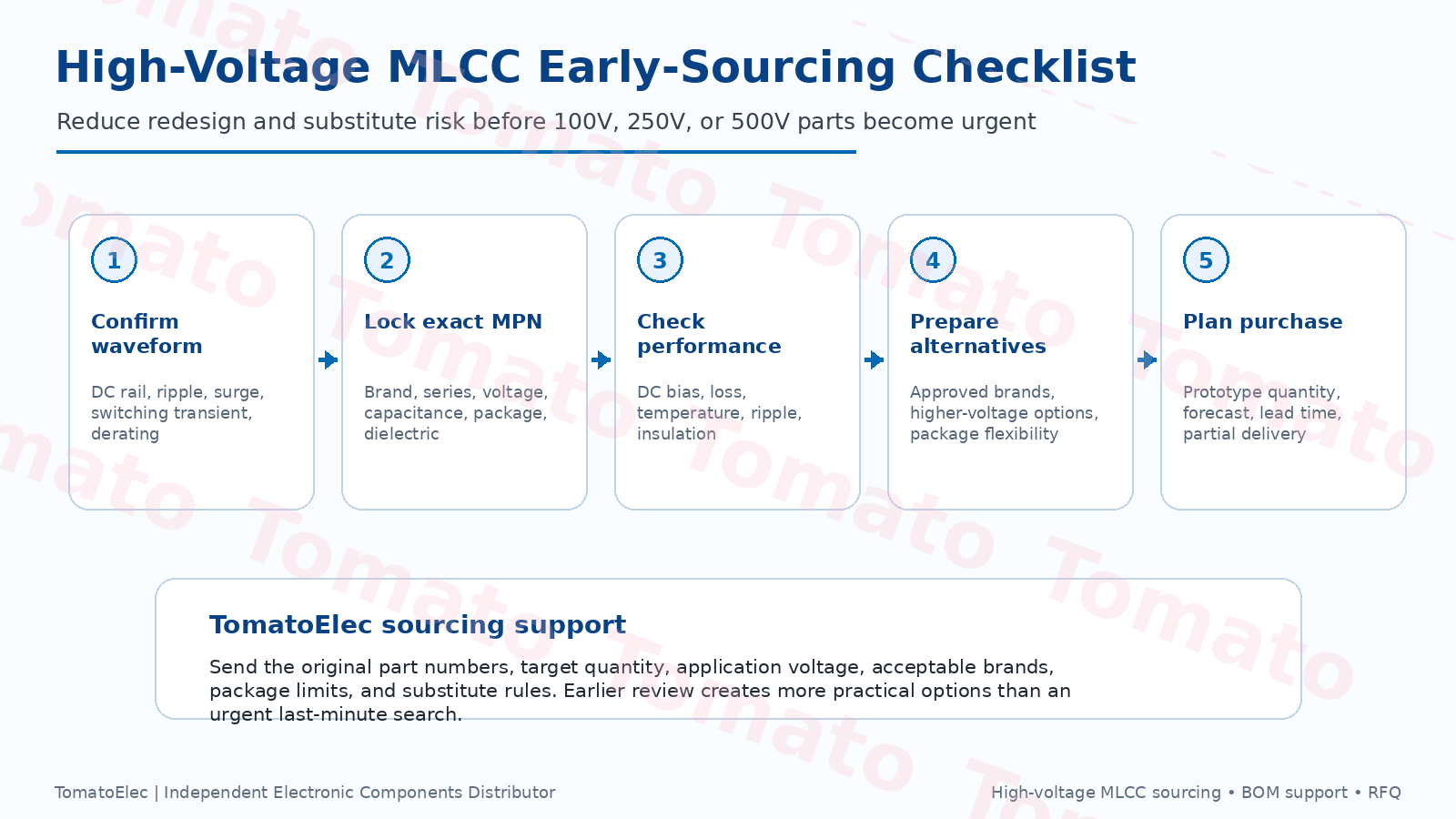
Before sending an RFQ for high-voltage MLCCs, prepare the information below:
- Original MPN: Provide the complete manufacturer part number.
- Application: State whether the part is used for filtering, snubber, resonant, sensing, decoupling, or another position.
- Operating voltage: Include normal DC voltage, ripple, startup, surge, and transient information if available.
- Capacitance and tolerance: Include the nominal value and acceptable range.
- Dielectric: Specify C0G/NP0, X7R, X7S, X8R, or another required characteristic.
- Package and thickness: Include case size, height limits, and land-pattern restrictions.
- Reliability requirement: State whether automotive, industrial, high-reliability, soft termination, or another grade is required.
- Approved brands: List accepted manufacturers and whether new brands can be reviewed.
- Quantity: Provide prototype, production, and annual forecast quantities where possible.
- Delivery schedule: State the required date and whether partial delivery is acceptable.
How TomatoElec supports high-voltage MLCC sourcing
TomatoElec is an electronic components independent distributor supporting buyers, engineers, and procurement teams with sourcing for MLCCs, capacitors, diodes, power management components, and other electronic parts.
If your project requires 100V, 250V, 500V, or other high-voltage MLCCs, you can send the original MPN list, target quantities, required delivery date, approved brands, package limits, and acceptable substitute rules.
TomatoElec can support availability checks, BOM sourcing support, inventory support, and reviewable alternative options. Availability and suitability should always be confirmed against the latest quotation and manufacturer documentation.
For related capacitor sourcing, buyers can review ceramic capacitors and submit requirements through the RFQ page. For difficult or urgent MLCC lists, please contact us with the complete specifications.
Final recommendation
High-voltage MLCC sourcing risk increases when voltage, capacitance, package size, dielectric, reliability grade, and delivery requirements must all match. The voltage number alone does not show how easy a part will be to replace.
100V products may offer more options, but high capacitance and small packages can still create constraints. At 250V and 500V, the realistic alternative pool often becomes smaller, especially when low loss, compact size, automotive qualification, or high reliability is required.
The practical solution is to review these parts earlier. Confirm the original MPN, identify fixed specifications, prepare approved alternatives, and check availability before the purchase becomes urgent. Earlier sourcing usually gives engineering and procurement teams more choices than a last-minute replacement search.