
Available 24/7 at
0755-82798135

CSLA2GF Current Sensor Guide: 125A AC/DC Sensing, Specifications, Applications, and Sourcing Notes
CSLA2GF is a Honeywell CSLA Series linear current sensor used for AC or DC current sensing in power supplies, motor control, load monitoring, and overcurrent detection circuits. It is not the kind of part buyers should treat as a generic sensor keyword. The suffix matters, the mounting style matters, and the current range matters.
For engineers, CSLA2GF is mainly a 125 A open-loop Hall-effect current sensing option with a pass-through structure. For buyers and sourcing teams, the key question is usually more practical: is the exact part available, can an alternative CSLA part be considered, and what information should be checked before sending an RFQ?
This guide looks at CSLA2GF from a sourcing and application point of view. It covers the core specifications, typical uses, comparison with CSLA2DK, replacement risks, and the information buyers should prepare when asking for availability or alternative options.

What is CSLA2GF?
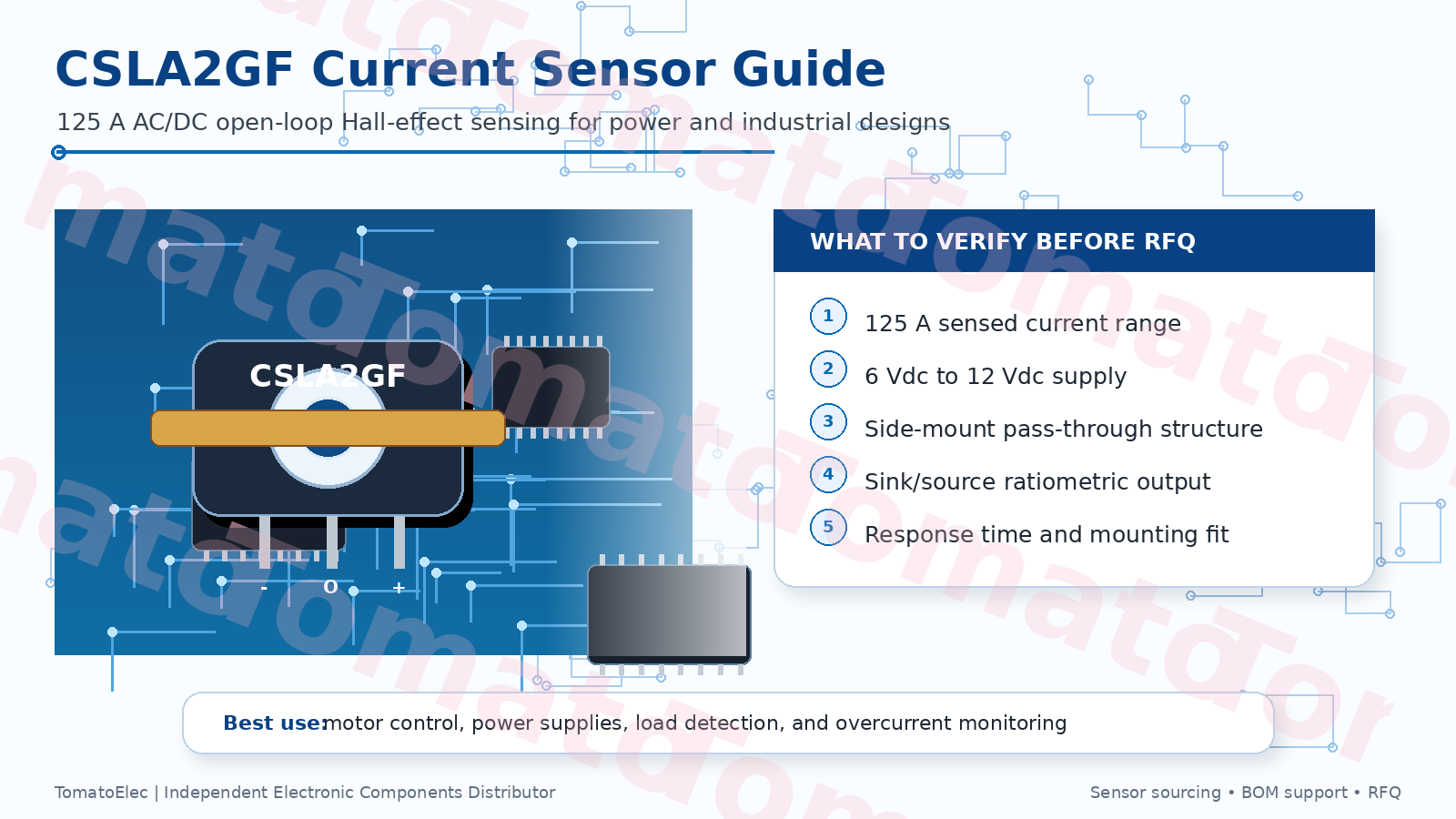
CSLA2GF is a Honeywell CSLA Series linear current sensor. It is designed for current sensing applications where a conductor passes through the sensor structure and the sensor provides a linear output related to the sensed current. The CSLA Series is used for monitoring alternating current or direct current, depending on the circuit design.
The part belongs to the CSLA2 group, which is optimized for a 6 Vdc to 12 Vdc supply range. This is different from the CSLA1 group, which is built around a higher supply voltage range. For buyers, this is one of the first things to check because similar-looking CSLA part numbers may not share the same operating supply conditions.
CSLA2GF is commonly searched by engineers and procurement teams who need a current sensor for higher-current power electronics, but the exact use case should still be checked. A current sensor used in a motor drive, a switched-mode power supply, or a load detection circuit may have different response-time, accuracy, mechanical, and signal-conditioning requirements.
Key CSLA2GF specifications
The most useful way to read CSLA2GF is not just as a single part number, but as a set of electrical and mechanical requirements. The table below summarizes the main points buyers should confirm before placing an order or asking for a substitute.
| Item | CSLA2GF information | Why it matters |
|---|---|---|
| Manufacturer | Honeywell | The original manufacturer part number should be used for sourcing and cross-reference checks. |
| Series | CSLA Series linear current sensor | Confirms the product family and general sensing architecture. |
| Sensed current | 125 A peak | The replacement part must support the required current range. |
| Supply voltage | 6 Vdc to 12 Vdc | The control board must provide a compatible supply rail. |
| Supply current | 20 mA max | Useful for power budgeting and system-level review. |
| Output behavior | Ratiometric output with Vcc/2 offset | Signal conditioning and ADC reading depend on supply voltage and offset behavior. |
| Sensitivity | 19.6 mV·N at 8 Vdc | Sensitivity affects output scaling and measured current interpretation. |
| Response time | 8 µs listed for CSLA2GF side-mount table | Important for fault detection and fast load-change monitoring. |
| Operating temperature | -25°C to 85°C series operating range | Thermal conditions should be checked against the actual application. |

How CSLA2GF works in current sensing
CSLA2GF uses a Hall-effect sensing approach. In practical terms, the measured conductor passes through the sensor area, and the sensor output changes in relation to the magnetic field generated by the current. This allows current sensing without placing a high-power shunt resistor directly in series with the load path.
The output is ratiometric, which means the output level is related to the supply voltage. The offset is centered around Vcc/2, so circuit designers need to consider the supply rail, ADC reference, signal filtering, and calibration method. Buyers should not ignore this point when comparing alternative current sensors.
Because CSLA2GF can be used for AC or DC current sensing, it is useful in designs where current direction, load changes, and power-stage behavior need to be monitored. However, the application circuit still determines whether the sensor is suitable for protection, measurement, feedback, or load detection.
Where CSLA2GF is commonly used
CSLA2GF is suitable for many current sensing applications where the design needs isolation-style current monitoring, a pass-through sensing structure, and support for AC or DC current. Common application areas include motor control, switched-mode power supplies, load detection, power distribution equipment, industrial control, and overcurrent fault protection.
In motor control systems, current sensing may be used to monitor load condition, detect abnormal current rise, or support system protection. In power supplies, a sensor such as CSLA2GF may help monitor input or output current depending on the system topology. In industrial equipment, it may be used for load status detection or basic current monitoring.
For buyers, application information matters because it affects replacement approval. A part used only for rough load detection may have different requirements from a part used in a protection loop. When sending an RFQ, it is useful to mention whether the part is used for monitoring, control feedback, or fault protection.
CSLA2GF vs CSLA2DK: why they are not the same
CSLA2GF and CSLA2DK are sometimes compared because both belong to the Honeywell CSLA2 current sensor family. That does not make them direct replacements. The suffix changes key specifications, including sensed current range and mounting configuration.
CSLA2GF is listed as a 125 A peak side-mount CSLA2 part, while CSLA2DK is listed as a 400 A peak bottom-mount CSLA2 part. Both belong to the CSLA2 supply range, but their mechanical structure and rated current are different. A buyer should not replace one with the other just because the beginning of the part number is similar.
If an engineer is comparing CSLA2GF with CSLA2DK, the first question should not be "which one is cheaper?" The first question should be whether the current range, mounting figure, conductor path, PCB clearance, output scaling, and response-time requirement match the original design.

| Comparison point | CSLA2GF | CSLA2DK |
|---|---|---|
| Series group | CSLA2 | CSLA2 |
| Sensed current | 125 A peak | 400 A peak |
| Mounting category | Side mount | Bottom mount |
| Supply voltage | 6 Vdc to 12 Vdc | 6 Vdc to 12 Vdc |
| Output offset | Vcc/2 | Vcc/2 |
| Replacement note | Best reviewed as a 125 A side-mount current sensor | Best reviewed as a higher-current bottom-mount option |
What to check before replacing CSLA2GF
When CSLA2GF is unavailable or lead time is long, it is reasonable to look for alternatives. The risky part is treating all CSLA2 sensors as interchangeable. They are not. A substitute should be reviewed against the original circuit and mechanical design.
Before approving a CSLA2GF replacement, check these points carefully:
- Exact manufacturer part number: Start with CSLA2GF and confirm whether the request allows alternatives.
- Current range: The substitute must support the required AC or DC current range with suitable margin.
- Supply voltage: Confirm compatibility with the available 6 Vdc to 12 Vdc supply rail.
- Output behavior: Check offset voltage, sensitivity, ratiometric output behavior, and signal-conditioning requirements.
- Mounting style: Confirm side-mount or bottom-mount structure, pass-through path, and PCB clearance.
- Response time: Review whether the part is used for measurement only or for fast fault detection.
- Temperature range: Make sure the operating environment is within the acceptable range.
- Lifecycle and availability: Check whether the part is active, constrained, obsolete, or only available through limited stock.
Practical RFQ and sourcing notes
A good RFQ for CSLA2GF should include more than the part number. If the buyer can provide the application, target quantity, acceptable delivery schedule, and substitute rules, suppliers can respond with more useful information.
For example, a simple request saying "need CSLA2GF" may only produce a stock check. A better request would say: "Need Honeywell CSLA2GF, target quantity 500 pcs, used in current sensing board, alternatives can be reviewed only if current range, supply voltage, mounting style, and output behavior are compatible." This gives the sourcing team a clearer path.
If alternatives are acceptable, list the review boundary clearly. Can the brand change? Can the current range be higher? Must it remain in the CSLA Series? Is the mounting fixed? Does the customer require engineering approval before shipment? These details prevent wrong substitutions and wasted quotation time.
How TomatoElec supports CSLA2GF sourcing
TomatoElec is an electronic components independent distributor supporting buyers, engineers, and procurement teams with sourcing for sensors, passive components, power management components, diodes, and other electronic parts. For CSLA2GF and related Honeywell current sensors, the practical goal is to help buyers check availability, review sourcing options, and prepare alternative candidates for approval when needed.
If you need CSLA2GF, CSLA2DK, or other CSLA Series current sensors, you can send the original MPN, target quantity, acceptable delivery time, and substitute rules. TomatoElec can support RFQ handling, BOM sourcing support, inventory support, and alternative option review.
For urgent or hard-to-source sensor requirements, submit your request through the RFQ page or contact us with the full part number and project requirement. Availability should always be confirmed by quotation before purchase planning.
Final recommendation
CSLA2GF is best handled as a specific Honeywell CSLA Series current sensor, not as a generic 125 A sensor keyword. Before sourcing or replacing it, check the current range, supply voltage, output behavior, mounting style, response time, and application requirement.
CSLA2DK may appear in related searches, but it is not a simple CSLA2GF replacement. The two parts belong to the same broader CSLA2 family, yet they differ in sensed current and mounting category. Treat them as related parts for comparison, not automatic substitutes.
For procurement teams, the safest approach is to start with the exact MPN, confirm the datasheet requirements, and only then review alternatives. A clear RFQ gives suppliers a better chance to find practical stock or a replacement candidate that engineering can actually review.