
Available 24/7 at
0755-82798135

AI Server MLCC Selection Guide: High-Capacitance, High-Voltage, and Low-ESL Ceramic Capacitors
AI servers place heavy stress on power delivery networks. High-current processors, GPUs, AI accelerators, HBM memory, high-speed interconnects, and dense power modules all require stable voltage rails with fast transient response and controlled ripple. This makes multilayer ceramic capacitors more important than they may appear from the outside.
For AI server boards, MLCC selection is not only about choosing a capacitance value. Engineers and sourcing teams need to consider high-capacitance availability, voltage rating, DC bias behavior, ESR, ESL, package size, thermal load, board placement, and whether approved alternatives are available before shortages appear.
This guide explains how to select MLCCs for AI server applications, with a focus on high-capacitance, high-voltage, and low-ESL ceramic capacitors. It is written for buyers, engineers, and procurement teams who need practical selection and sourcing guidance for server power and high-density computing boards.
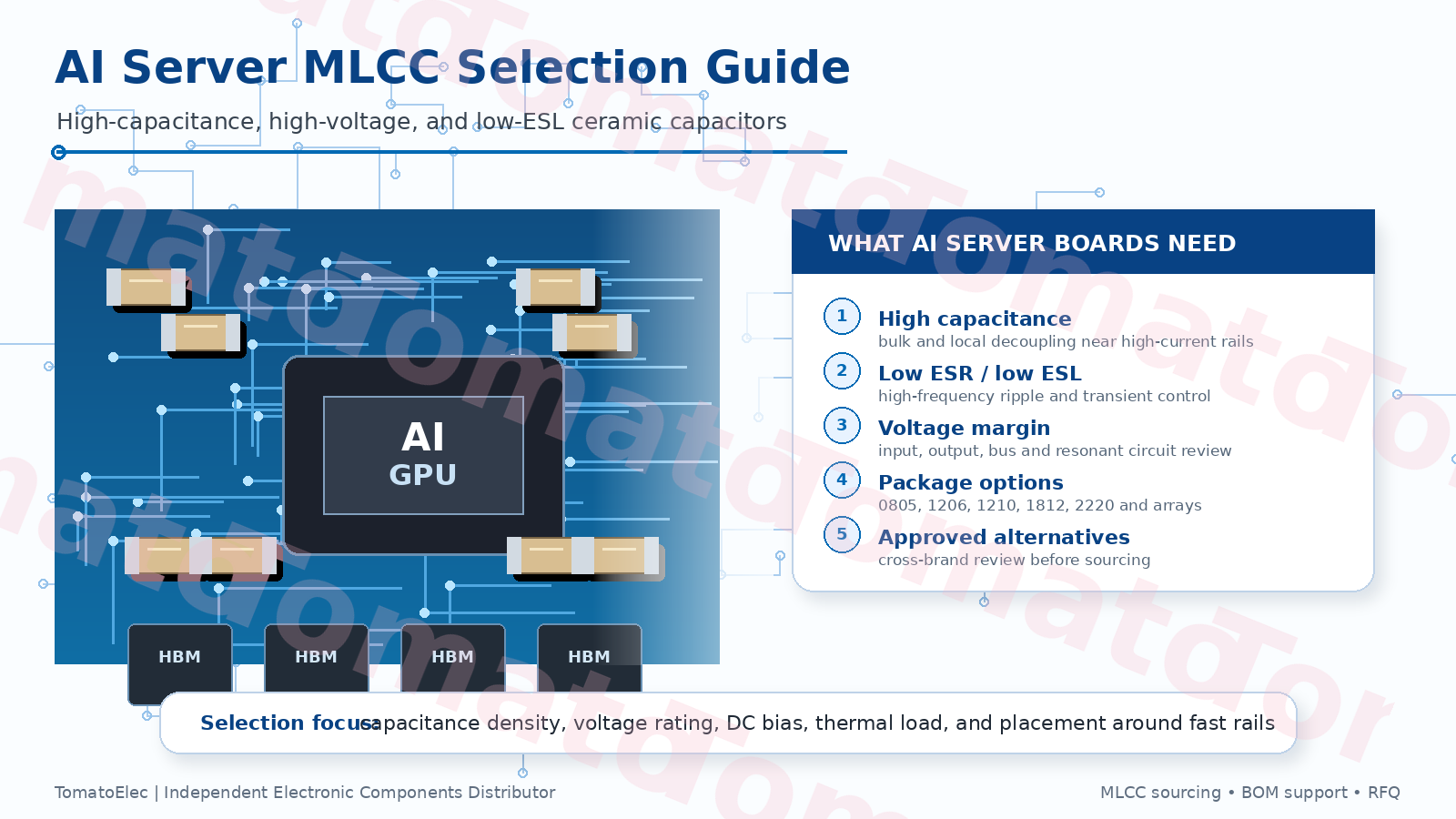
Why AI servers need different MLCC selection
AI server boards are different from ordinary computing boards because the power density is much higher. A single board may include GPUs, AI ASICs, high-speed memory, network devices, point-of-load converters, and dense power distribution paths. These circuits create fast load transients and wide-band noise that require careful capacitor placement.
In many AI server designs, MLCCs are used in large quantities for local decoupling, output filtering, input filtering, resonant circuits, flying capacitor stages, and noise suppression. The same capacitance value may behave differently depending on voltage bias, package, dielectric, temperature, and layout.
For procurement teams, this means a simple request such as "10uF 25V 0805 MLCC" may not be enough. The final choice may depend on effective capacitance under DC bias, low-ESL requirements, height limits, voltage margin, thermal behavior, and whether the alternative manufacturer series has already been approved.
Where MLCCs are used on AI server boards
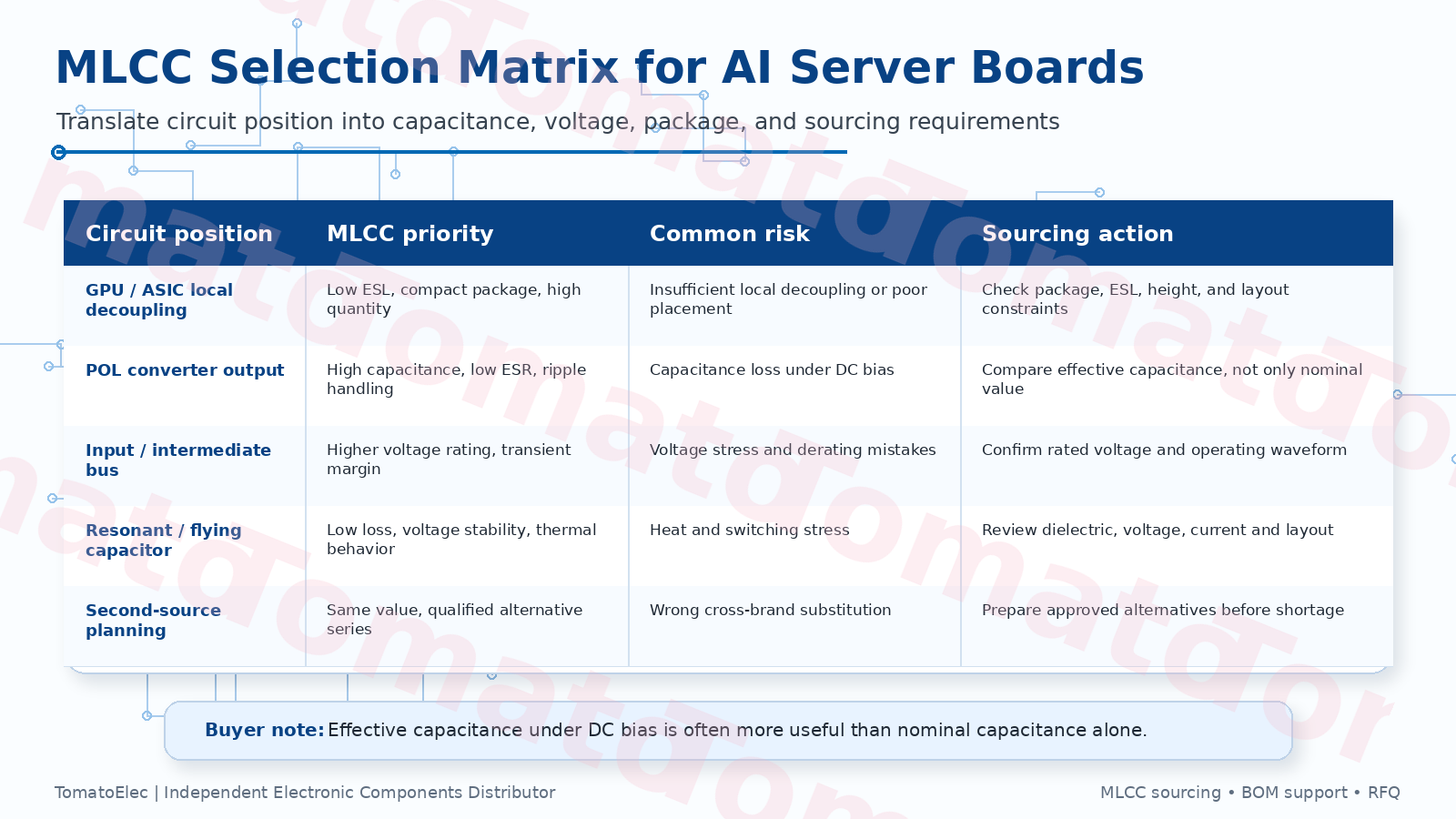
MLCCs appear across many power and signal positions on AI server boards. Around GPUs and AI accelerators, they are used for dense local decoupling close to high-current pins. Near point-of-load converters, they help stabilize output rails and reduce ripple. In input or intermediate bus positions, higher-voltage MLCCs may be used for filtering and transient support.
In resonant power stages, flying capacitor circuits, and high-frequency switching areas, low loss, voltage stability, and thermal behavior become more important. In high-speed data and clock circuits, low-ESL and placement-sensitive ceramic capacitors may help suppress high-frequency noise when used correctly.
The right MLCC depends on the circuit position. A capacitor used near a GPU power rail is not selected the same way as a capacitor used in a high-voltage input filter or resonant converter. This is why buyers should request application context whenever possible.
High-capacitance MLCCs for power rail stability
High-capacitance MLCCs are commonly used to support power rail stability in AI server systems. They help provide local charge, reduce voltage droop during load transients, and work with other capacitor types in the broader power delivery network.
However, the nominal capacitance printed in the part description is not always the capacitance available in the actual circuit. DC bias can reduce effective capacitance, especially for high-capacitance Class II ceramic capacitors. This means a 22uF or 47uF MLCC may deliver a lower effective capacitance under operating voltage.
When sourcing high-capacitance MLCCs for AI server use, buyers should confirm capacitance, voltage rating, dielectric, package size, thickness, temperature characteristic, and manufacturer series. If the original design requires a specific series, do not replace it with a generic high-capacitance MLCC without review.
High-voltage MLCCs for input, bus, and resonant circuits
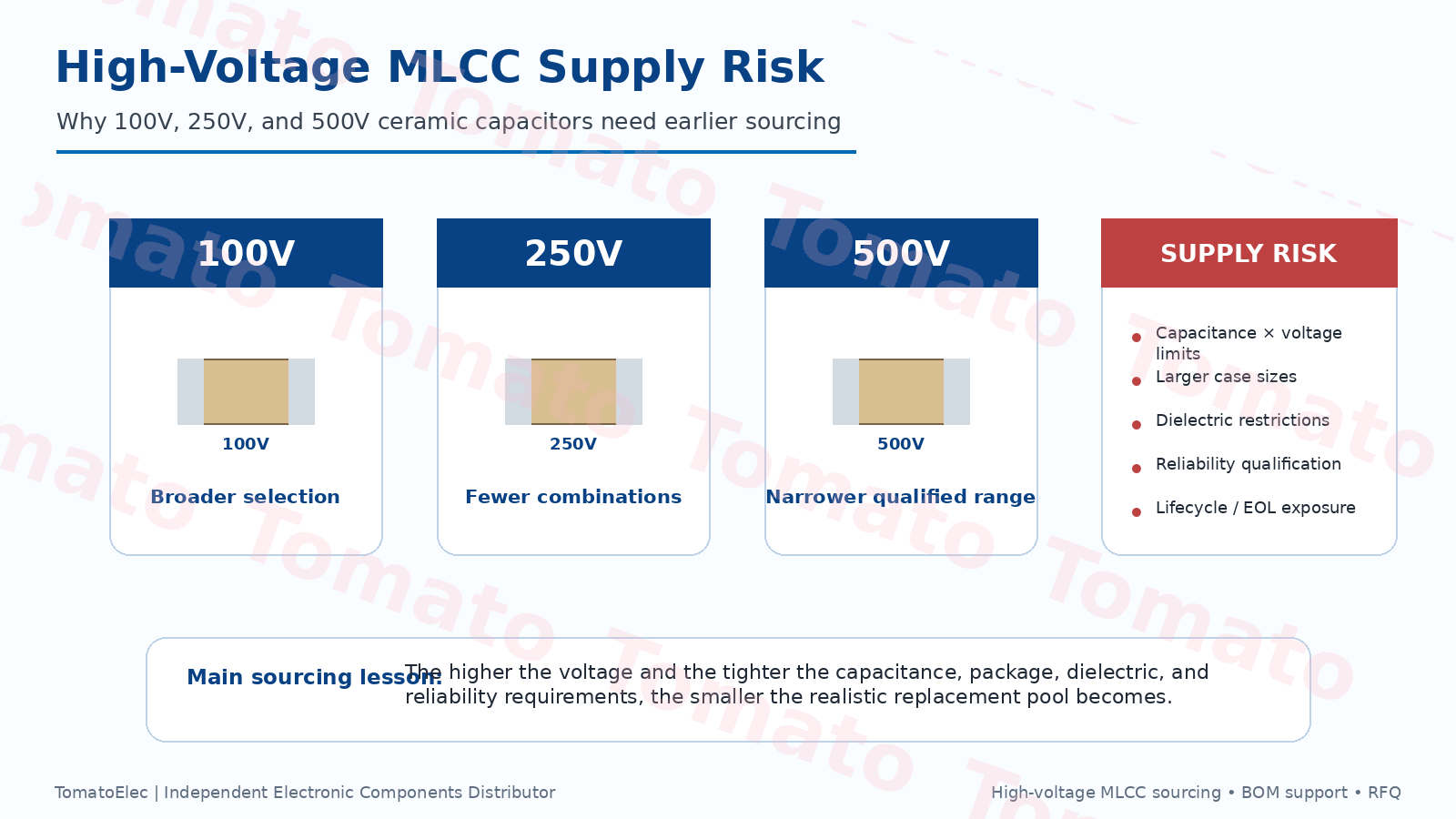
High-voltage MLCCs are often used in input stages, bus filters, resonant circuits, wireless power-related circuits, and high-voltage switching areas. In AI server power systems, voltage stress, ripple, and switching behavior can make this selection more sensitive than ordinary decoupling.
For these positions, rated voltage should be checked against the real circuit waveform rather than only the nominal rail voltage. Transients, startup conditions, ripple voltage, and derating policy can change the required voltage class.
In high-voltage applications, dielectric class and loss characteristics also matter. A low-loss high-voltage ceramic capacitor may be preferred in resonant or high-frequency circuits where heat generation and stability are important. Procurement teams should avoid reducing voltage rating or changing dielectric without engineering approval.
Low-ESL ceramic capacitors for fast transient response
Low ESL is important in AI server boards because fast switching currents and high-speed load changes can create voltage spikes and high-frequency noise. Even when capacitance is high, poor package choice or poor placement can limit high-frequency performance.
Low-ESL MLCC options may include reverse-geometry capacitors, three-terminal capacitors, capacitor arrays, interposer structures, and package layouts designed to shorten current paths. The exact choice depends on board layout, frequency range, impedance target, assembly height, and approved vendor list.
For engineers, the capacitor must be evaluated as part of the power delivery network. For buyers, the practical point is to avoid treating all MLCCs with the same capacitance and voltage as equivalent. Package construction and layout requirements can matter as much as the basic electrical values.
DC bias, effective capacitance, and derating
DC bias is one of the most common reasons MLCC substitutions fail in power circuits. Under applied DC voltage, many high-capacitance ceramic capacitors lose part of their effective capacitance. This can affect output ripple, transient response, and system stability.
For AI server MLCC selection, buyers should ask whether the engineering team requires a specific effective capacitance at a given operating voltage. If so, a simple nominal capacitance match is not enough. The proposed alternative must be checked against DC bias curves or manufacturer data.
Voltage derating is another important factor. A higher voltage rating can improve margin, but it may also change case size, capacitance availability, and cost. The right choice depends on the actual rail voltage, transient stress, package constraints, and design approval rules.
Package size, layout, and thermal considerations
AI server boards are crowded. Power modules, processors, memory devices, connectors, heatsinks, and airflow structures all compete for space. This makes MLCC package size and height important sourcing parameters, not just mechanical details.
Small packages can improve placement density and reduce loop area, but they may limit available capacitance or voltage rating. Larger packages can provide higher capacitance or voltage capability, but may create placement, mechanical, or assembly constraints. The best package is the one that fits both the circuit and the layout.
Thermal behavior should also be checked. MLCCs near high-current power stages, hot processors, or dense converter areas may face more thermal stress. Low ESR helps reduce heating, but ripple current, board temperature, and airflow still matter.
How to prepare alternative MLCC options
AI server demand can tighten supply for specific high-capacitance, high-voltage, and low-ESL MLCCs. Waiting until the original part is already constrained makes sourcing harder. A better method is to prepare approved alternatives before the shortage becomes urgent.
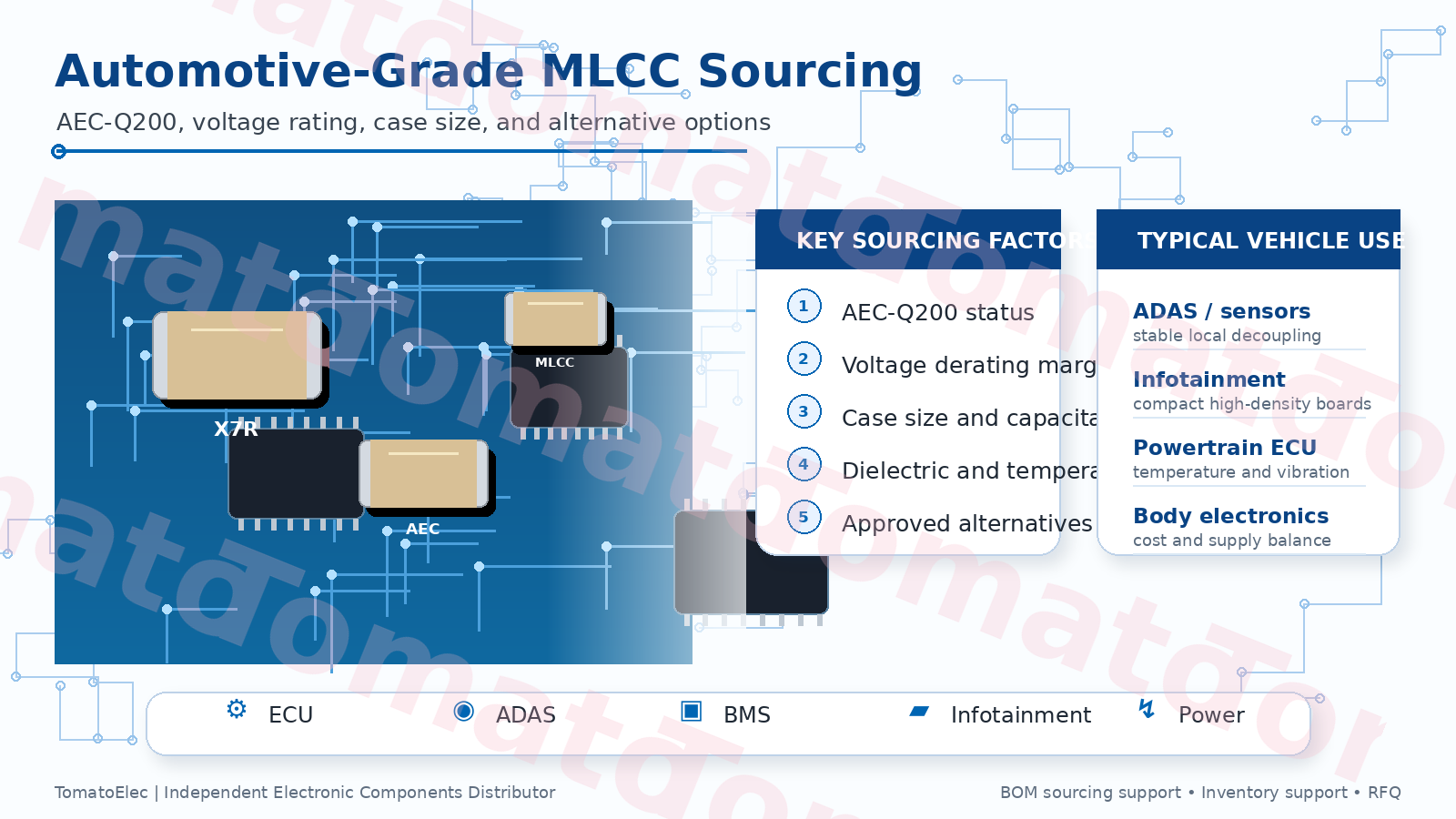
Alternative review should start with the original manufacturer part number. Compare capacitance, tolerance, rated voltage, dielectric, package size, thickness, ESR, ESL, temperature characteristic, DC bias behavior, termination, and lifecycle status. If a replacement changes brand or series, engineering review is usually required.
Common MLCC manufacturers for server and power electronics designs include Murata, Samsung Electro-Mechanics, TDK, Taiyo Yuden, Yageo, KEMET, KYOCERA AVX, and others. These names should be treated as possible sourcing directions, not automatic substitutes. The final approval must depend on the actual circuit requirement.
Practical RFQ checklist for AI server MLCCs
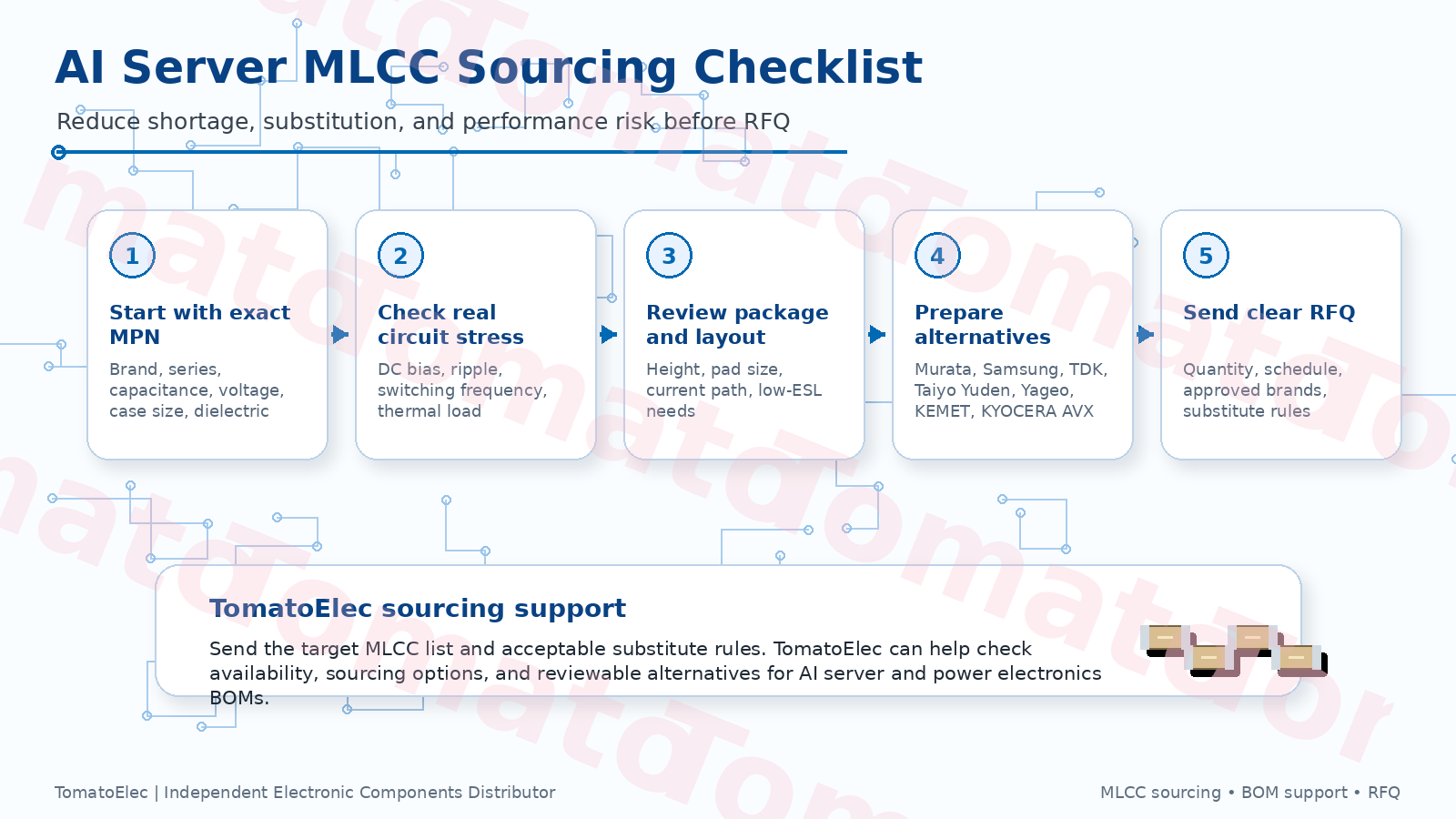
Before sending an RFQ for AI server MLCCs, prepare a clear sourcing request. This helps suppliers respond faster and reduces the risk of receiving unsuitable alternatives.
- Original MPN: Provide the exact manufacturer part number if available.
- Application position: State whether the part is used for GPU decoupling, POL output, input filtering, resonant circuit, or general power rail support.
- Capacitance and tolerance: Include nominal value and acceptable tolerance range.
- Effective capacitance: Note whether a specific capacitance is required under DC bias.
- Rated voltage: Confirm required voltage class and whether higher voltage alternatives are acceptable.
- Dielectric: Specify C0G/NP0, X7R, X7S, X8R, or other required temperature characteristics.
- Package size and height: Include case size, thickness limits, and layout restrictions.
- Low-ESL requirement: State whether reverse-geometry, three-terminal, array, or special low-ESL construction is required.
- Approved brands: List accepted manufacturers and whether cross-brand alternatives can be reviewed.
- Quantity and schedule: Provide target quantity, lead time requirement, and whether partial delivery is acceptable.
How TomatoElec supports AI server MLCC sourcing
TomatoElec is an electronic components independent distributor supporting buyers, engineers, and procurement teams with sourcing for MLCCs, capacitors, diodes, power management components, and other electronic parts. For AI server MLCC sourcing, the goal is not only to find a similar capacitance value, but to help buyers check availability, review alternatives, and prepare RFQ options that can be evaluated by engineering teams.
If your project requires high-capacitance MLCCs, high-voltage ceramic capacitors, low-ESL decoupling capacitors, or cross-brand alternatives, you can send the original MPN list, target quantity, delivery schedule, and acceptable substitute rules. TomatoElec can support availability checks, BOM sourcing support, inventory support, and RFQ handling.
For related capacitor sourcing, buyers can also review ceramic capacitors and submit requirements through the RFQ page. If your MLCC list is difficult to source or requires careful alternative review, please contact us with the full specification and application information.
Final recommendation
AI server MLCC selection should be handled as a power integrity and sourcing task, not only as a capacitor value match. High-capacitance, high-voltage, and low-ESL ceramic capacitors each solve different problems on the board.
For engineers, the key is to match the capacitor to the circuit position, voltage stress, frequency behavior, DC bias requirement, and layout. For buyers, the key is to source the exact MPN first and prepare reviewable alternatives before supply becomes constrained.
A strong RFQ should include the original MPN, capacitance, voltage rating, dielectric, package size, low-ESL requirement, application position, approved brands, target quantity, and substitute rules. This gives sourcing teams a better chance to find practical MLCC options for AI server and high-density power electronics designs.