
Available 24/7 at
0755-82798135

Automotive-Grade MLCC Sourcing Guide: AEC-Q200, Voltage Rating, Case Size, and Alternative Options
Automotive electronics require components that can handle higher reliability expectations, wider temperature conditions, vibration, long product lifecycles, and strict approval processes. For multilayer ceramic capacitors, this makes sourcing more complex than simply matching capacitance, voltage, and package size.
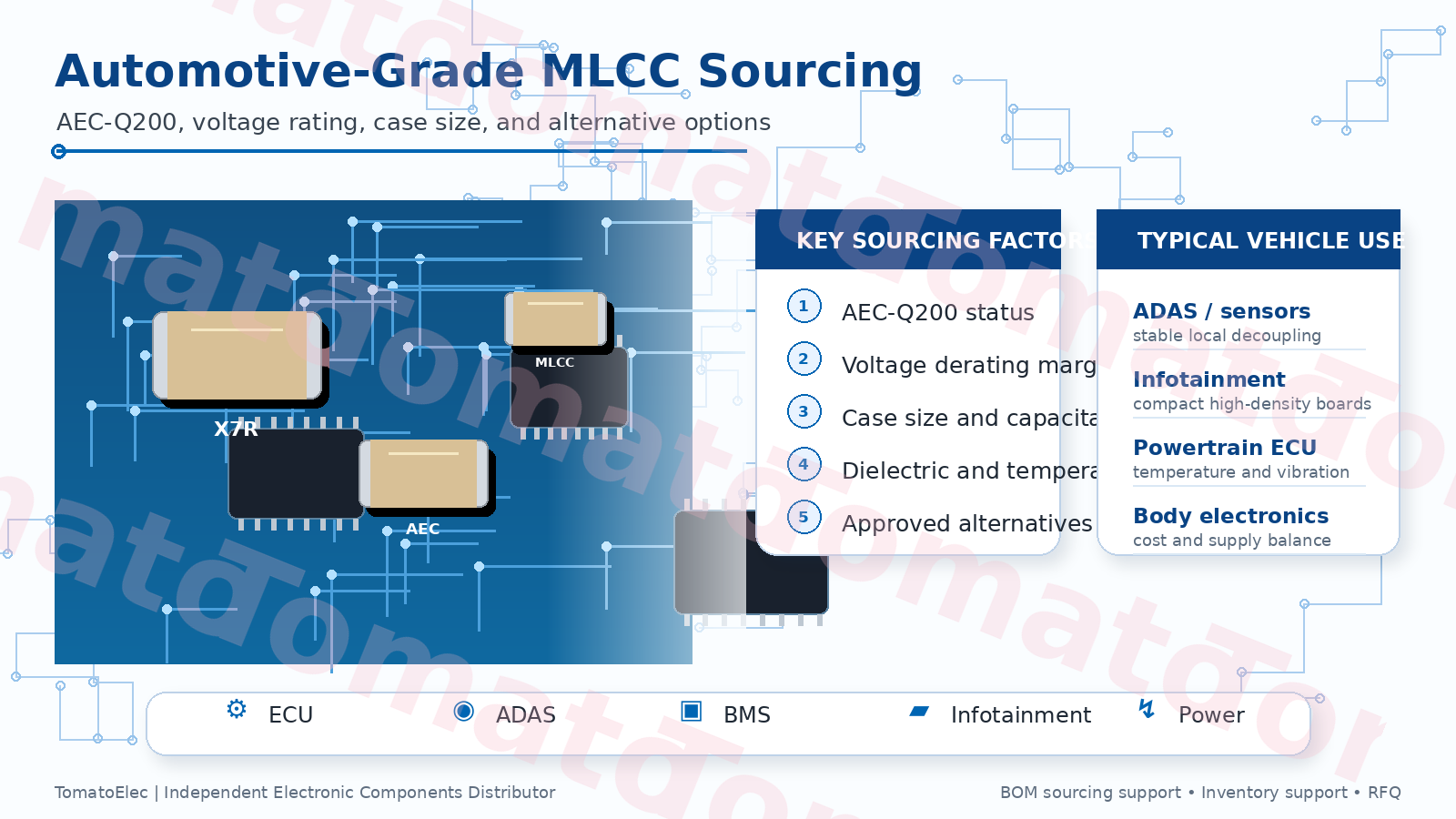
Automotive-grade MLCCs are commonly used in ECUs, ADAS modules, body electronics, infotainment systems, powertrain control, battery management systems, sensors, and onboard power circuits. In these applications, a small capacitor substitution mistake can affect electrical performance, long-term reliability, or customer approval.
This guide explains how buyers, engineers, and procurement teams can source automotive-grade MLCCs by checking AEC-Q200 status, voltage rating, case size, dielectric type, termination structure, and alternative options before placing an RFQ or approving a substitute.
Why automotive-grade MLCC sourcing is different
General-purpose MLCC sourcing usually focuses on basic electrical parameters such as capacitance, voltage rating, tolerance, dielectric, and package size. Automotive-grade MLCC sourcing must go further. Buyers need to confirm whether the part belongs to an automotive-qualified series, whether the manufacturer lists AEC-Q200 compliance, and whether the part is suitable for the actual circuit position.
In automotive programs, components may need to support long-term supply, traceable sourcing, stricter quality expectations, and stable performance under heat, vibration, humidity, and electrical stress. This is why engineers often specify exact manufacturer part numbers instead of allowing broad generic substitutions.
For procurement teams, the risk is clear: two MLCCs may look similar on paper, but one may be a general commercial part while the other belongs to an automotive-grade product family. Before replacing an automotive MLCC, the complete part number, product series, datasheet, reliability level, and application requirement should be reviewed.
What AEC-Q200 means for MLCC buyers
AEC-Q200 is an automotive stress test qualification standard for passive components. For MLCC buyers, it is an important first filter because it helps identify capacitor families designed and qualified for automotive environments. However, AEC-Q200 status should not be treated as the only selection requirement.
AEC-Q200 does not mean every MLCC is suitable for every automotive circuit. Buyers still need to check the rated voltage, capacitance value, temperature characteristic, tolerance, DC bias behavior, case size, termination type, lifecycle status, and original equipment approval requirements.
The safest sourcing method is to start from the approved manufacturer part number, then confirm whether any alternative option has the same automotive qualification level and matches the engineering requirements. If the original design specifies an AEC-Q200 MLCC, do not replace it with a standard commercial MLCC without engineering review.
Key parameters to check before sourcing
Before sending an RFQ for automotive-grade MLCCs, buyers should collect the full electrical and mechanical requirements. A short request such as "10uF 25V 0805 MLCC" is usually not enough for automotive applications. The dielectric, tolerance, temperature range, qualification level, and exact series can change the result significantly.
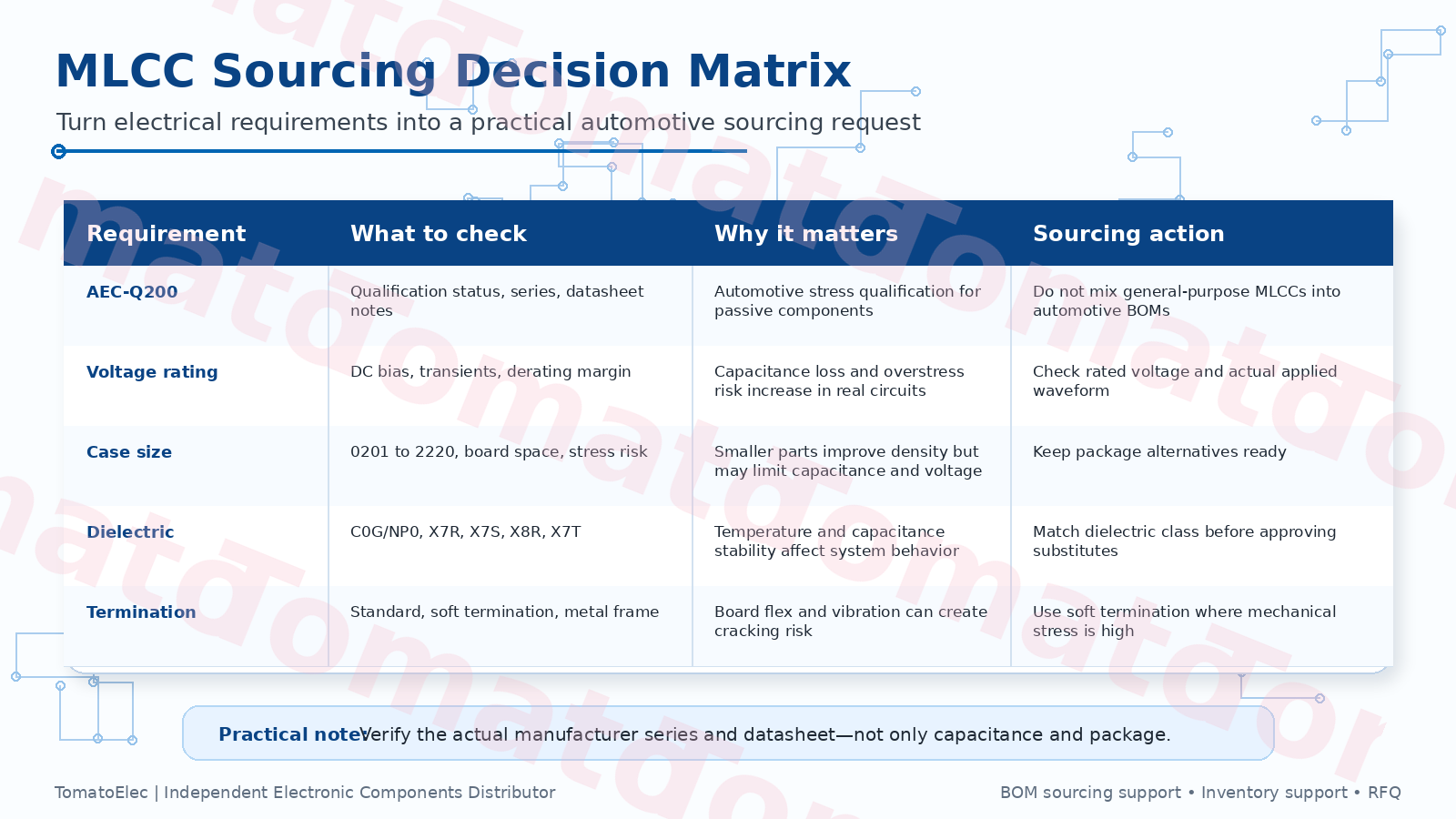
The table below shows the core parameters sourcing teams should check before requesting automotive MLCC availability or approving an alternative part.
| Parameter | What to check | Why it matters |
|---|---|---|
| AEC-Q200 status | Manufacturer series, datasheet, reliability level | Confirms whether the part is intended for automotive-grade use. |
| Capacitance | Nominal capacitance, tolerance, DC bias effect | Actual capacitance in circuit may be lower than the nominal value. |
| Voltage rating | Rated DC voltage, transient conditions, derating margin | Insufficient voltage margin can increase reliability risk. |
| Case size | 0402, 0603, 0805, 1206, 1210, 1812, 2220 and others | Package size affects board layout, capacitance availability, and mechanical stress. |
| Dielectric | C0G/NP0, X7R, X7S, X8R, X7T and related classes | Temperature stability and capacitance behavior differ by dielectric class. |
| Termination | Standard termination, soft termination, metal frame structure | Termination type can affect resistance to board flex and mechanical cracking. |
Voltage rating and derating considerations
Voltage rating is one of the most important factors in automotive MLCC sourcing. A capacitor should not be selected only because its nominal capacitance and package match the original part. The actual circuit voltage, ripple, switching transients, startup conditions, and possible surge events should also be considered.
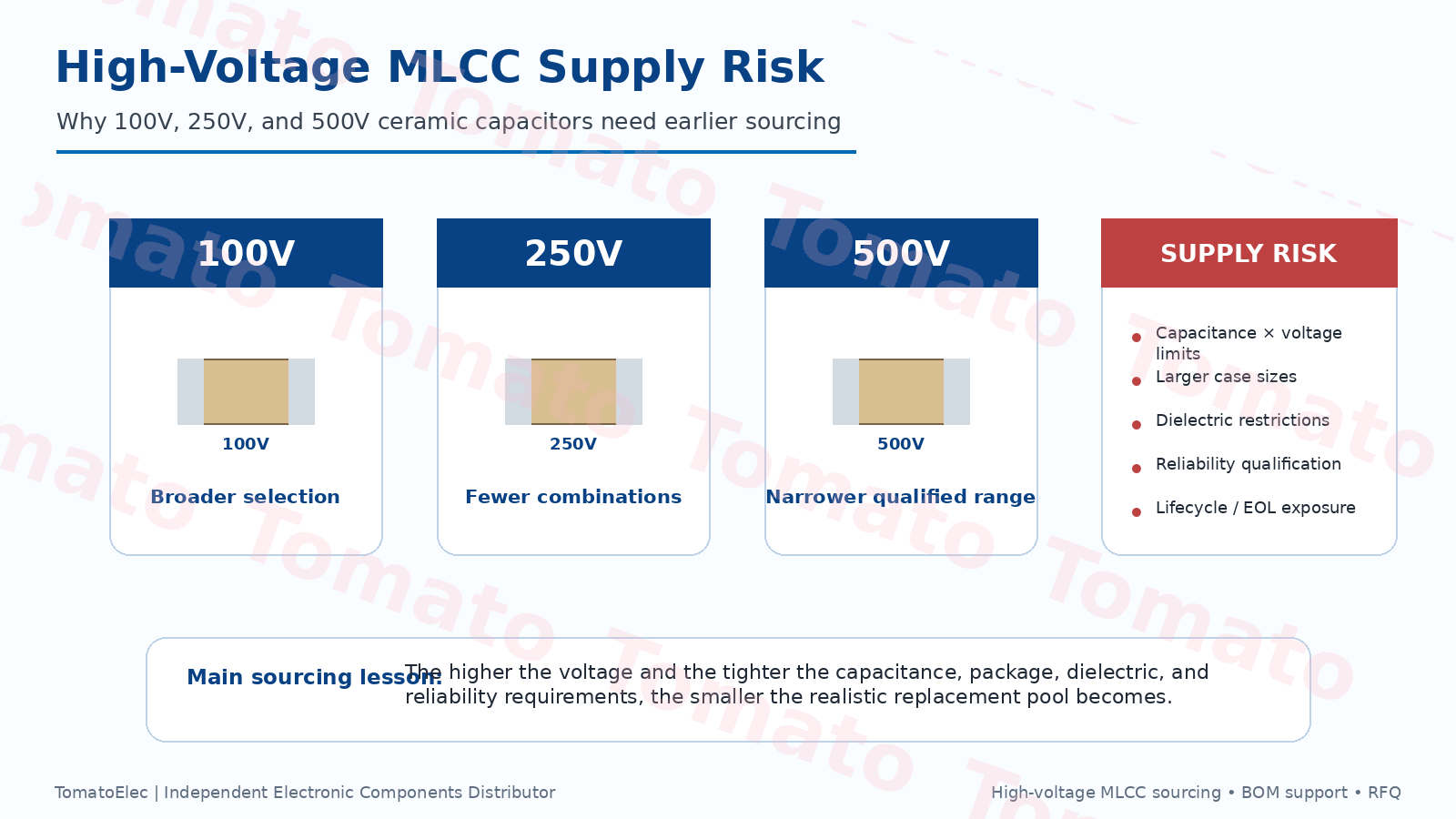
In many automotive circuits, engineers choose a higher rated voltage than the normal operating voltage to provide margin. This is especially important in power rails, DC-DC converter input or output stages, battery-related circuits, motor control, and high-voltage sensing or filtering positions.
Procurement teams should avoid substituting a lower voltage MLCC unless engineering has reviewed and approved the change. Even when the capacitance and case size are the same, a lower voltage rating can change reliability risk and may not be acceptable for automotive designs.
Case size, capacitance, and board space trade-offs
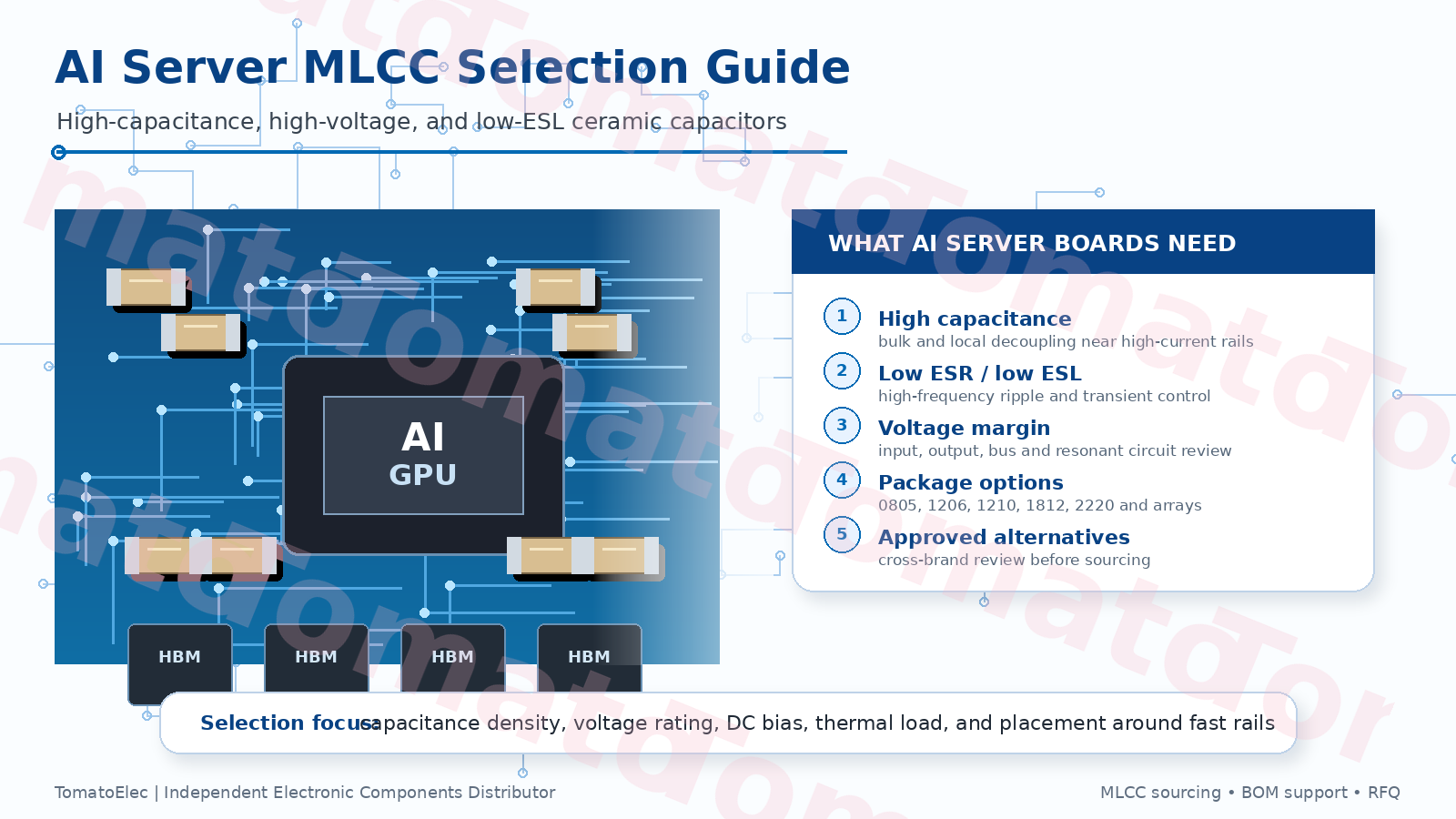
Automotive electronics continue to become smaller, more integrated, and more power dense. This increases demand for MLCCs that provide higher capacitance in smaller case sizes. However, smaller packages can also create sourcing challenges when high capacitance, high voltage, and automotive qualification are required at the same time.
For example, a high-capacitance 0805 or 1206 automotive MLCC may not always have the same availability across Murata, Samsung Electro-Mechanics, TDK, Taiyo Yuden, Yageo, KEMET, KYOCERA AVX, and other manufacturers. Case size alternatives may be possible, but board layout and mechanical clearance must be reviewed first.
When a target MLCC is difficult to source, buyers should ask whether engineering can accept a larger case size, a different capacitance tolerance, a higher voltage rating, or an alternative manufacturer series. These options can improve sourcing flexibility, but none should be changed without approval.
Dielectric, temperature, and termination choices
Dielectric type affects capacitance stability across temperature, voltage, and operating conditions. C0G/NP0 MLCCs are often used where very stable capacitance and low loss are required, but capacitance values are usually lower. X7R, X7S, X8R, and related dielectrics are widely used for decoupling, smoothing, and general automotive power applications where higher capacitance is needed.
Temperature range is especially important in automotive systems. Components used near powertrain, engine control, braking, lighting, or battery systems may face more demanding thermal conditions than components used in basic consumer electronics. Always match the temperature characteristic to the application environment.
Termination structure is another important factor. In automotive boards exposed to vibration, bending, or thermal cycling, soft termination or reinforced termination MLCCs may be specified to reduce mechanical cracking risk. If the original part uses soft termination, do not replace it with a standard termination part unless the change is approved.
Common automotive MLCC applications
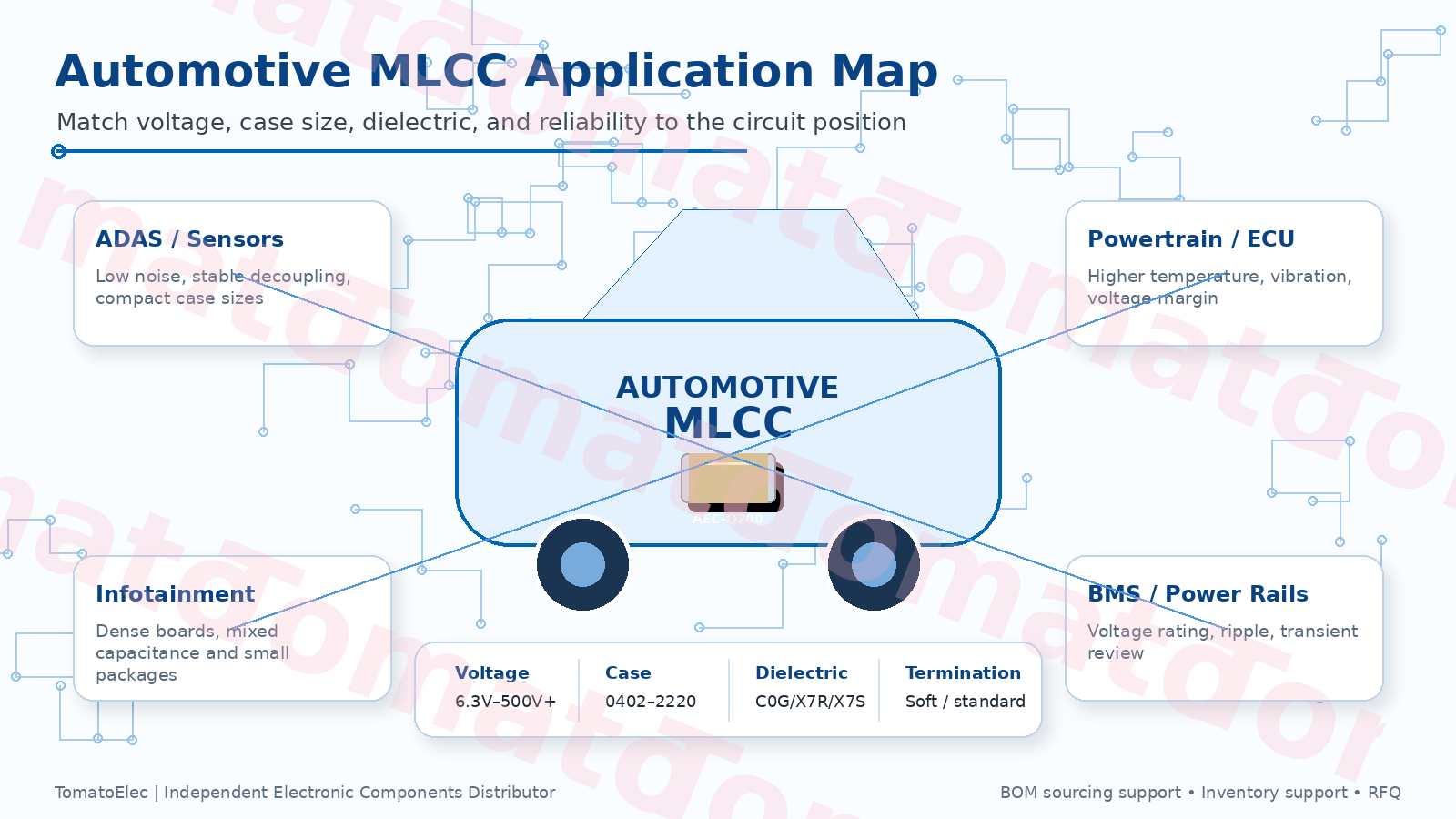
Automotive-grade MLCCs are used across many vehicle systems. Their function may include decoupling, filtering, smoothing, noise suppression, timing support, signal conditioning, and power rail stabilization. The correct part depends on the circuit position and reliability requirement.
In ADAS and sensor modules, MLCCs may be used around processors, cameras, radar modules, and local power rails. In infotainment systems, compact MLCCs support high-density boards and mixed-signal circuits. In powertrain and ECU applications, capacitors may need higher temperature ratings, stronger mechanical reliability, and stable performance under vibration.
Battery management systems, onboard chargers, lighting modules, body electronics, and DC-DC converters may require different voltage ratings and package sizes. This is why an automotive MLCC sourcing request should describe the application when possible, not only the capacitance value.
How to review alternative MLCC options
Alternative MLCC sourcing is common when lead times extend, original parts become difficult to source, or project teams need a second-source option. However, automotive MLCC alternatives require a controlled review process. A substitute should not be approved only because it has the same capacitance, voltage, and package.
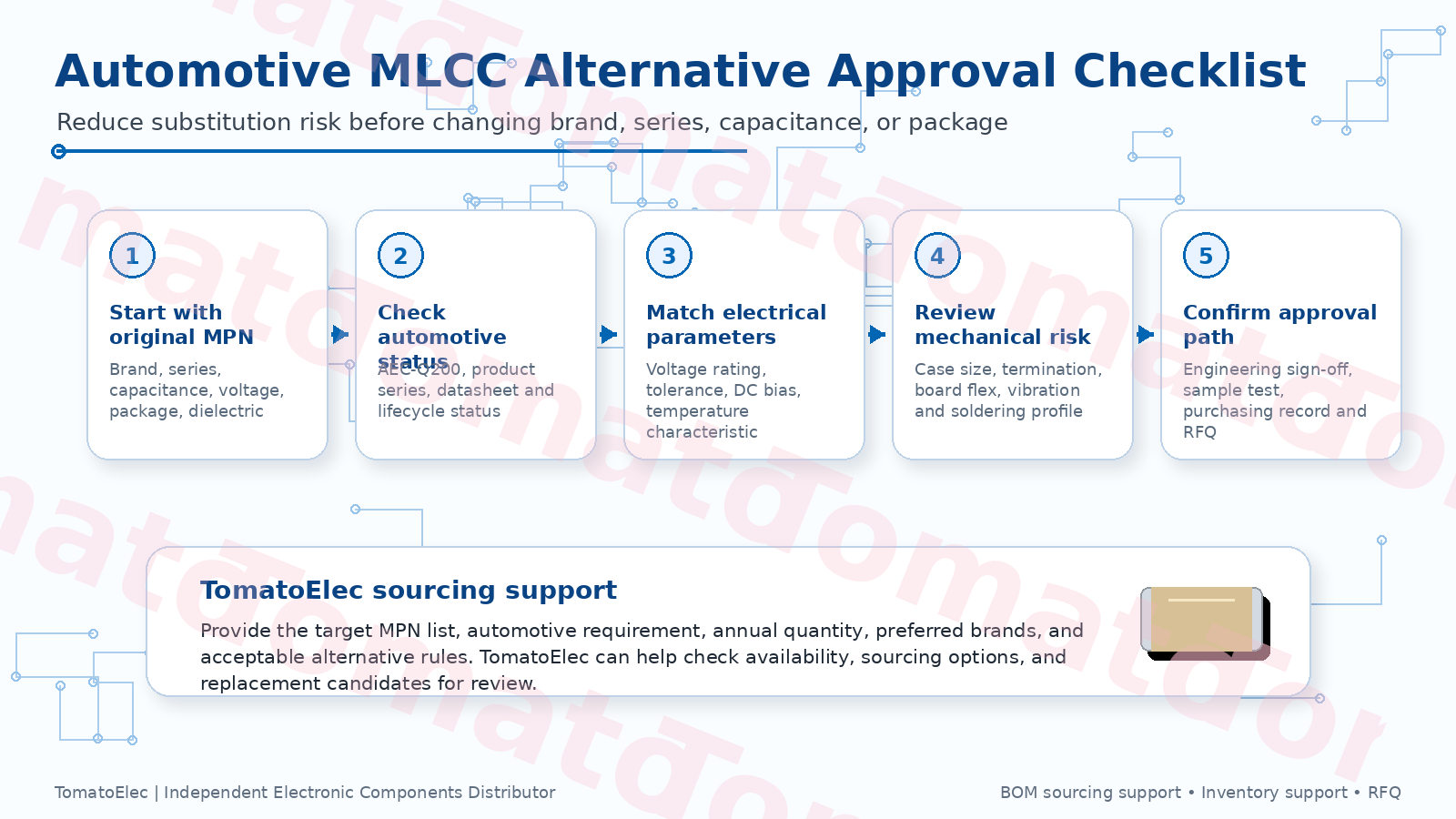
Start by comparing the original manufacturer part number with the proposed alternative. Check the manufacturer, series, capacitance, tolerance, rated voltage, dielectric, temperature characteristic, case size, thickness, termination, automotive qualification, datasheet notes, and lifecycle status.
If the alternative comes from a different brand, such as moving between Murata, Samsung Electro-Mechanics, TDK, Taiyo Yuden, Yageo, KEMET, or KYOCERA AVX, engineering approval is usually required. Procurement teams can prepare options, but the final decision should be based on electrical, mechanical, and quality review.
Practical sourcing checklist
Before requesting automotive-grade MLCC availability, prepare a clear sourcing checklist. This helps suppliers respond faster and reduces the risk of receiving unsuitable alternatives.
- Original MPN: Provide the exact manufacturer part number if available.
- Manufacturer and series: Identify whether the part belongs to an automotive-grade MLCC family.
- AEC-Q200 requirement: State whether AEC-Q200 qualification is required.
- Capacitance and tolerance: Include nominal value and acceptable tolerance range.
- Rated voltage: Confirm the required voltage rating and whether higher voltage options are acceptable.
- Case size: Include package size and whether board layout allows alternatives.
- Dielectric and temperature: Specify C0G/NP0, X7R, X7S, X8R, X7T or other required characteristics.
- Termination type: Note if soft termination or reinforced termination is required.
- Quantity and schedule: Provide target quantity, delivery schedule, and whether partial supply is acceptable.
- Alternative rules: Clarify whether cross-brand alternatives can be offered for engineering review.
How TomatoElec supports automotive MLCC sourcing
TomatoElec is an electronic components independent distributor supporting buyers, engineers, and procurement teams with sourcing for MLCCs, capacitors, diodes, power management components, and other electronic parts. For automotive-grade MLCCs, the goal is not only to find a similar part number, but to help buyers review availability, sourcing options, and alternative candidates for approval.
If your project requires AEC-Q200 MLCCs, high-voltage ceramic capacitors, compact high-capacitance MLCCs, or cross-brand alternatives, you can send the original MPN list, required quantity, target delivery time, and acceptable substitute rules. TomatoElec can support availability checks, BOM sourcing support, inventory support, and RFQ handling.
For related capacitor sourcing, buyers can also review ceramic capacitors and submit requirements through the RFQ page. If the part is difficult to source or requires careful alternative review, please contact us with the full specification and application information.
Final recommendation
Automotive-grade MLCC sourcing should be handled with a controlled process. Start with the original manufacturer part number, confirm AEC-Q200 status, check voltage rating and derating margin, review case size and dielectric, and only then consider alternative options.
For simple commercial products, a close electrical match may be enough. For automotive electronics, that approach is too risky. The better method is to prepare a complete requirement list and review each substitute against the original electrical, mechanical, reliability, and approval requirements.
When supply is tight, alternative sourcing can still work, but it must be done carefully. A well-prepared RFQ with exact MPNs, automotive requirements, acceptable brands, and substitute rules gives sourcing teams a much better chance of finding practical and reviewable MLCC options.