
Available 24/7 at
0755-82798135

How to Select the Right Resistor for Your Electronic Project: A Complete Guide
Resistors are among the most widely used components in electronic circuits. Whether you are designing a simple hobby project, a consumer device, an industrial controller, or a more advanced embedded system, choosing the right resistor is critical for performance, safety, and long-term reliability.
At first glance, a resistor may seem like a simple part. However, selecting the correct resistor involves much more than choosing a resistance value. Engineers and buyers also need to consider tolerance, power rating, temperature stability, package size, mounting type, and application requirements.
In this guide, we will explain how to select the right resistor for your electronic project, what specifications matter most, and how to avoid common mistakes during component selection. If you want to explore more electronic components and sourcing solutions, visit TomatoElec.
What Does a Resistor Do?
A resistor is a passive electronic component that limits current flow, divides voltage, sets bias conditions, and protects sensitive parts of a circuit. In practice, resistors are used in nearly every electronic device.
Typical resistor functions include:
- Limiting current to LEDs and ICs
- Dividing voltage in analog and digital circuits
- Pull-up and pull-down functions in logic systems
- Feedback and gain control in amplifiers
- Signal conditioning and filtering
- Current sensing and protection circuits
Because resistors play these important roles, selecting the wrong type can cause overheating, inaccurate circuit behavior, reduced lifespan, or even system failure.
Main Types of Resistors
There are several resistor types available on the market, and each serves different application needs.
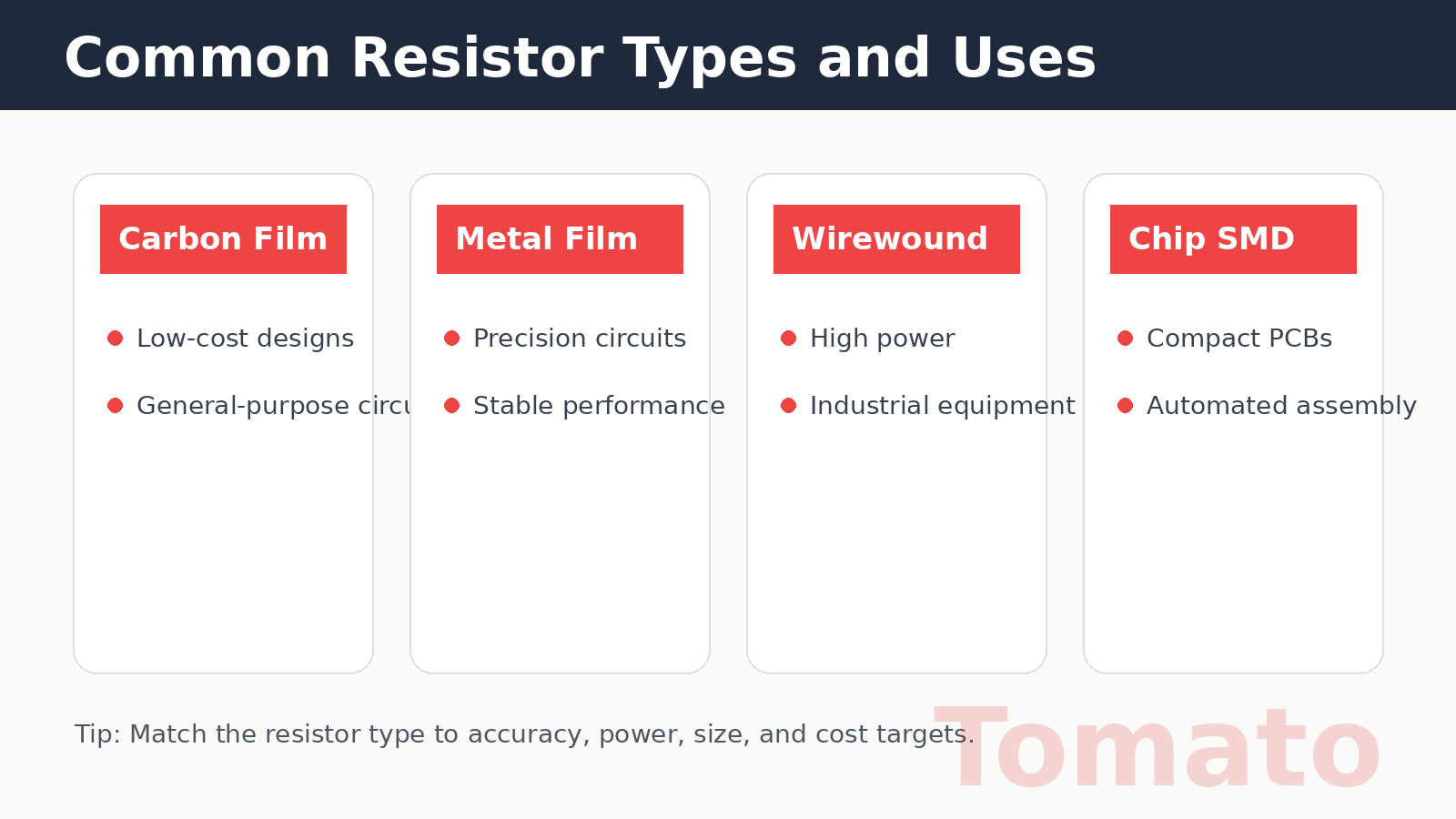
1. Carbon Film Resistors
Carbon film resistors are low-cost and commonly used in general-purpose applications. They are suitable for basic circuits where high precision is not required.
2. Metal Film Resistors
Metal film resistors offer better accuracy, lower noise, and improved temperature stability compared to carbon film resistors. They are often used in precision analog circuits, instrumentation, and control systems.
3. Wirewound Resistors
Wirewound resistors are designed for high-power applications. They can handle larger currents and dissipate more heat, making them ideal for power supplies, motor drives, and industrial systems.
4. Thick Film and Thin Film SMD Resistors
These are common in surface-mount electronics and are widely used in PCB assembly. Thin film resistors are preferred for high-precision applications, while thick film resistors are often more cost-effective for general use.
5. Variable Resistors
Variable resistors, such as potentiometers and trimmers, allow manual or adjustable resistance changes. They are often used for calibration, tuning, and user controls.
Key Factors to Consider When Selecting a Resistor
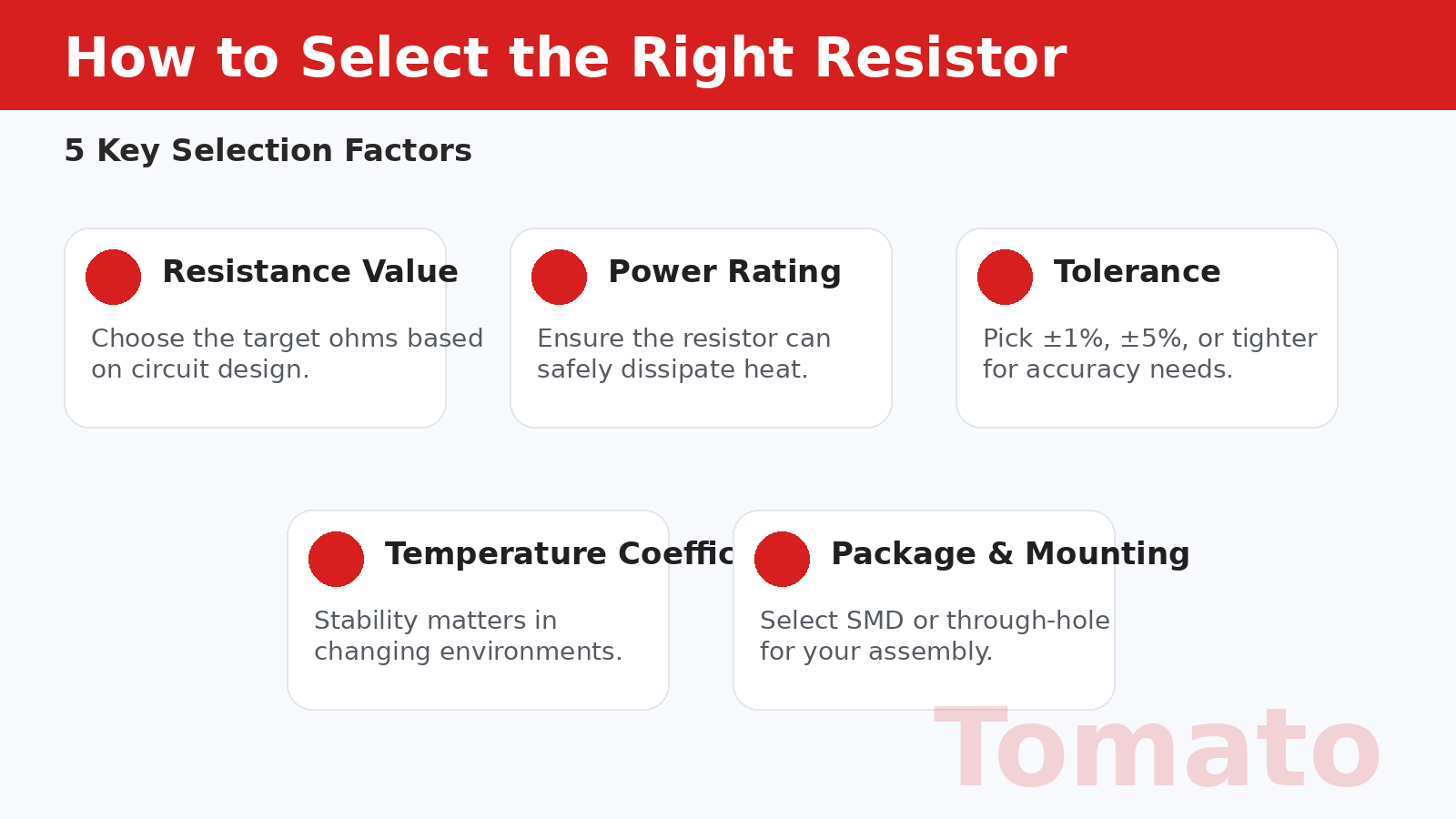
1. Resistance Value
The first step is selecting the correct resistance value, measured in ohms (Ω), kilo-ohms (kΩ), or mega-ohms (MΩ). The target value should match your circuit design calculations.
If the resistance value is too low, the circuit may draw too much current. If it is too high, the circuit may not function as intended.
2. Tolerance
Tolerance indicates how much the actual resistance may vary from the nominal value. Common tolerances include ±1%, ±2%, ±5%, and ±10%.
For general-purpose circuits, ±5% may be acceptable. For precision analog, sensing, medical, or measurement applications, tighter tolerance such as ±1% or better is often preferred.
3. Power Rating
Power rating defines how much power a resistor can safely dissipate without damage. Common ratings include 1/16W, 1/10W, 1/8W, 1/4W, 1/2W, 1W and above.
Always select a resistor with enough power margin. Running a resistor close to its maximum rating can shorten lifespan and create thermal problems.
4. Temperature Coefficient
The temperature coefficient of resistance, often expressed in ppm/°C, shows how much the resistance changes with temperature. In high-stability circuits, low temperature coefficient resistors are important.
5. Package Size and Mounting Type
Physical size matters in modern electronics, especially for compact PCB layouts. Designers must choose between surface-mount and through-hole packages based on board space, manufacturing process, and mechanical needs. You can browse related products in the resistors category.
6. Operating Environment
If the circuit will be exposed to heat, vibration, humidity, or harsh industrial conditions, resistor stability and reliability become more important. Automotive, medical, and industrial electronics often require parts with stronger environmental performance.
How to Read Resistor Specifications
When sourcing resistors, engineers and buyers should review the datasheet carefully. Important parameters usually include:
- Resistance value
- Tolerance
- Rated power
- Maximum working voltage
- Temperature coefficient
- Package dimensions
- Mounting type
- Material or film technology
- Operating temperature range
Reading datasheets carefully helps reduce sourcing errors and ensures compatibility with the target application.
SMD vs Through-Hole Resistors
SMD Resistors
SMD resistors are compact, lightweight, and suitable for automated high-volume PCB assembly. They are ideal for modern consumer electronics, communication devices, IoT products, and compact control boards.
- Small size
- High assembly efficiency
- Good for dense PCB layouts
- Lower cost in mass production
Through-Hole Resistors
Through-hole resistors are easier to handle manually and are often preferred in prototyping, educational projects, repair work, and applications requiring stronger mechanical connection.
- Easy manual soldering
- Better for prototyping and testing
- Stronger physical mounting in some designs
The right choice depends on your manufacturing method, board size, mechanical demands, and service requirements.
Common Application Scenarios
Consumer Electronics
For compact consumer products, SMD thick film resistors are often the standard choice because they support automated production and save PCB space.
Precision Measurement Circuits
Metal film or thin film resistors with tight tolerance and low temperature coefficient are better for signal conditioning, precision reference circuits, and instrumentation.
Power Electronics
Wirewound or high-power resistors are commonly used in power supplies, inrush current limiting, load control, and braking circuits.
LED Circuits
Current-limiting resistors are essential for protecting LEDs. Here, selecting the correct resistance and power rating is especially important.
Industrial and Automotive Systems
Applications exposed to harsher environments may require more robust resistor technologies with improved thermal and environmental stability.
Mistakes to Avoid When Choosing a Resistor
Ignoring Power Derating
A resistor may work in theory, but if it runs too hot in practice, reliability will suffer. Always consider derating and leave safety margin.
Choosing the Wrong Tolerance
For precision circuits, using a loose-tolerance resistor can create measurement errors or unstable performance.
Overlooking Package Constraints
A resistor with the correct electrical value may still be unsuitable if the package does not fit the PCB layout or assembly process.
Focusing Only on Price
Low-cost resistors can be attractive, but for industrial, automotive, or precision applications, quality and consistency often matter more than minimal cost savings.
Skipping Datasheet Review
Relying only on a part description without checking the full datasheet can lead to sourcing mistakes, especially when multiple package and tolerance options exist.
Final Tips Before Purchasing
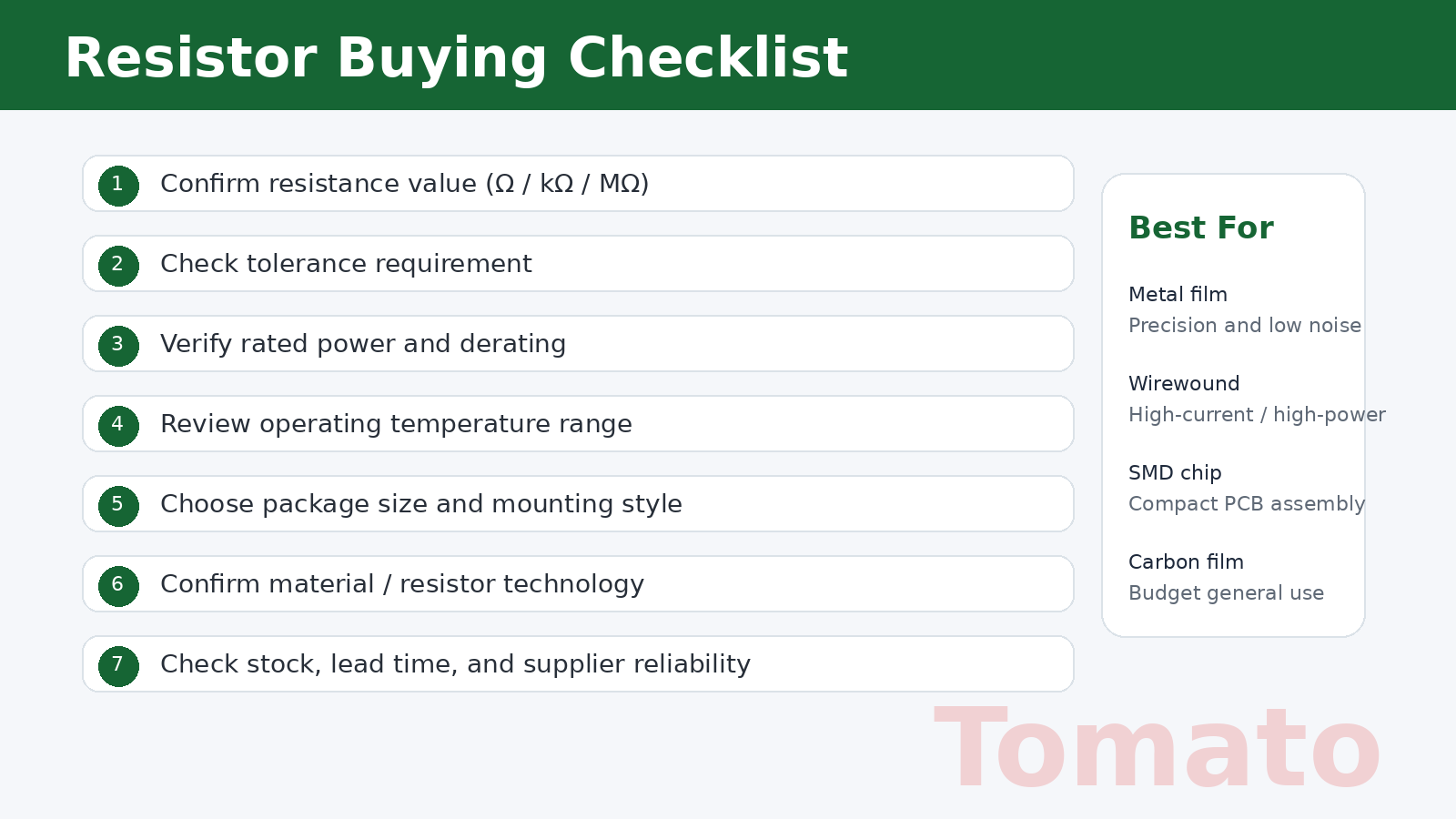
Before purchasing resistors for your project, confirm the following:
- The resistance value matches your design target
- Tolerance fits your circuit accuracy requirement
- Power rating provides enough margin
- Package size is compatible with your PCB layout
- Mounting type matches your assembly process
- Temperature performance suits the operating environment
- Supplier inventory and lead time meet your production plan
For OEM, repair, prototyping, and volume production, working with a reliable electronic components supplier can help reduce risk and improve procurement efficiency.
Conclusion
Selecting the right resistor is a key part of successful electronic design. A resistor is not just defined by its ohm value. Tolerance, power rating, temperature stability, package size, and application environment all affect circuit performance and long-term reliability.
By understanding the different resistor types and the main selection factors, engineers, buyers, and electronics enthusiasts can make better sourcing and design decisions. Whether you need compact SMD resistors for PCB assembly or precision resistors for sensitive analog systems, choosing the right component will help ensure better performance and fewer design problems.
If you are looking for reliable electronic components for your next project, visit TomatoElec to explore more resistor products or reach out through the contact page.