
Available 24/7 at
0755-82798135

Ceramic Capacitor vs Tantalum Capacitor: Key Differences, Applications, and How to Choose
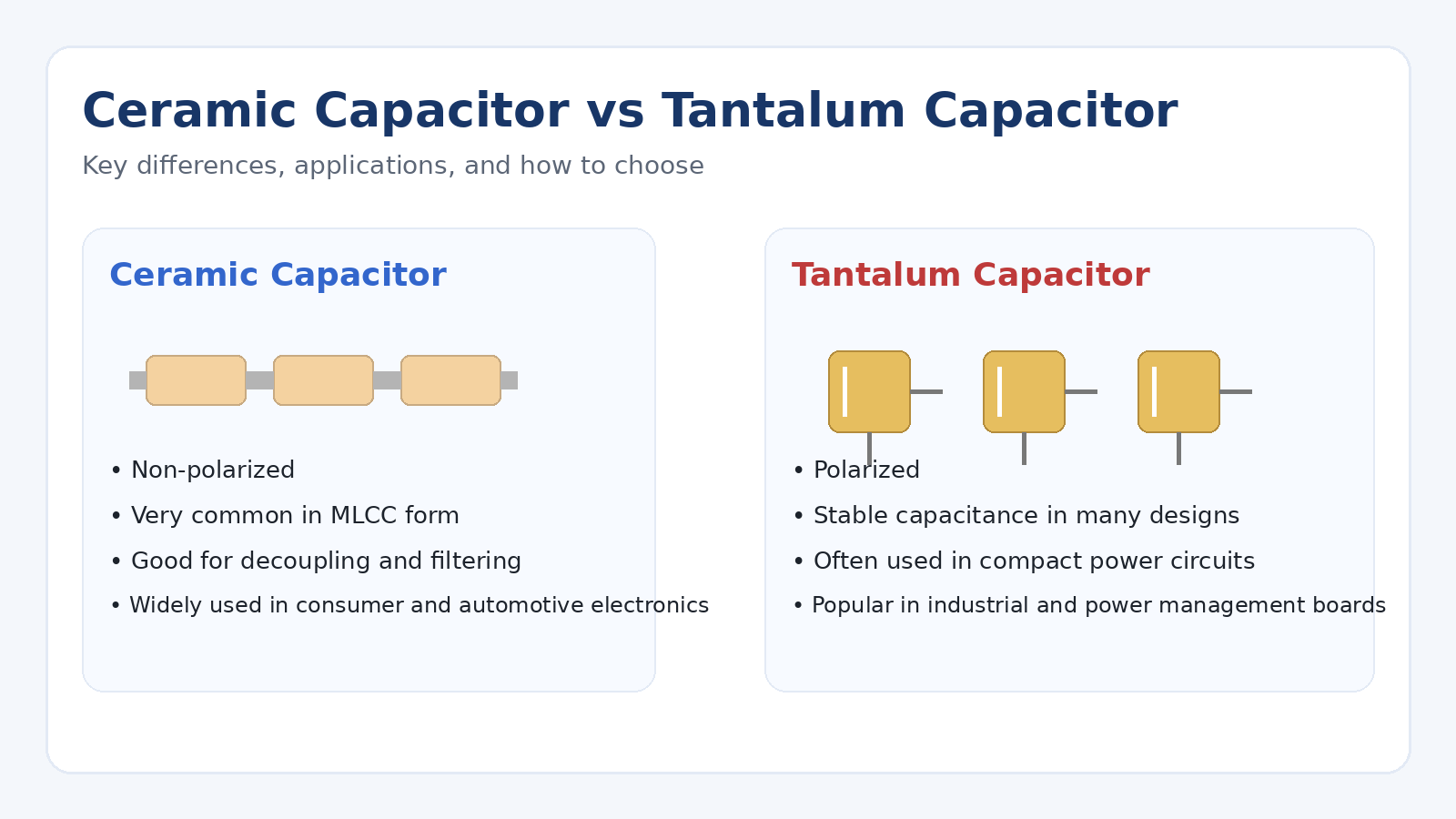
Capacitors are essential components in modern electronic circuits, but different capacitor technologies are designed for different priorities. Two of the most widely discussed options are ceramic capacitors and . Although both are used for energy storage, filtering, decoupling, and timing, they differ in structure, electrical behavior, application range, and selection logic.
This article compares ceramic capacitors and tantalum capacitors in a practical way. It explains their key differences, typical strengths, common applications, and how engineers and buyers can choose the right type for a specific design.
What Is a Ceramic Capacitor?
A ceramic capacitor uses ceramic material as the dielectric. It is one of the most common capacitor types in electronics and is widely used in multilayer ceramic capacitor (MLCC) form. Ceramic capacitors are available in many sizes and capacitance ranges, and they are especially common in compact PCB designs.
Because ceramic capacitors are non-polarized, they are easy to use in many circuit positions. They are commonly selected for decoupling, bypassing, filtering, and high-frequency applications.
What Is a Tantalum Capacitor?
A tantalum capacitor uses tantalum metal as the anode and usually offers stable capacitance performance in a compact package. Tantalum capacitors are polarized, so correct orientation matters during installation.
They are often used in power management, low-noise filtering, and circuits where stable capacitance and compact size are important. In many designs, engineers choose tantalum capacitors when they want a predictable capacitor option for power rails or bulk capacitance in limited board space.
Key Differences Between Ceramic and Tantalum Capacitors
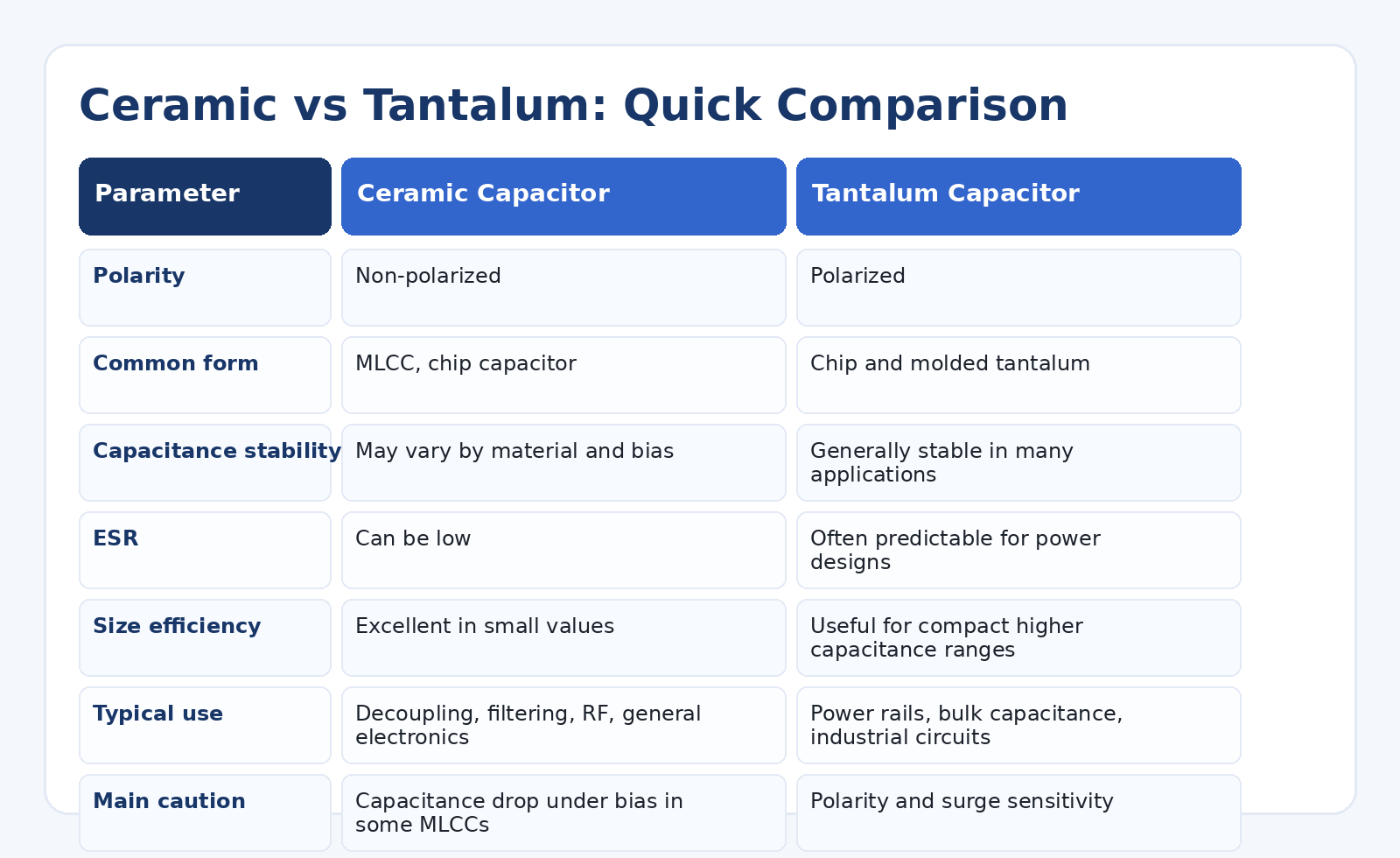
The main differences between ceramic capacitors and tantalum capacitors usually involve polarity, capacitance behavior, ESR characteristics, size efficiency, and application suitability.
- Polarity: Ceramic capacitors are non-polarized, while tantalum capacitors are polarized.
- Capacitance behavior: Ceramic capacitors, especially some MLCC types, may show capacitance change under DC bias. Tantalum capacitors are often chosen for more stable capacitance behavior in certain designs.
- Frequency performance: Ceramic capacitors are commonly preferred for decoupling and high-frequency noise suppression.
- Compact higher-capacitance use: Tantalum capacitors are often used when designers want compact capacitance for power circuits.
- Risk factors: Ceramic capacitors may crack under mechanical stress, while tantalum capacitors require attention to polarity and surge conditions.
Advantages of Ceramic Capacitors
- Non-polarized and easy to place in many circuit positions
- Widely available in MLCC and chip capacitor formats
- Good for decoupling, bypassing, RF, and filtering applications
- Available in very small package sizes for compact electronics
- Commonly used across consumer, automotive, communication, and industrial electronics
Advantages of Tantalum Capacitors
- Stable capacitance performance in many applications
- Useful for compact power rail and bulk capacitance designs
- Often selected for power management, industrial boards, and low-noise filtering circuits
- Can provide a practical balance of capacitance and package size in certain designs
Common Application Scenarios
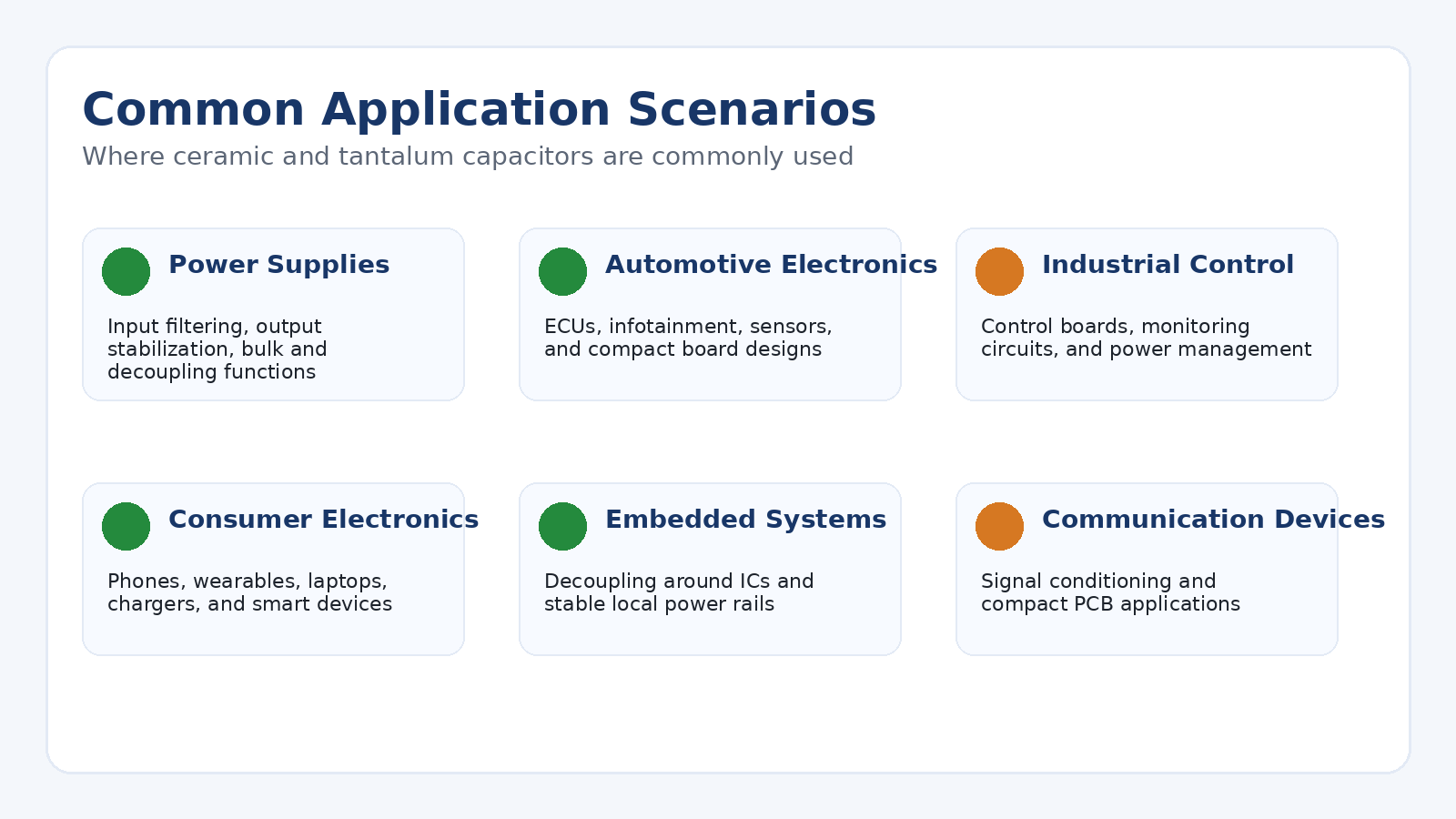
Both capacitor types are widely used, but their roles may differ depending on the circuit target.
- Ceramic capacitors: IC decoupling, RF circuits, high-frequency filtering, general consumer electronics, automotive modules, and compact PCB designs.
- Tantalum capacitors: Power supply input/output smoothing, bulk capacitance in limited space, industrial control boards, embedded power rails, and certain low-noise analog or power circuits.
How to Choose the Right Capacitor
Choosing between ceramic and tantalum capacitors depends on the actual application rather than a simple "better or worse" decision. A few practical questions help narrow the selection:
- Does the circuit need a non-polarized capacitor?
- Is the capacitor mainly for decoupling, filtering, or bulk energy storage?
- Is stable capacitance under operating conditions important?
- How much board space is available?
- Are ESR behavior, voltage rating, and surge conditions important in the design?
- Is the end application consumer, industrial, automotive, or power-related?
Note: In many real circuits, ceramic capacitors and tantalum capacitors are not direct competitors in every position. They are often used together, with ceramic capacitors handling high-frequency decoupling and tantalum capacitors supporting bulk or power-related stability where appropriate.
Ceramic Capacitor vs Tantalum Capacitor: Quick Comparison Table
| Parameter | Ceramic Capacitor | Tantalum Capacitor |
|---|---|---|
| Polarity | Non-polarized | Polarized |
| Typical use | Decoupling, filtering, RF, general electronics | Power rails, bulk capacitance, industrial and power circuits |
| Main strength | Compact, versatile, good for high-frequency use | Stable capacitance in many designs, compact for certain power uses |
| Main caution | Capacitance drop under bias in some MLCCs, cracking risk | Polarity sensitivity and surge-related risk |
| Common form | MLCC, chip capacitor | Molded tantalum, chip tantalum |
FAQ
Which is better, ceramic capacitor or tantalum capacitor?
Neither is universally better. The right choice depends on the application, voltage conditions, size limits, ESR requirements, and circuit function.
Why are ceramic capacitors so widely used?
Ceramic capacitors are compact, non-polarized, and highly practical for decoupling, filtering, and general-purpose electronics.
When should I use a tantalum capacitor?
Tantalum capacitors are often used when stable capacitance, compact package size, and power rail support are important in the design.
Can ceramic capacitors replace tantalum capacitors?
Sometimes, but not always. The replacement depends on capacitance stability, ESR, voltage, application, and space requirements.
Looking for ceramic capacitors, tantalum capacitors, or alternative parts?
This topic works well for capacitor category pages, product guides, brand pages, and RFQ-focused landing pages. You can also add internal links to Ceramic Capacitors, Tantalum Capacitors, AVX, Murata, Samsung Electro-Mechanics, or send an RFQ for capacitor sourcing support.