
Available 24/7 at
0755-82798135

TI Power Sequencing and Rail Monitoring for Server Boards
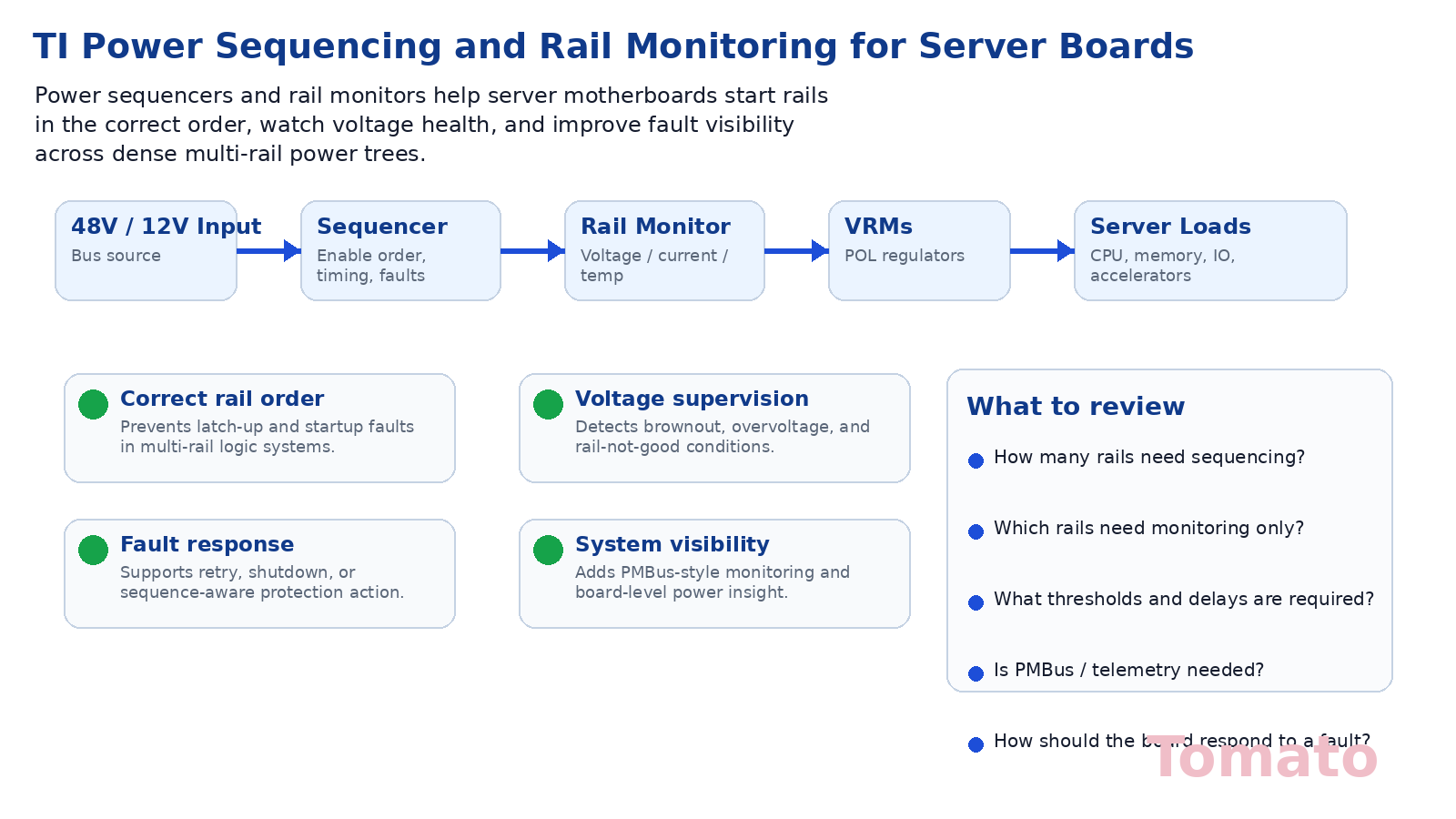
TI power sequencing and rail monitoring solutions are highly relevant in server motherboard design because modern boards often contain many tightly related voltage rails that must start, shut down, and recover in a controlled way.
On a server board, power is not just about generating the required voltages. It is also about bringing rails up in the correct order, checking whether each rail is healthy, reacting correctly to faults, and giving the system enough visibility to improve reliability and serviceability.
This article explains how TI power sequencing and rail monitoring solutions fit into server motherboard design, and what engineers and buyers should review when building or sourcing a multi-rail power architecture. For more electronic components and sourcing support, visit TomatoElec.
1. Why Power Sequencing Matters on Server Motherboards
Server motherboards usually include multiple dependent rails for management functions, memory, processors, IO, and supporting logic. These rails do not always start at the same time, and many of them must follow a specific order so the board can initialize safely.
If sequencing is not handled correctly, the system may experience startup instability, improper regulator behavior, logic faults, or delayed bring-up. This is why power sequencing remains a key design function in complex server platforms.
TI's sequencer portfolio is specifically built for systems that need to control and monitor multiple rails. The official TI sequencer overview describes the UCD90x family as digital power-supply sequencers with system health monitors, while datasheets such as UCD90240, UCD90320, and UCD9090A show multi-rail sequencing, programmable dependencies, and fault-aware behavior. :contentReference[oaicite:1]{index=1}
2. Why Rail Monitoring Is Equally Important
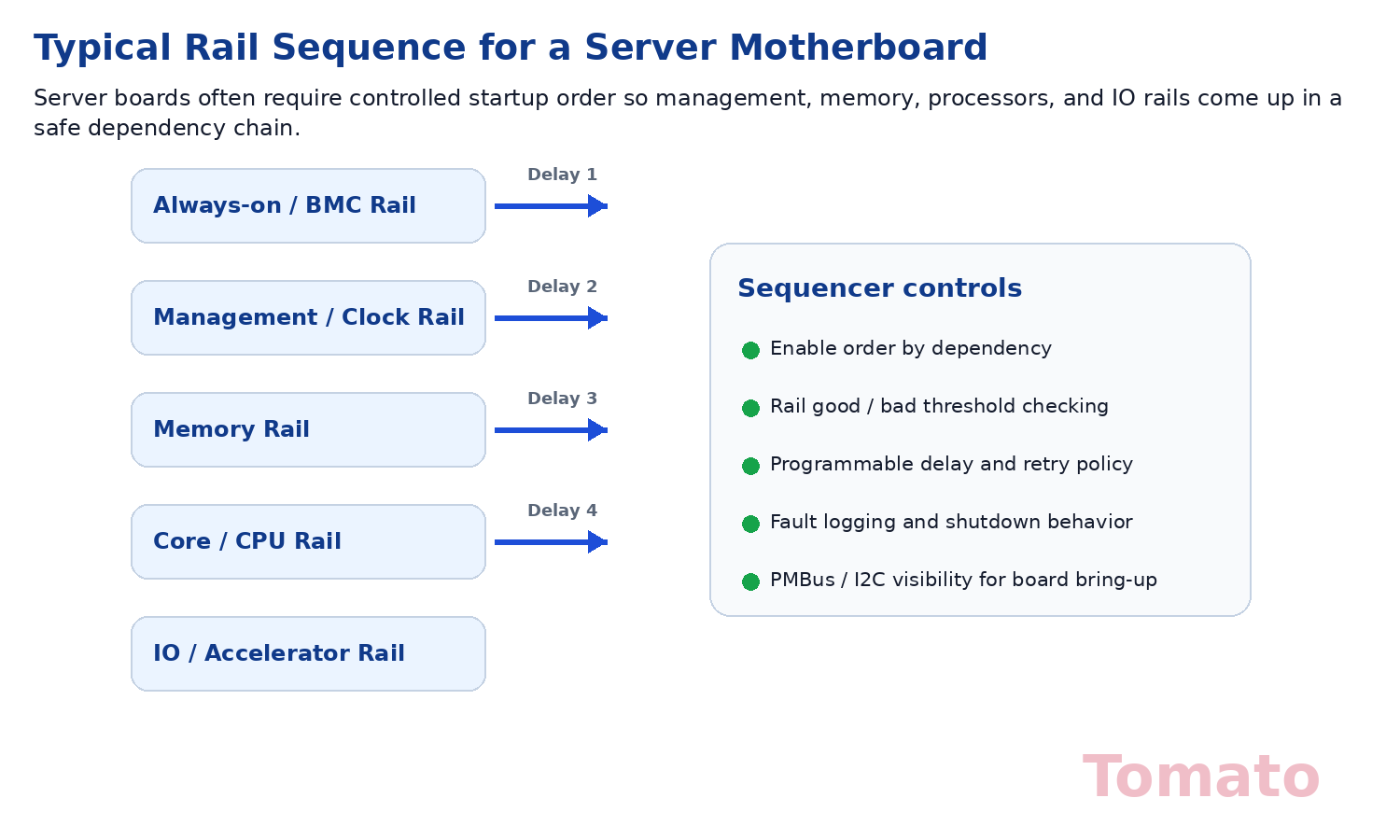
Sequencing alone is not enough for a reliable server motherboard. Each important rail also needs to be monitored so the system can detect undervoltage, overvoltage, delayed startup, unexpected drop events, or power-good failures.
In a dense compute board, early fault visibility helps reduce debug time, improve field reliability, and protect expensive downstream devices. It also helps platform teams understand whether problems come from the regulator stage, the load, thermal stress, or board-level interactions.
TI's official documentation emphasizes this combined role clearly. UCD90240 can continuously monitor rail voltages, currents, temperatures, and fault conditions while reporting system health through PMBus. UCD90320 adds sequencing, monitoring, margining, event logging, and coordinated fault handling across many rails, and UCD9090A integrates 10-rail monitoring and sequencing for servers and storage systems. :contentReference[oaicite:2]{index=2}
3. Typical Sequencing Structure on a Server Board
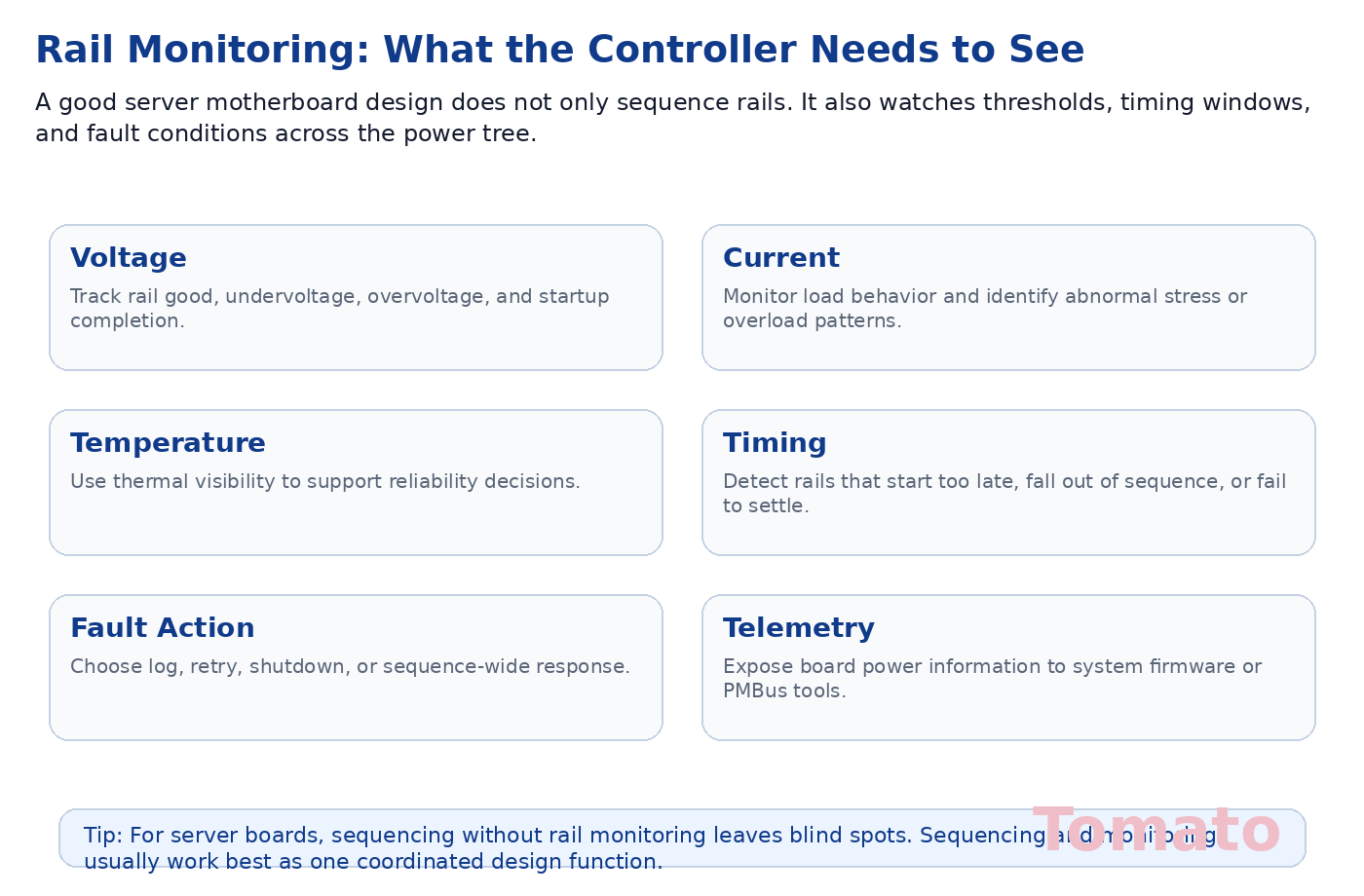
On a server motherboard, sequencing logic is usually linked to regulator enables, power-good dependencies, and monitoring pins across the board power tree. One part of the board may require always-on or management rails first, followed by supporting logic rails, memory rails, processor rails, and then high-current IO or accelerator-related rails.
This sequence can vary by platform, but the design principle remains the same: critical rails should come up in a controlled dependency order, and monitored rails should trigger the correct response if something is outside threshold.
TI's PMBus sequencer datasheets show exactly this type of role. UCD90240 can manage up to 24 rails and be cascaded to much larger systems; UCD90320 can sequence, monitor, and margin a combination of analog and digital rails with event logging; and UCD9090A supports sequence dependencies, multiple thresholds, and ACPI-related rail-state behavior. :contentReference[oaicite:3]{index=3}
4. What to Look for in a TI Sequencer or Monitor
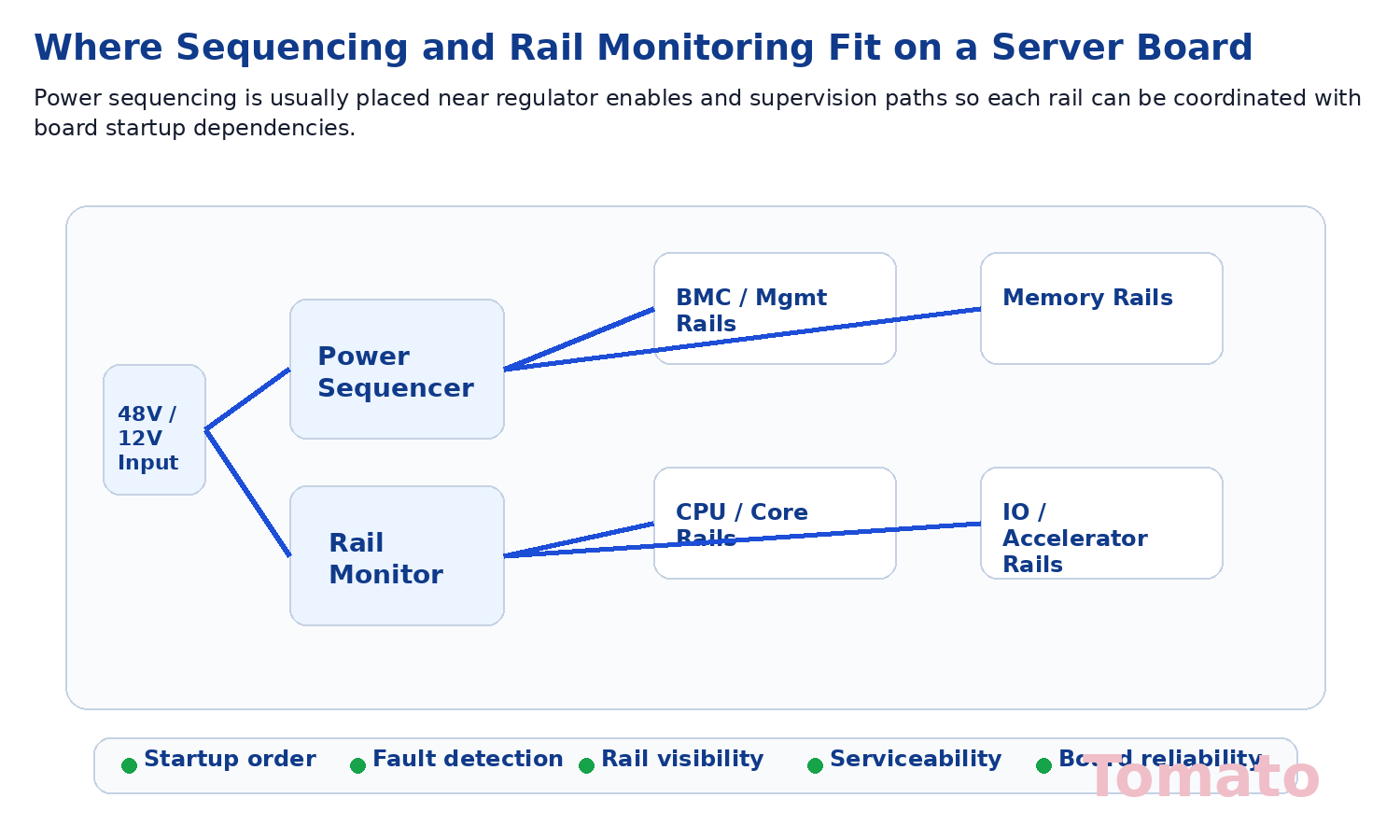
Choosing the right TI solution starts with the board's real rail count and control requirement. Some server boards mainly need multi-rail sequencing and threshold monitoring. Others also need PMBus visibility, margining, event logging, digital rail support, or more advanced fault coordination.
The most important review points usually include:
- How many rails need enable control?
- How many rails need active monitoring?
- What voltage thresholds and delay timing are required?
- Does the system need PMBus or firmware-level visibility?
- Should the board retry, shut down, or log on a fault?
- Are low-power states or configurable rail states needed?
TI's product documentation supports this selection logic directly. The sequencer overview highlights flexible sequencing and monitoring without hardware changes, while UCD9090A explicitly supports multiple thresholds, sequence dependencies, event logging, and configurable rail states. :contentReference[oaicite:4]{index=4}
5. Power States, Fault Response, and System Visibility
For server motherboards, a good sequencing solution should do more than start rails in order. It should also help the board react correctly during abnormal events and make it easier to understand what happened.
That means fault logging, threshold reporting, programmable response behavior, and firmware-visible system health information can all be important. In practical terms, this supports faster validation, clearer root-cause analysis, and more reliable platform behavior over time.
TI explicitly includes these capabilities across the UCD90x family. Official datasheets describe nonvolatile fault logging, black-box logging, PMBus system-health reporting, cascading for larger systems, and configurable fault responses, which are highly relevant for server-class board design. :contentReference[oaicite:5]{index=5}
6. Practical Design Checklist
Before selecting a TI sequencing and rail-monitoring solution for a server motherboard, review the following points:
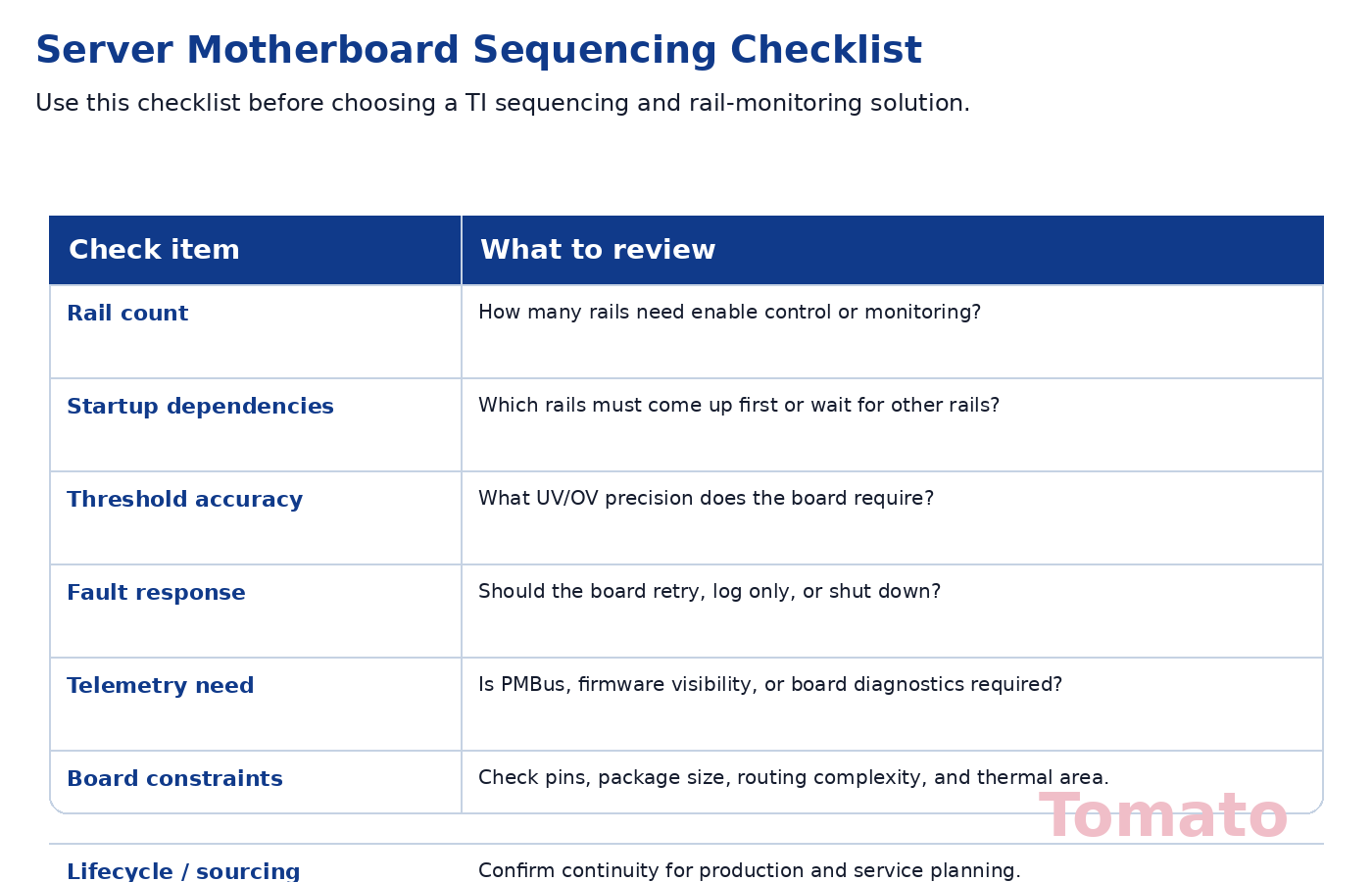
- Confirm the real number of rails that need sequencing and monitoring.
- Define startup dependencies between management, memory, processor, and IO rails.
- Review undervoltage and overvoltage accuracy requirements.
- Decide how faults should be handled: log, retry, or shutdown.
- Confirm whether PMBus or firmware-level telemetry is required.
- Check package, routing complexity, and GPIO allocation on the board.
- Review lifecycle and supply continuity for production planning.
Conclusion
TI power sequencing and rail monitoring solutions are important building blocks for modern server motherboard design. They help bring rails up safely, monitor rail health, improve fault visibility, and support a more reliable multi-rail power architecture.
The best choice depends on the board's rail count, dependency structure, monitoring depth, fault strategy, and system-management requirement. If you are evaluating TI solutions for server motherboard power design, visit the TomatoElec homepage or contact us through the contact page.