
Available 24/7 at
0755-82798135

How to Choose the Right Schottky Diode for Power Supply Design
Schottky diodes are widely used in power supply design because they offer low forward voltage drop and fast switching behavior, which can help reduce loss and improve efficiency in many rectification and power-path applications.
For engineers and buyers, however, choosing the right Schottky diode is not only about selecting a low-VF part. Reverse voltage, average current, leakage current, package type, and thermal performance all affect whether the diode will work reliably in the real circuit.
This guide explains how to choose the right Schottky diode for power supply design and what should be checked before final selection. For more electronic components and sourcing support, visit TomatoElec.
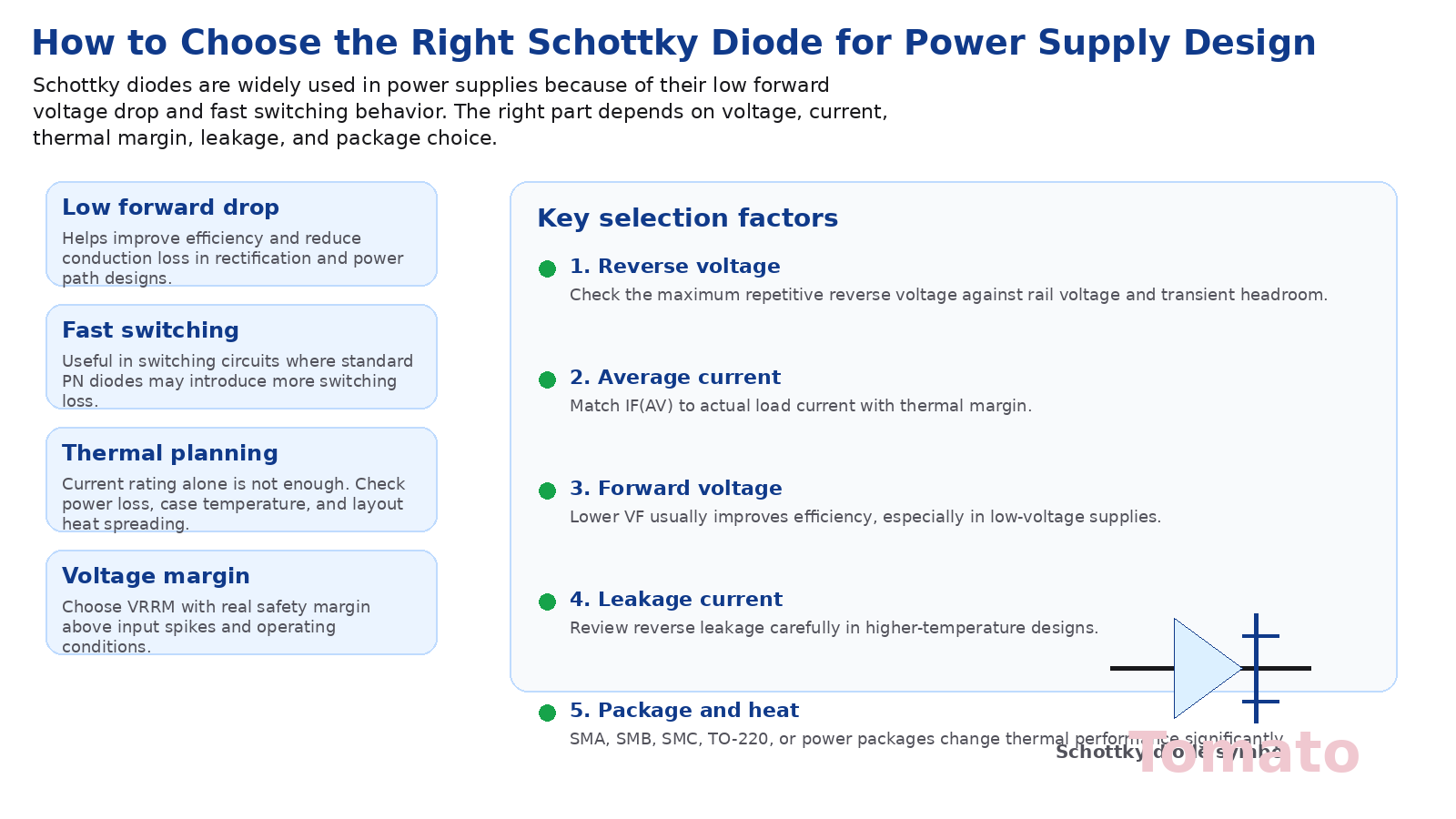
1. Why Schottky Diodes Are Common in Power Supplies
Compared with standard PN diodes, Schottky diodes are often preferred in power supplies because they can provide lower forward voltage drop and faster switching performance. This makes them especially useful in low-voltage rails, switching power supplies, and designs where efficiency is a key concern.
In practical applications, Schottky diodes may be used for output rectification, reverse-polarity protection, ORing functions, clamp paths, or freewheeling paths. The exact selection depends on where the diode sits in the circuit and what type of electrical and thermal stress it will face.
2. Voltage and Current Selection
The first two parameters to review are reverse voltage rating and forward current rating. The diode should have enough VRRM margin above the real operating voltage and any expected transient conditions. Using only the nominal rail voltage is often not enough.
At the same time, average forward current and surge conditions should be checked against the real load profile. A diode that appears acceptable on paper may still overheat if the actual current waveform, startup surge, or ambient temperature is more severe than expected.
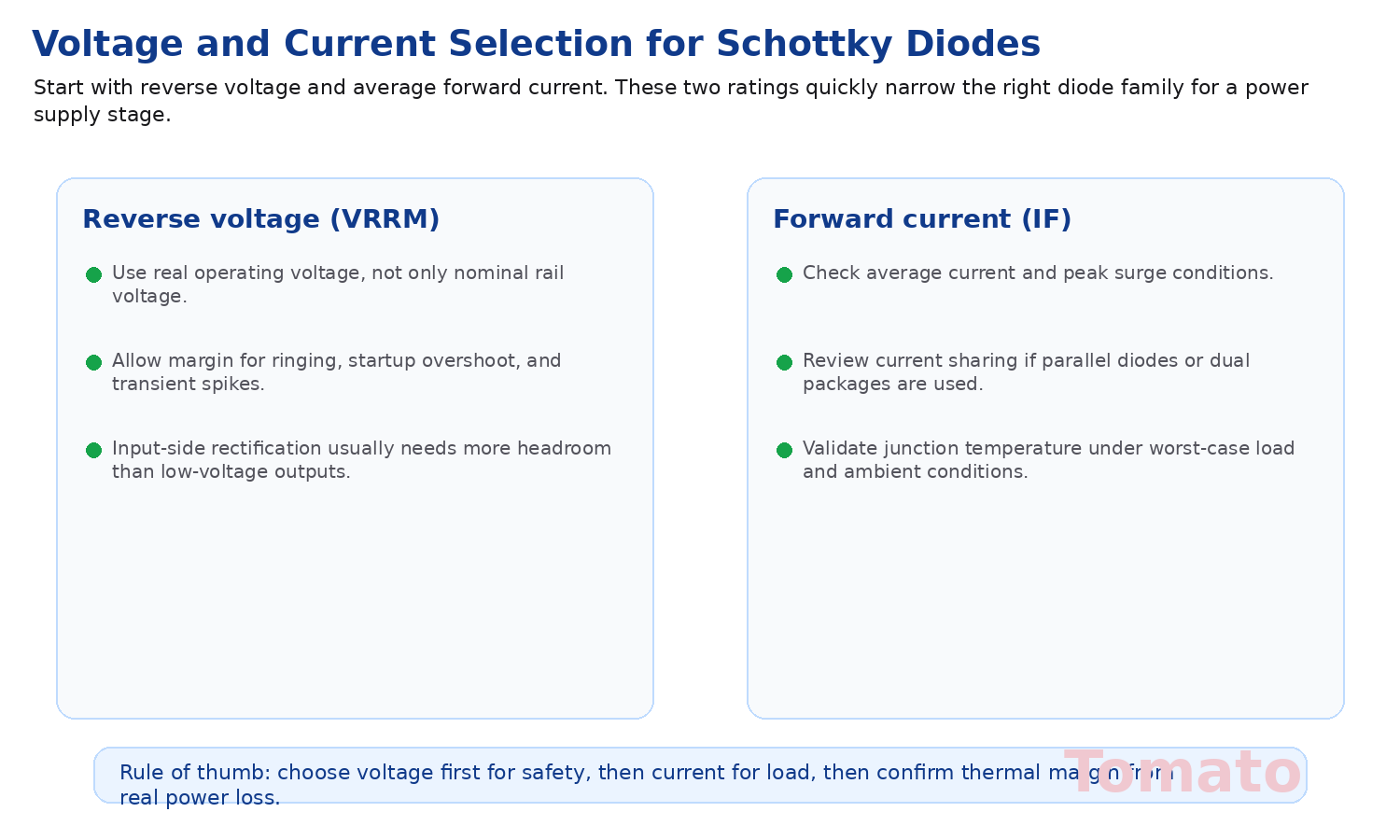
In other words, voltage selection is mainly about safety margin, while current selection is closely linked to thermal design and real operating conditions.
3. Forward Voltage, Efficiency, and Thermal Trade-Offs
One of the main reasons designers choose Schottky diodes is the lower forward voltage drop. In low-voltage power supplies, even a modest reduction in forward drop can improve efficiency and reduce heat.
However, lower forward voltage is not the only factor that matters. Reverse leakage tends to increase with temperature, and package thermal performance can strongly limit the real usable current. That means a diode with attractive electrical numbers may still be the wrong choice if thermal dissipation is not managed correctly.
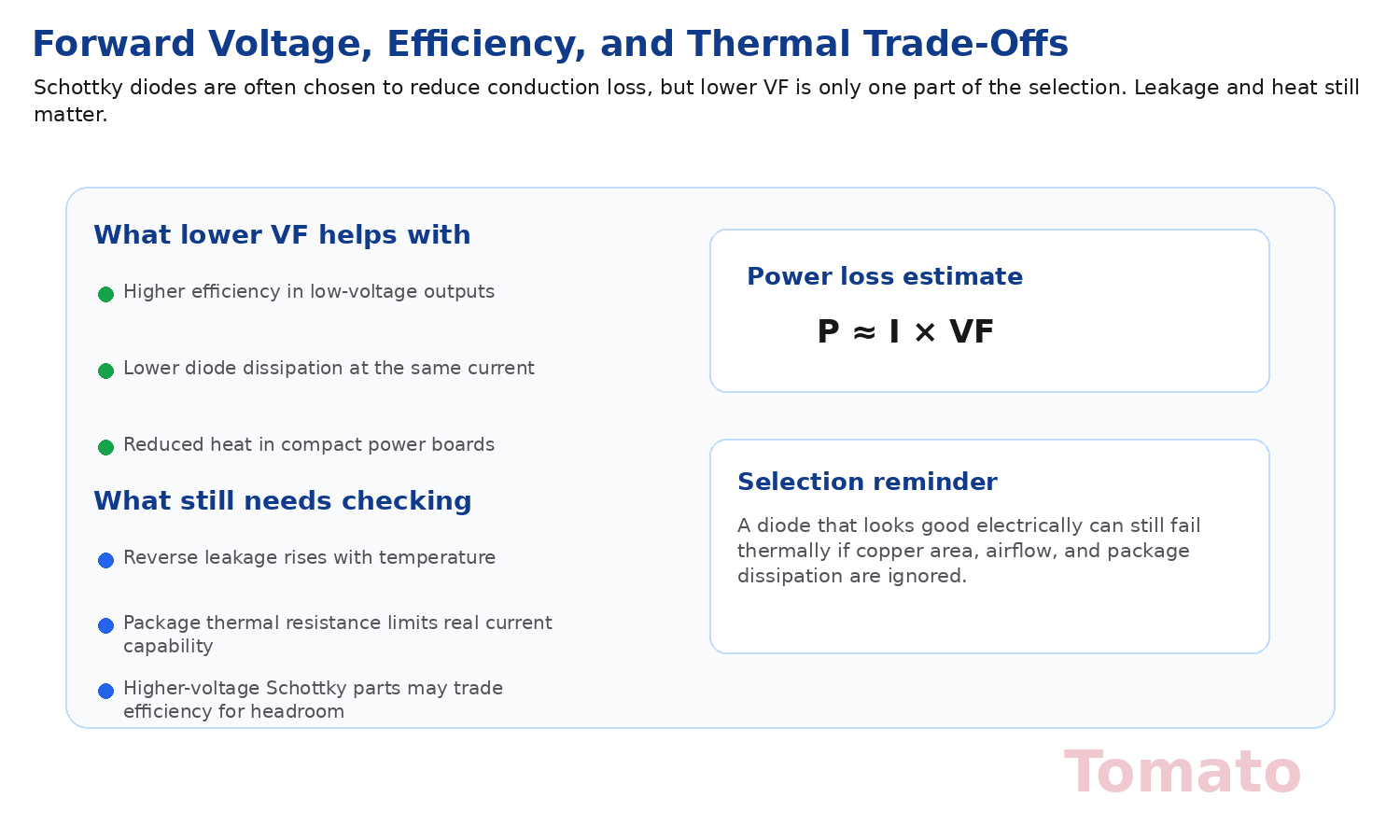
A practical review should therefore include conduction loss, expected case temperature, PCB copper area, airflow, and the real thermal path of the design.
4. Typical Applications in Power Supply Design
Schottky diodes are commonly used in output rectification stages of switching power supplies, where low forward voltage helps improve efficiency. They are also widely used in reverse-polarity protection, ORing paths, and freewheeling or clamp positions around switching nodes.
The best device for one application may not be the best for another. For example, a diode selected for a compact low-voltage output may prioritize low VF, while a diode used on a higher-voltage input-related path may require stronger voltage headroom and tighter thermal review.
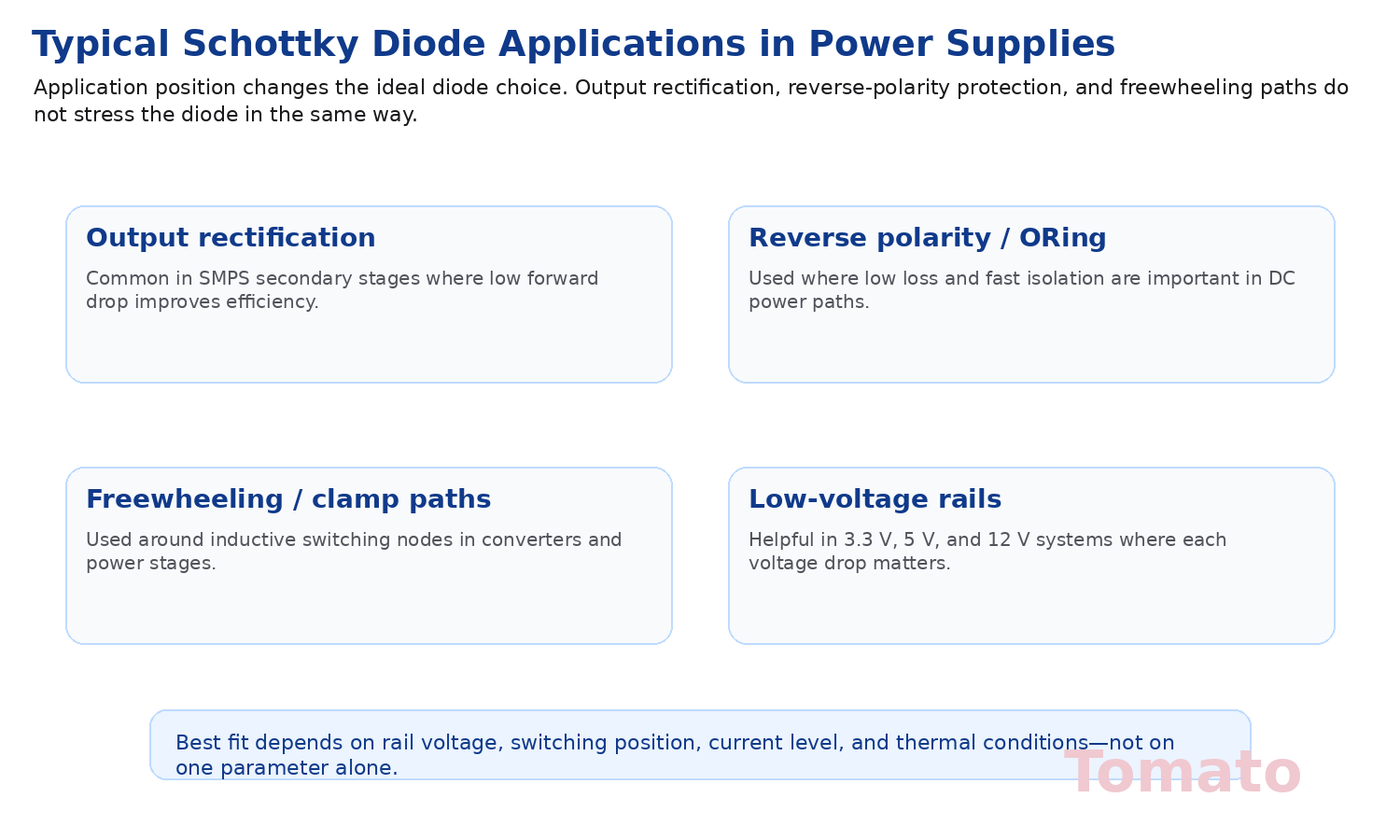
This is why application position should always be reviewed together with electrical ratings, instead of selecting only by part family or package style.
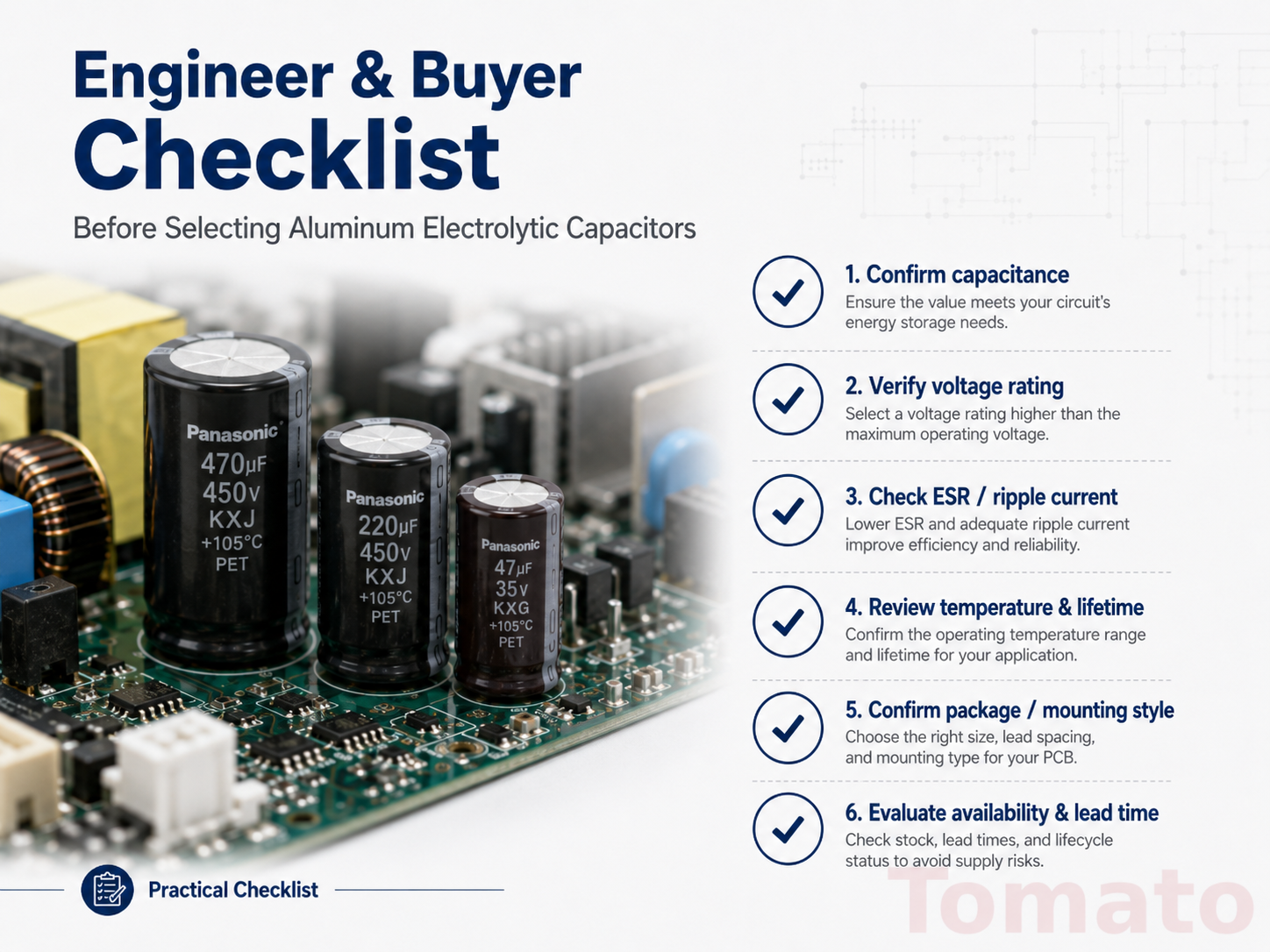
5. Practical Selection Checklist
Before locking a Schottky diode into a power supply design, review the following checklist:
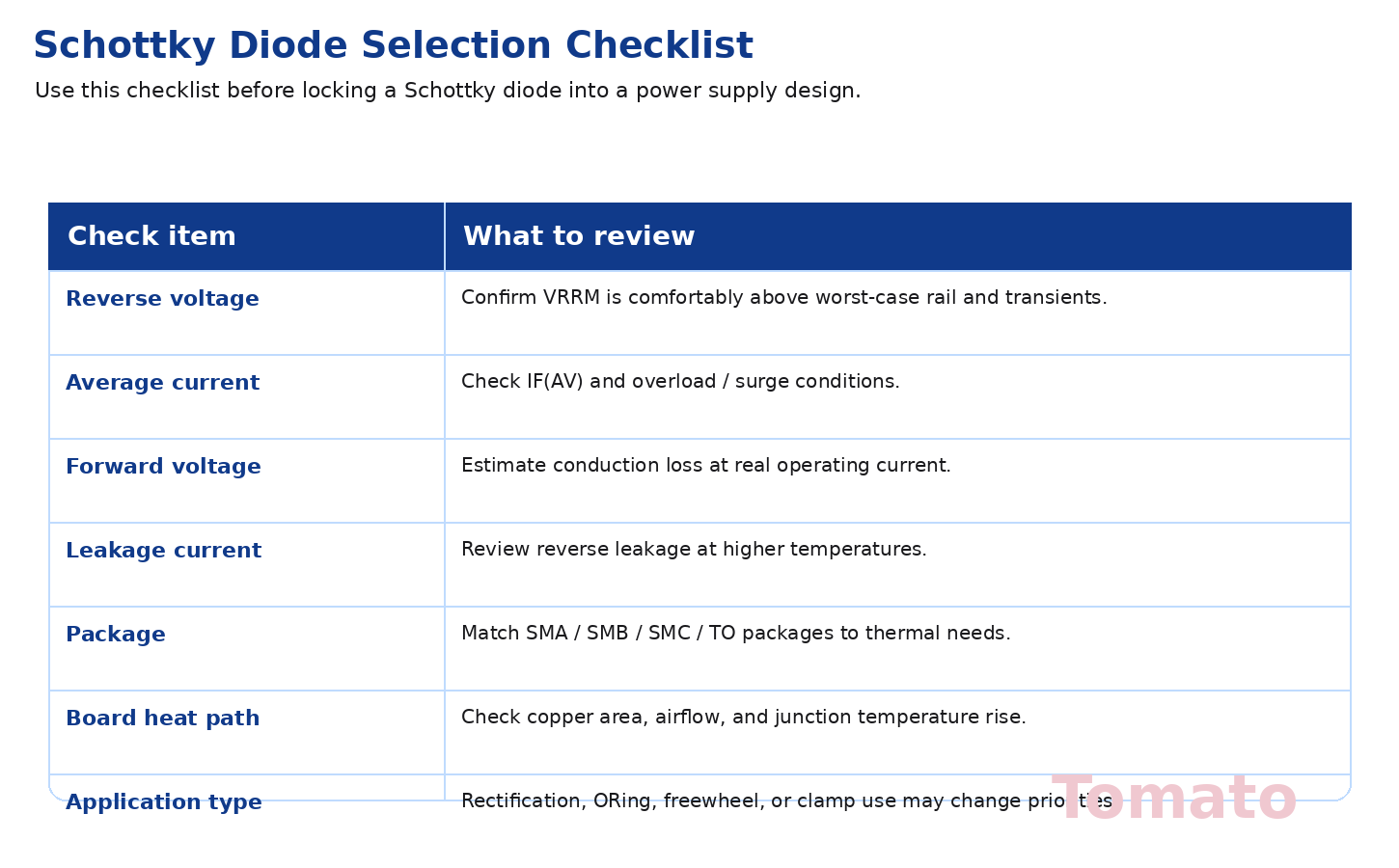
- Confirm that VRRM is above the real rail voltage and transient conditions.
- Check average forward current and surge current margin.
- Estimate conduction loss using real operating current and forward voltage.
- Review reverse leakage, especially at higher temperature.
- Match the package to the required thermal performance.
- Check PCB copper area, airflow, and junction temperature rise.
- Make sure the selection matches the actual application position in the circuit.
Conclusion
Choosing the right Schottky diode for power supply design requires more than looking for a low forward voltage part. Reverse voltage, current capability, leakage current, thermal margin, package choice, and actual circuit position all matter.
A better selection process starts with the real rail voltage and current, then moves to efficiency, heat, and application type. If you are evaluating diodes and other power components, visit the TomatoElec homepage or contact us through the contact page.