
Available 24/7 at
0755-82798135

How to Choose TI Hot Swap Controllers for Server and Data Center Power Designs
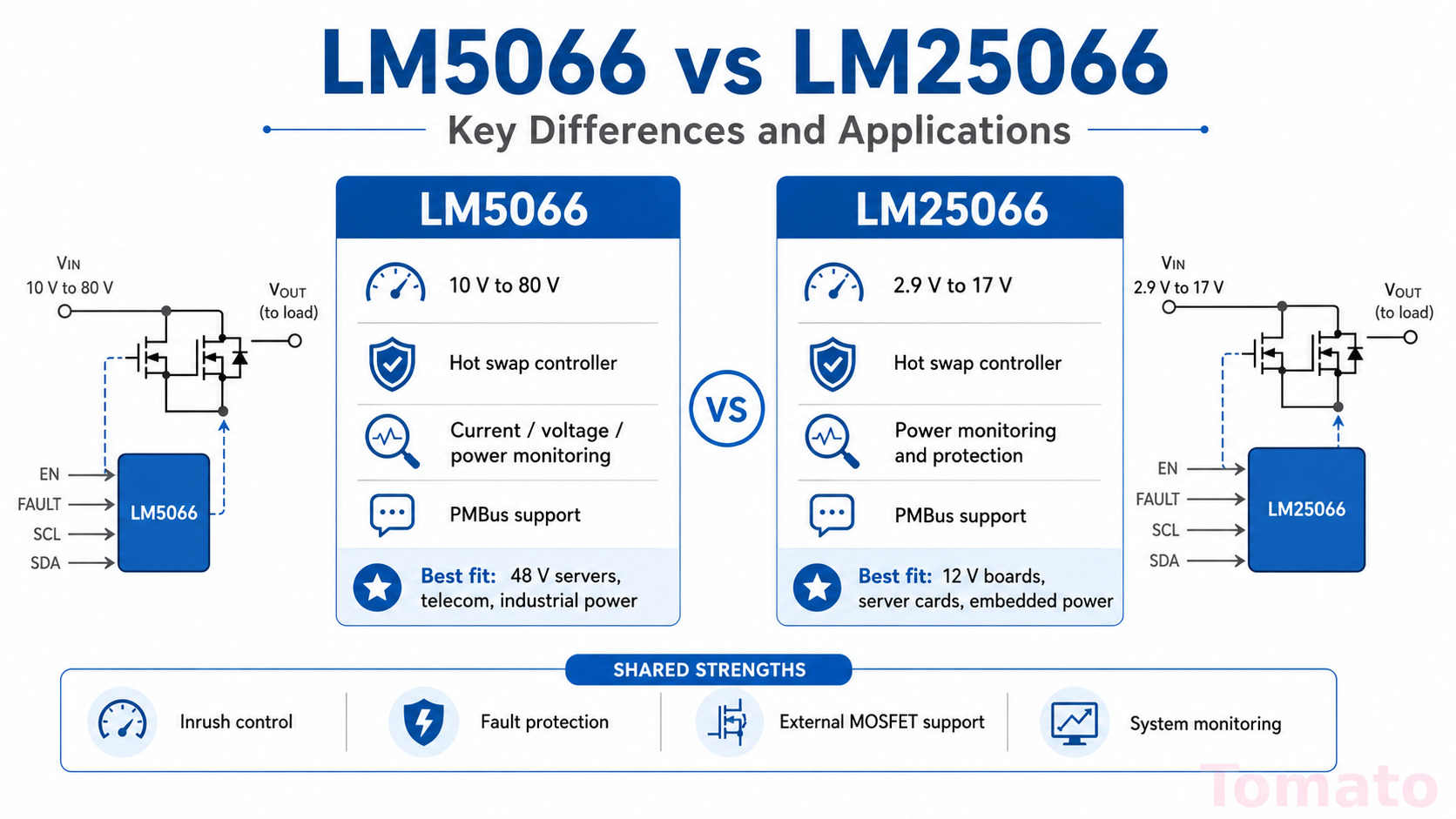
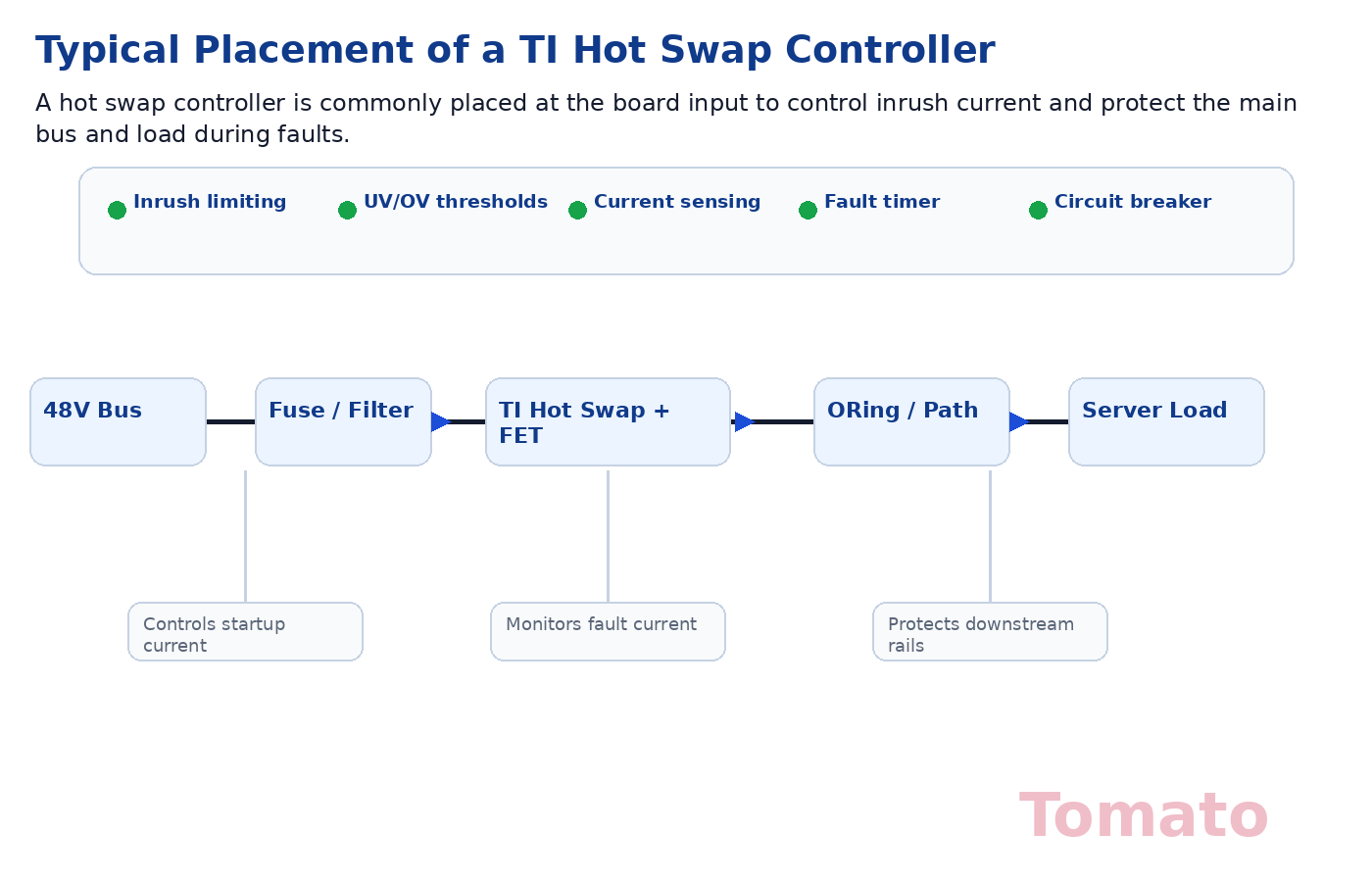
TI hot swap controllers are important devices in server and data center power designs because they help manage startup inrush current, protect the power path during fault events, and support more reliable board-level power insertion and operation.
In modern server and data center systems, power density keeps increasing, while uptime, fault isolation, and serviceability remain critical. That means the input protection stage can no longer be chosen casually. Engineers need to consider voltage architecture, current stress, fault response, MOSFET protection margin, and diagnostic requirements before selecting a hot swap controller.
This guide explains how to choose TI hot swap controllers for server and data center power designs, and shows which design factors matter most in practical board-level power paths. For more electronic components and sourcing support, visit TomatoElec.
1. Why Hot Swap Controllers Matter in Server and Data Center Power
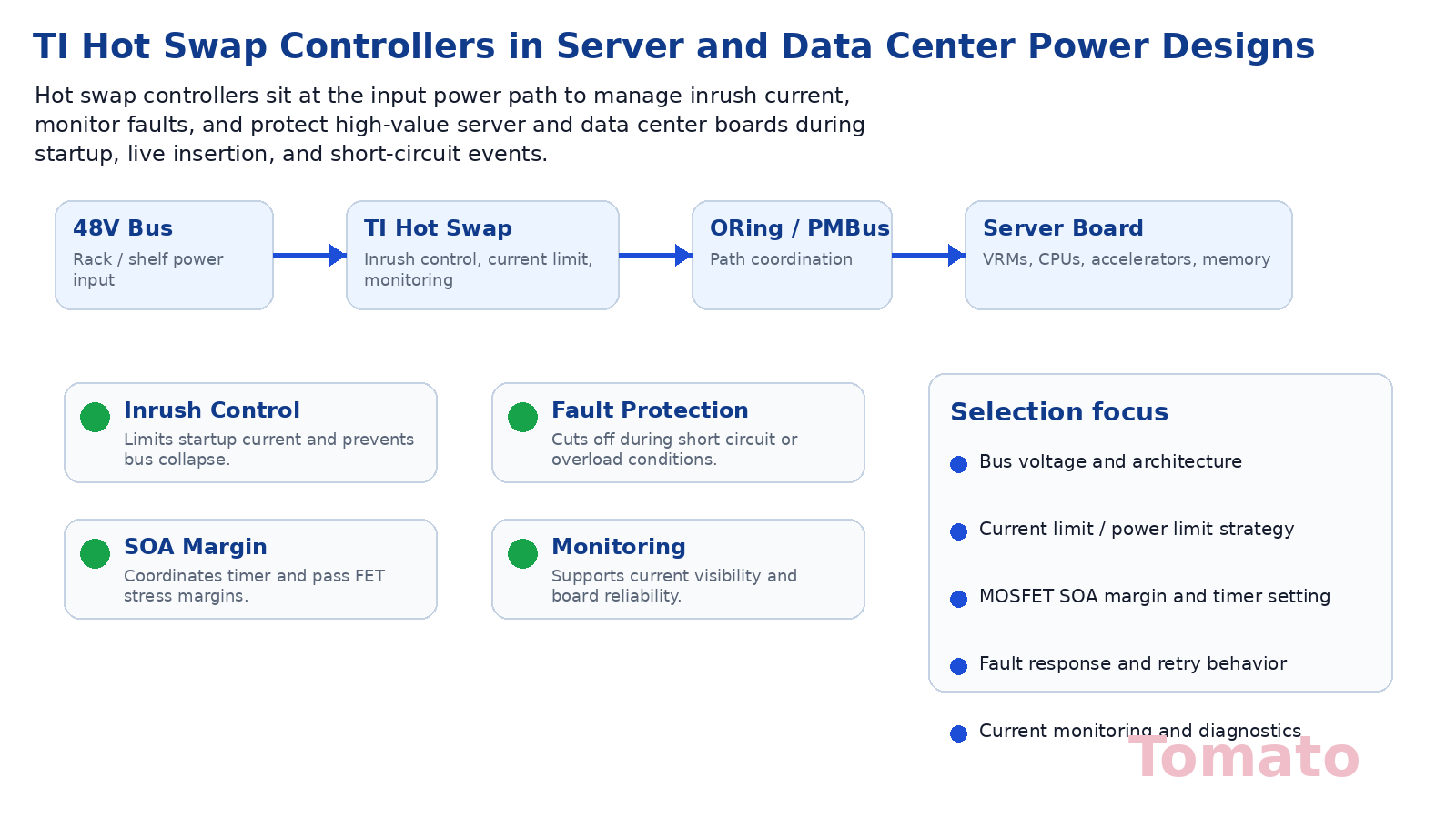
In server and data center power systems, the hot swap controller is usually placed at the board or subsystem input. Its job is to control inrush current during startup or live insertion, and to protect the main bus and downstream load if a short circuit, overload, or abnormal condition occurs.
This function becomes especially important in high-value server boards, accelerator cards, power distribution modules, and other systems where uncontrolled inrush or delayed fault isolation could damage components or disturb the shared power rail.
TI's official hot-swap resources emphasize inrush management, fault protection, and robust board insertion behavior, while TI's broader data center compute resources group hot-swap controllers together with eFuses, ORing controllers, and other protection devices for modern compute power architectures.:contentReference[oaicite:1]{index=1}
2. Key Selection Factors
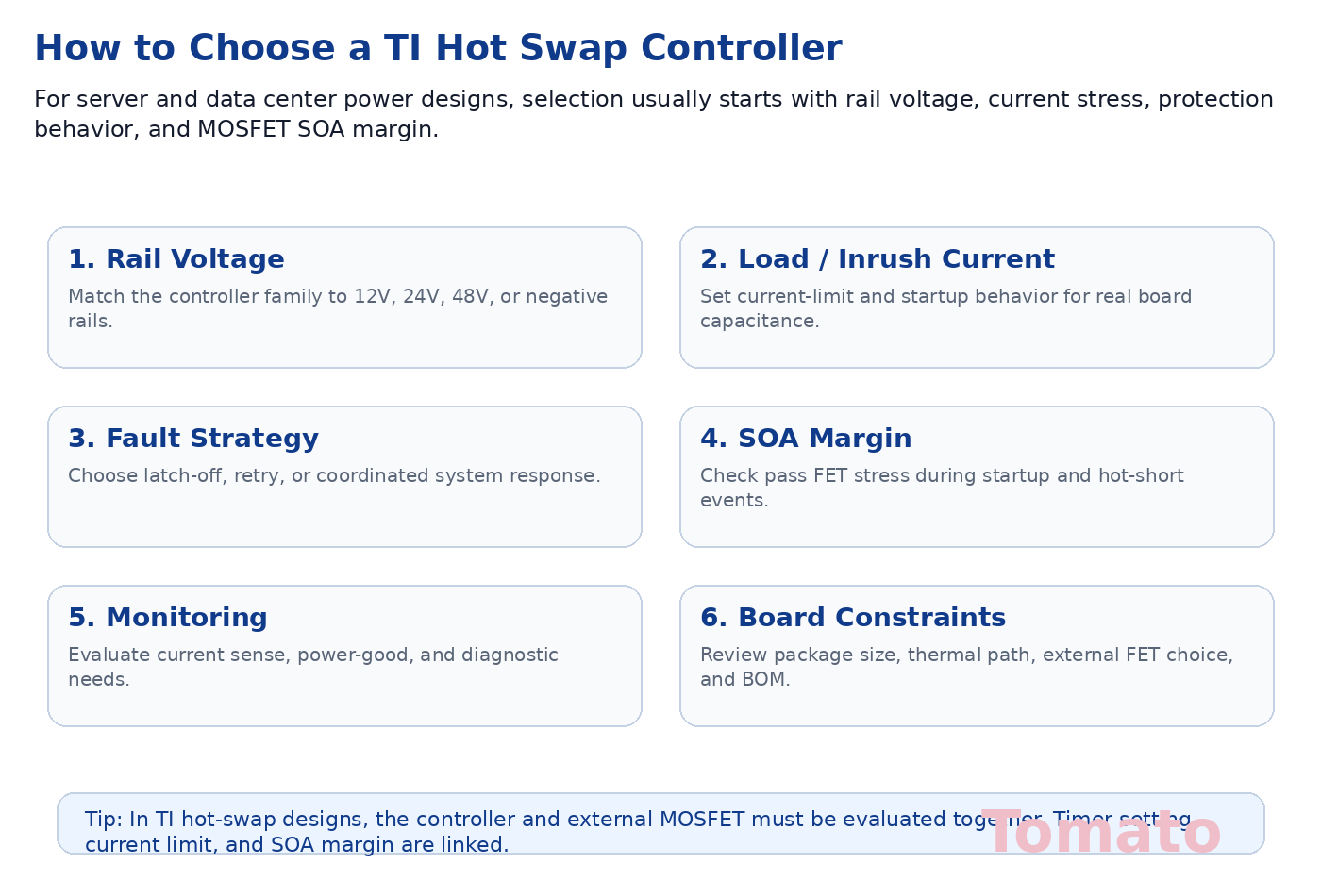
Choosing the right TI hot swap controller starts with the actual power rail and protection problem. Engineers should not select a device only by current rating or only by package.
The most important first-step questions are:
- What is the input voltage architecture of the board?
- How much startup current and steady-state current must the circuit handle?
- What MOSFET stress will occur during startup and hot-short conditions?
- Should the system latch off, retry automatically, or coordinate with higher-level supervision?
- Is current monitoring or board-level diagnostics required?
- What thermal and board-area limits apply?
TI's design guidance specifically points to current limit, power limit, fault timing, and MOSFET SOA margin as key checks in a robust hot-swap design.:contentReference[oaicite:2]{index=2}
3. Choosing for Different Power Architectures
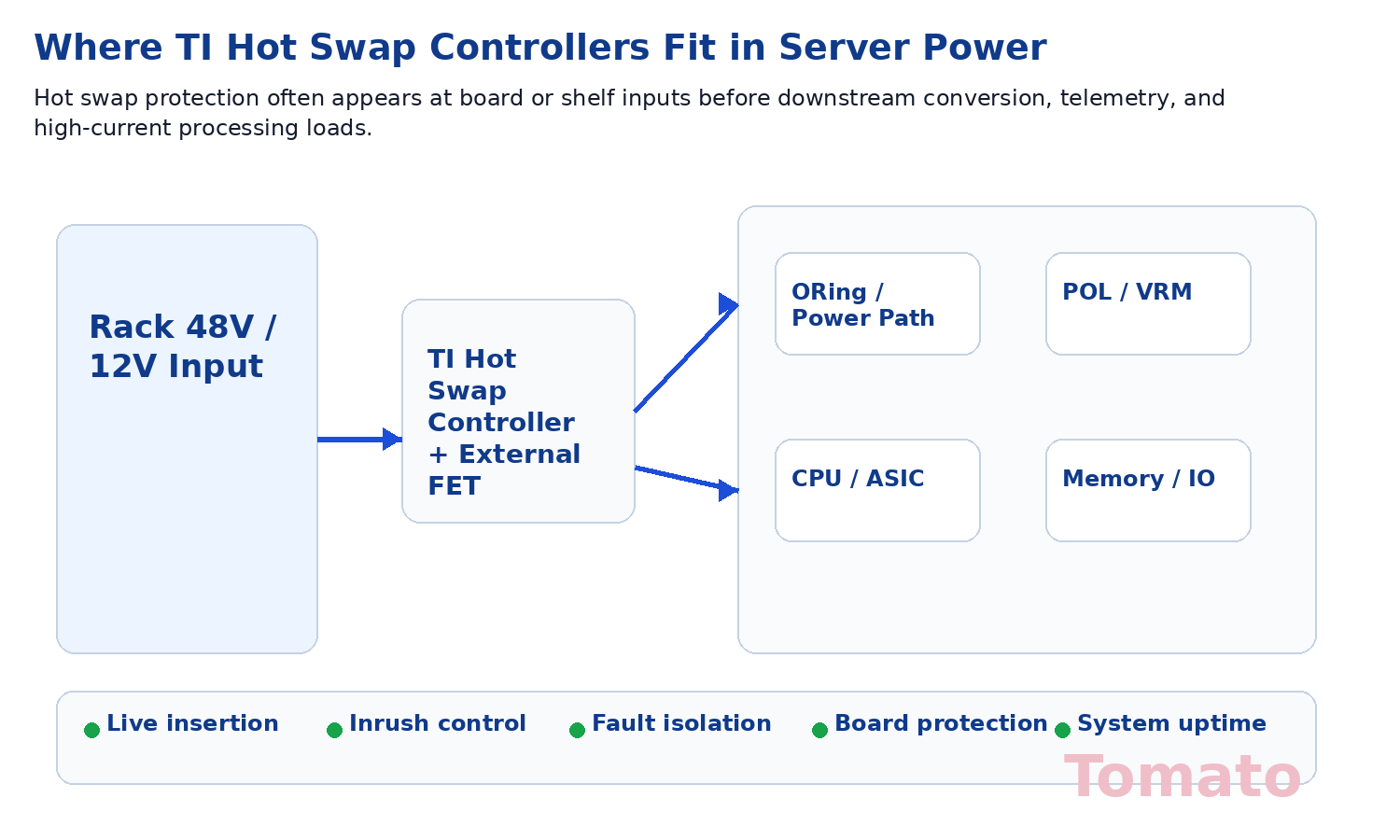
Server and data center boards do not all use the same input rail. Some designs work from intermediate buses, while others use higher-voltage distribution strategies such as 48V architectures. The correct TI hot swap controller should match the actual rail voltage, protection threshold strategy, and downstream power-tree structure.
In some applications, the hot swap stage mainly protects a board-level input before downstream DC-DC conversion. In others, it must also support system serviceability, ORing coordination, telemetry visibility, or tighter fault isolation requirements.
TI has continued expanding power-protection offerings for modern data center architectures, including solutions for denser compute systems and higher-voltage power paths.:contentReference[oaicite:3]{index=3}
4. MOSFET SOA, Fault Timer, and Protection Margin
One of the most important hot-swap design mistakes is focusing on the controller alone and not evaluating the external MOSFET correctly. In many TI hot-swap designs, the controller and pass MOSFET must be treated as one protection system.
During startup, overload, or hot-short events, the MOSFET may see high current and high voltage at the same time. That is why SOA margin, fault timer duration, power limit behavior, and ambient temperature all need to be checked together.
TI's design documentation specifically warns that hot-swap applications place heavy stress on the pass MOSFET and that ensuring safe operation under worst-case conditions is a major part of the design task. TI's design calculator guidance also highlights the need to check SOA margin using inputs such as maximum load current, ambient temperature, RDS(on), current limit, power limit, and the SOA curve.:contentReference[oaicite:4]{index=4}
5. Monitoring, Diagnostics, and System Coordination
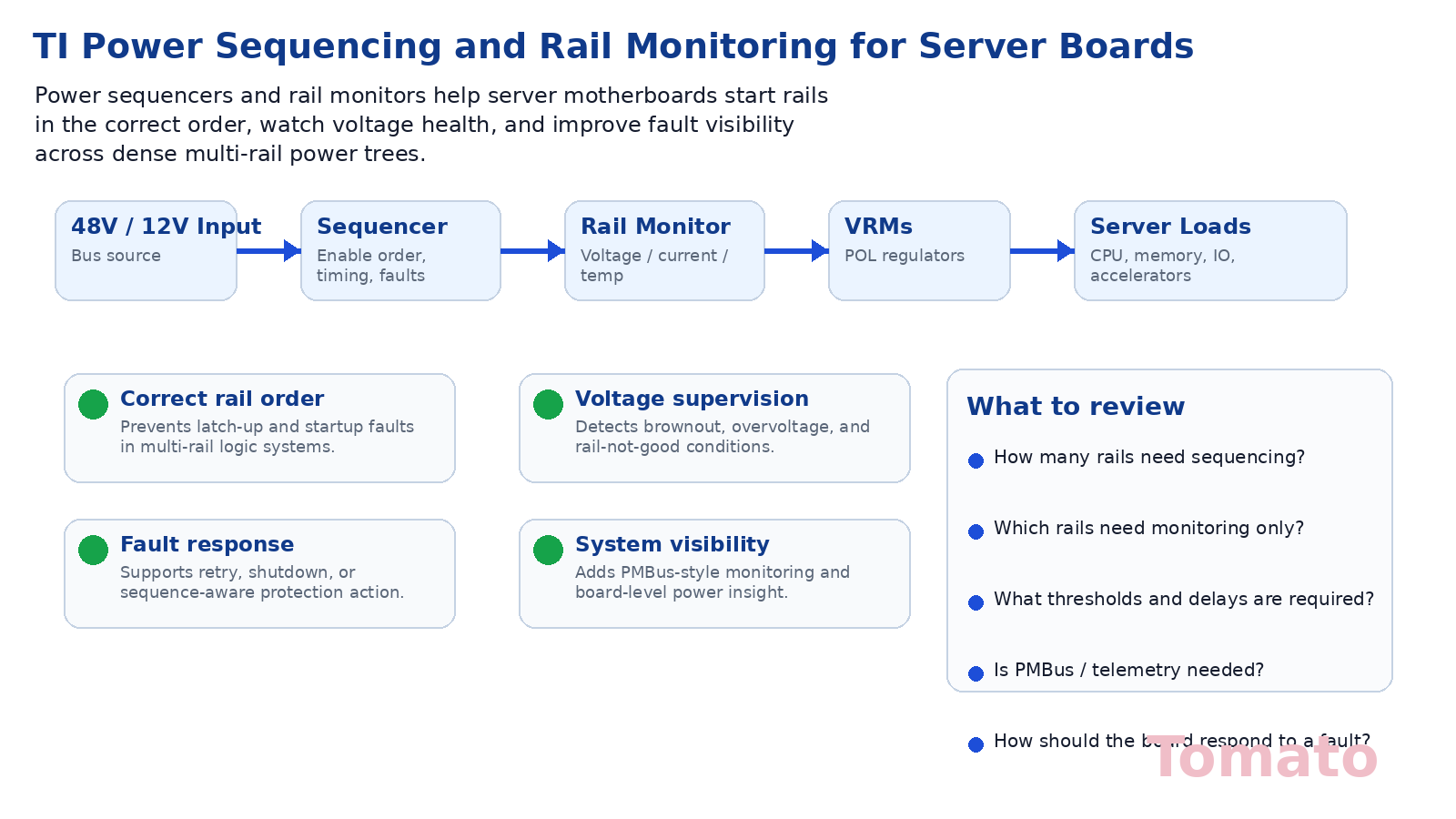
In higher-end server and data center boards, the hot swap function is not only about surviving faults. It may also need to support monitoring, power-good visibility, system coordination, and clearer fault diagnosis.
This means the right device selection may depend on whether the design needs current monitoring, threshold programmability, timing control, retry behavior, or interaction with ORing, eFuse, or supervisory functions elsewhere in the power tree.
TI's data center compute design resources explicitly position protection devices alongside monitoring and integrated protection features, which is important when board-level power design must support both resilience and serviceability.:contentReference[oaicite:5]{index=5}
6. Practical Design Checklist
Before locking a TI hot swap controller into a server or data center board design, check the following points:
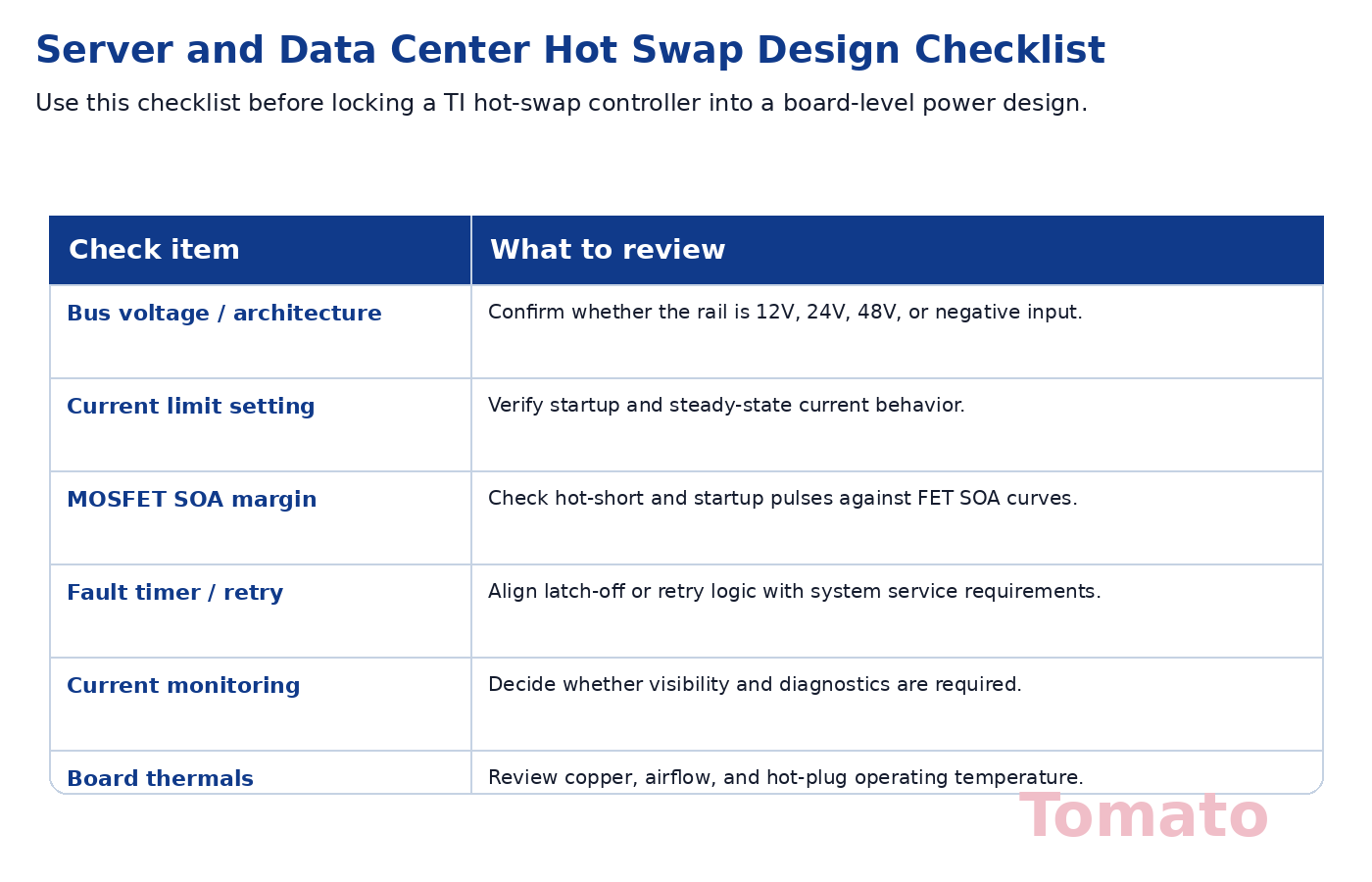
- Confirm the actual bus voltage and architecture.
- Verify startup current, inrush current, and steady-state current conditions.
- Check MOSFET SOA margin for startup and hot-short stress.
- Review fault timer, latch-off, and retry strategy.
- Confirm whether monitoring or diagnostics are required.
- Review thermal conditions, copper area, and airflow.
- Make sure the hot-swap stage fits the overall system protection strategy.
Conclusion
Choosing TI hot swap controllers for server and data center power designs requires more than selecting a part with the right current rating. The best choice comes from matching the controller to the input rail, the inrush and fault profile, the external MOSFET SOA margin, the thermal condition, and the board's monitoring and protection strategy.
For engineering and sourcing teams, a strong hot-swap design improves startup behavior, protects expensive boards, and supports more reliable system operation in demanding server and data center environments. If you are evaluating TI power-protection solutions, visit the TomatoElec homepage or contact us through the contact page.