
Available 24/7 at
0755-82798135

Schottky Diode vs Regular Diode: Key Differences and Applications
Diodes are among the most fundamental components in electronic circuits. They are widely used for rectification, current direction control, voltage clamping, protection, and switching. Although many diode types appear similar at first glance, their actual electrical behavior can vary significantly depending on structure and material.
Two of the most common categories are Schottky diodes and regular diodes. Engineers, buyers, and maintenance teams often need to choose between them when designing or sourcing components for power supplies, protection circuits, and general electronic applications.
In this guide, we explain the key differences between Schottky diodes and regular diodes, compare their electrical characteristics, and show where each type is most suitable. To explore more electronic components and sourcing solutions, visit TomatoElec.
What Is a Schottky Diode?
A Schottky diode is a semiconductor diode known for its low forward voltage drop and fast switching speed. Unlike a standard PN-junction diode, a Schottky diode uses a metal-semiconductor junction. This structure helps reduce conduction loss and supports faster response in high-frequency circuits.
Schottky diodes are widely used in switching power supplies, DC-DC converters, reverse polarity protection, and other applications where efficiency and speed are important.
What Is a Regular Diode?
A regular diode typically refers to a standard PN-junction diode used for general rectification or signal control. These diodes are widely available and used in many conventional electronic circuits.
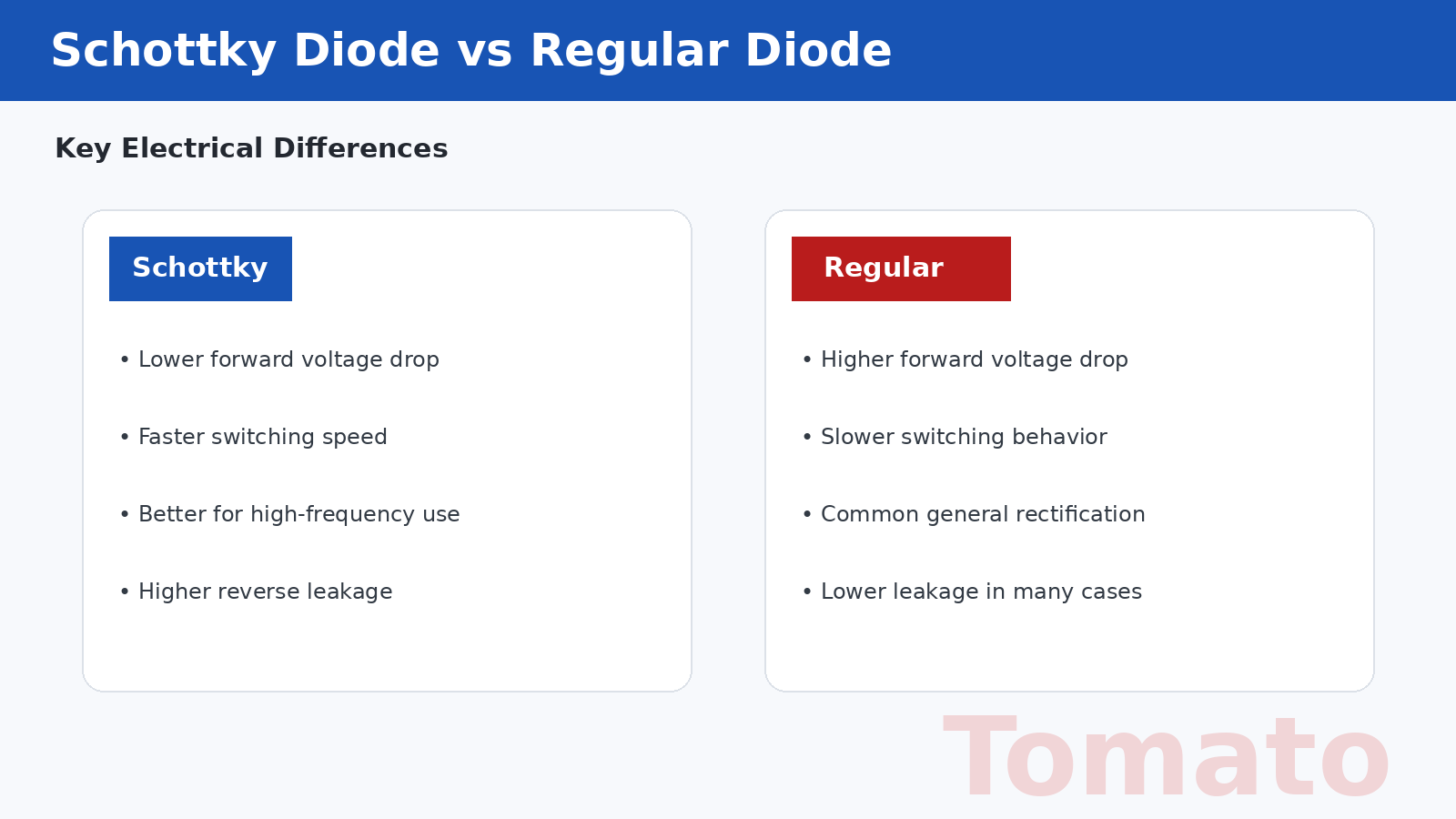
Compared with Schottky diodes, regular diodes usually have a higher forward voltage drop and slower switching behavior, but in many cases they provide lower reverse leakage and are suitable for standard rectification tasks.
Key Differences Between Schottky and Regular Diodes
1. Forward Voltage Drop
One of the most important differences is forward voltage drop. Schottky diodes usually have a lower forward voltage drop than regular diodes. This helps reduce conduction loss and improve efficiency, especially in low-voltage power circuits.
Regular diodes typically show a higher forward voltage drop, which may lead to more heat generation in some applications.
2. Switching Speed
Schottky diodes are well known for fast switching performance. This makes them suitable for high-frequency applications such as switching regulators and SMPS designs.
Regular diodes are often slower and may not be the best choice in circuits where fast recovery or high switching speed is required.
3. Reverse Leakage Current
Schottky diodes generally have higher reverse leakage current than regular diodes. This characteristic should be considered carefully, especially in temperature-sensitive or low-leakage designs.
4. Thermal and Efficiency Performance
Because of lower forward voltage drop, Schottky diodes can improve efficiency and reduce power loss in many power circuits. However, leakage current and temperature effects must still be reviewed as part of overall thermal design.
5. Cost and Application Fit
Regular diodes are often widely used in standard circuits because they are common and suitable for many basic rectification functions. Schottky diodes are usually selected when lower voltage drop and faster response justify the choice.
Typical Applications
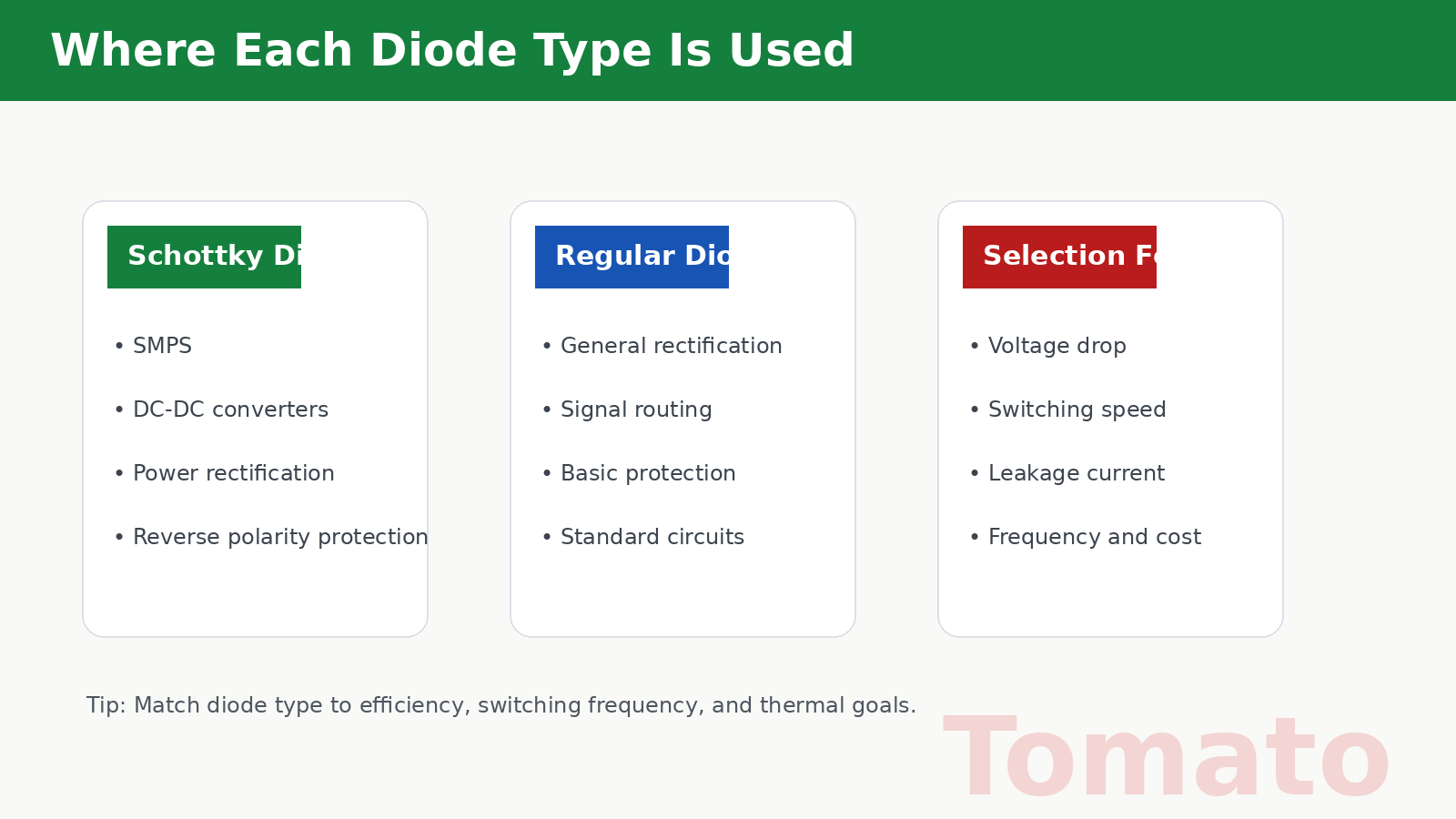
Schottky Diodes
Schottky diodes are commonly used in:
- Switching power supplies
- DC-DC converters
- Output rectification circuits
- Reverse polarity protection
- Low-voltage high-efficiency designs
Regular Diodes
Regular diodes are often used in:
- General rectification circuits
- Basic signal routing
- Standard power input protection
- Conventional electronic control boards
How to Choose the Right Diode
Check Forward Voltage Requirements
If low conduction loss is important, a Schottky diode may be the better option.
Review Switching Frequency
For high-frequency circuits, Schottky diodes are often preferred because of their faster switching characteristics.
Evaluate Leakage Current
If reverse leakage is a critical issue, regular diodes may be more suitable in some designs.
Consider Thermal Conditions
Temperature behavior matters, especially in compact power circuits or high-current applications.
Match the Diode to the Real Application
The best choice depends on circuit voltage, current, frequency, thermal design, and efficiency target. Designers should evaluate the full operating condition instead of selecting only by part category.
Common Selection Mistakes
Choosing by Current Only
Current rating alone is not enough. Voltage drop, switching speed, leakage current, and temperature behavior all matter.
Ignoring Forward Voltage Drop
In power applications, forward voltage drop has a direct impact on efficiency and heating.
Overlooking Reverse Leakage
Schottky diodes may offer better speed and lower voltage drop, but reverse leakage should not be ignored.
Using the Wrong Diode in High-Frequency Circuits
A standard diode may not perform well in switching applications that need faster response.
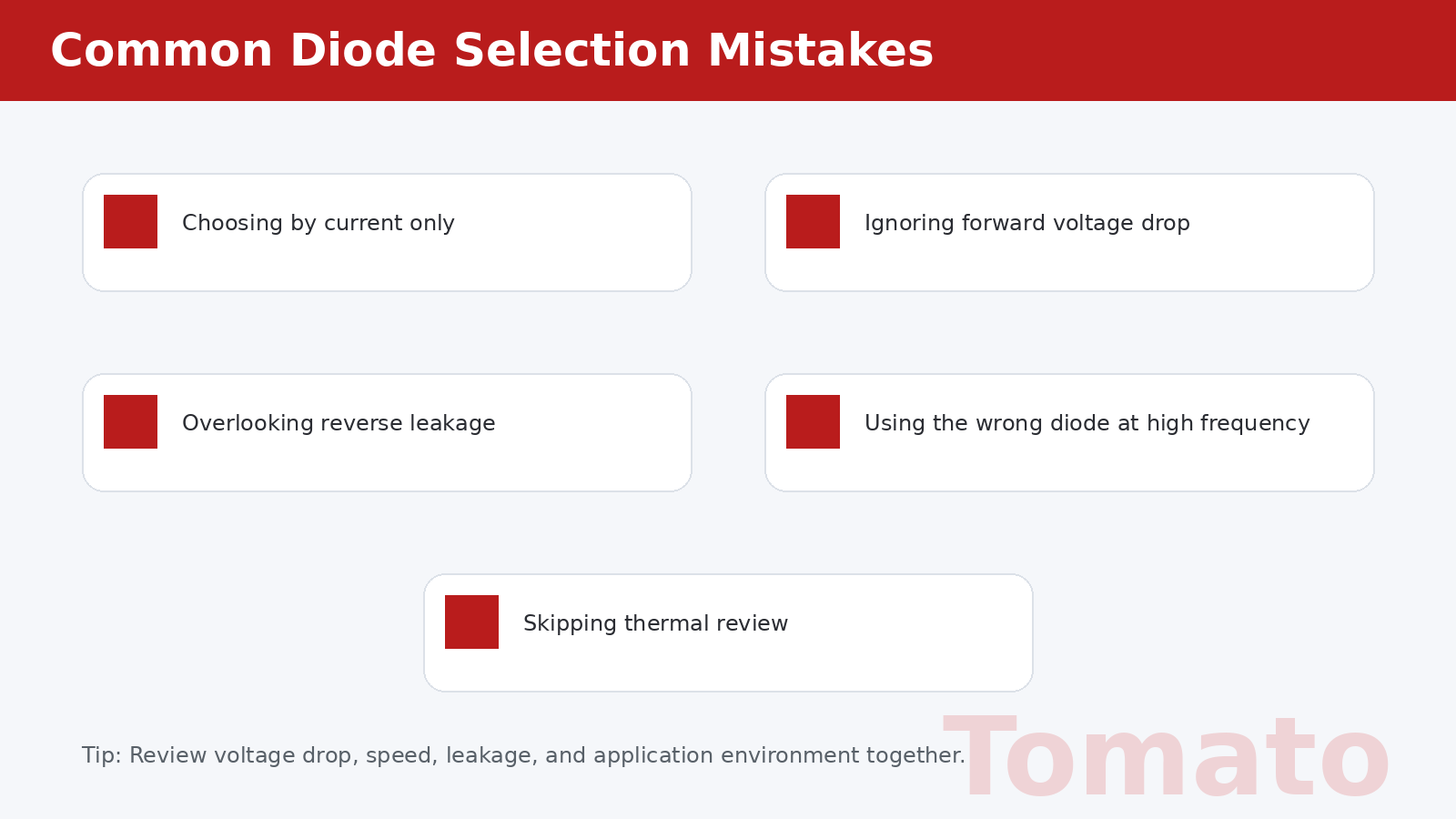
Skipping Thermal Review
Thermal behavior should always be checked, especially when current and efficiency requirements are tight.
Conclusion
Schottky diodes and regular diodes each have important roles in electronic circuits. Schottky diodes are often preferred for low forward voltage drop and fast switching, while regular diodes remain useful in many standard rectification and protection tasks.
By understanding the differences in voltage drop, speed, leakage current, and application fit, engineers and sourcing teams can choose the right diode more effectively. If you are looking for diodes and other electronic components for your next project, visit TomatoElec to explore more diode products or reach out through the contact page.