
Available 24/7 at
0755-82798135

Murata and Samsung MLCC Supply Trends
As demand for high-performance electronics continues to grow, MLCCs from leading brands such as Murata and Samsung Electro-Mechanics are receiving renewed attention from buyers, engineers, and supply chain teams. For many projects, MLCC sourcing is no longer only about price, but also about lead time, availability, package compatibility, and approved alternatives.
Murata and Samsung MLCCs are widely used in consumer electronics, industrial equipment, automotive systems, telecom hardware, AI servers, data center power designs, and compact PCB assemblies. When demand increases in several markets at the same time, certain capacitance, voltage, size, and reliability combinations can become harder to source.
This article explains Murata and Samsung MLCC supply trends, what buyers should watch during tight availability, and how to evaluate lead time, stock visibility, and alternative options before production is affected. For MLCC sourcing support, visit TomatoElec.
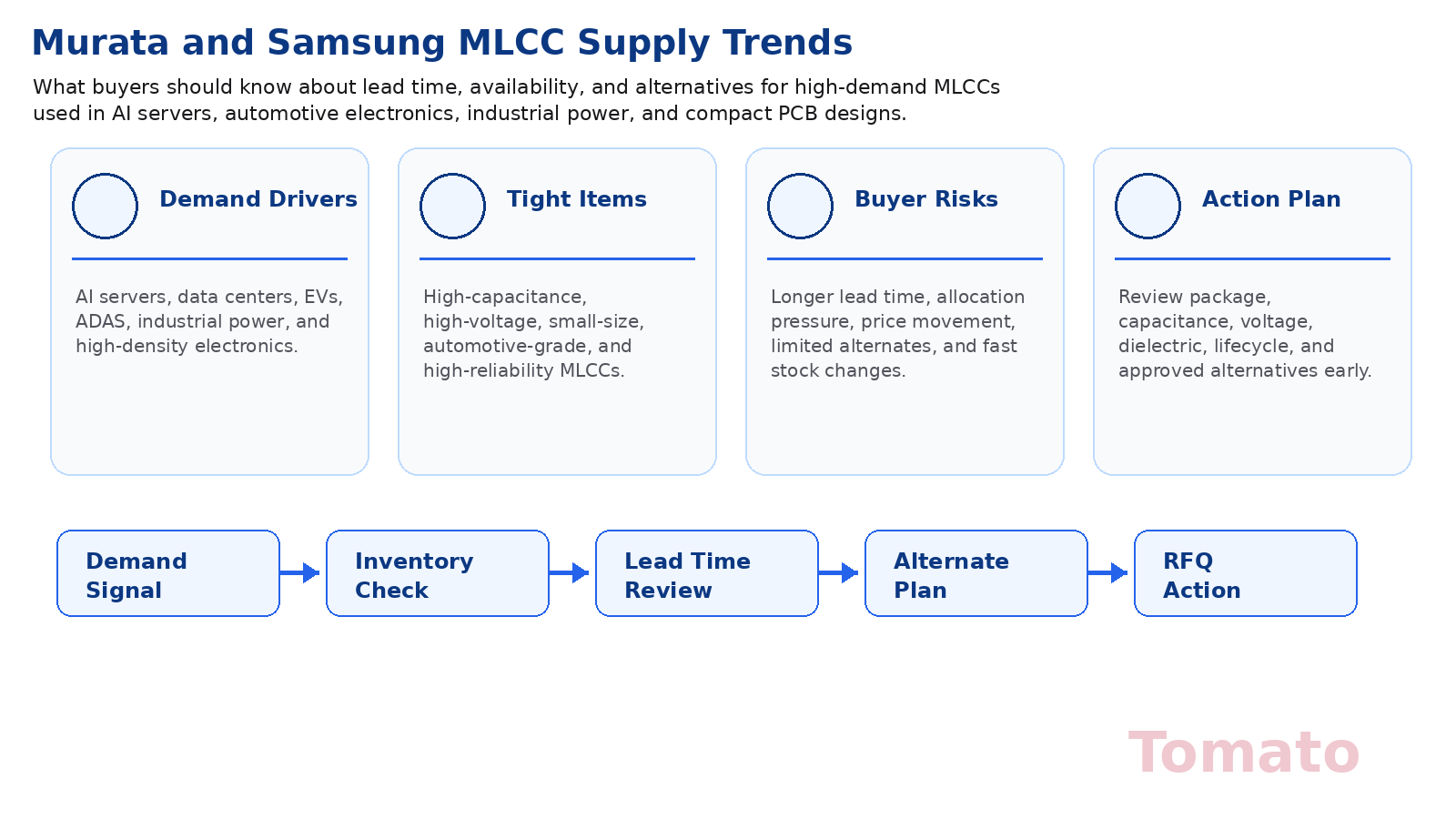
1. Why Murata and Samsung MLCC Supply Trends Matter
MLCCs are small components, but they are used in very large quantities across modern electronic designs. They support decoupling, filtering, voltage stabilization, noise suppression, and power integrity in many types of circuits.
Because Murata and Samsung are two of the most important MLCC manufacturers, changes in their product focus, capacity allocation, and high-reliability MLCC demand can influence the wider market. When demand rises for high-end applications, buyers may see longer lead times or tighter availability on selected values.
For procurement teams, this means MLCC sourcing should be reviewed before the shortage becomes urgent. A part that looks common in the BOM may still become difficult if it combines a popular case size, high capacitance, high voltage rating, automotive grade, or special dielectric requirement.
2. What Is Driving MLCC Demand
Several demand drivers are affecting MLCC supply at the same time. AI servers and data center equipment require strong power integrity around processors, accelerator boards, memory, networking devices, and power modules. These systems can use large numbers of capacitors for decoupling and filtering.
Automotive electronics are another major driver. EVs, ADAS, powertrain control, battery systems, 48 V subsystems, and safety-related ECUs all require reliable capacitors that can operate under demanding temperature, vibration, and lifetime conditions.
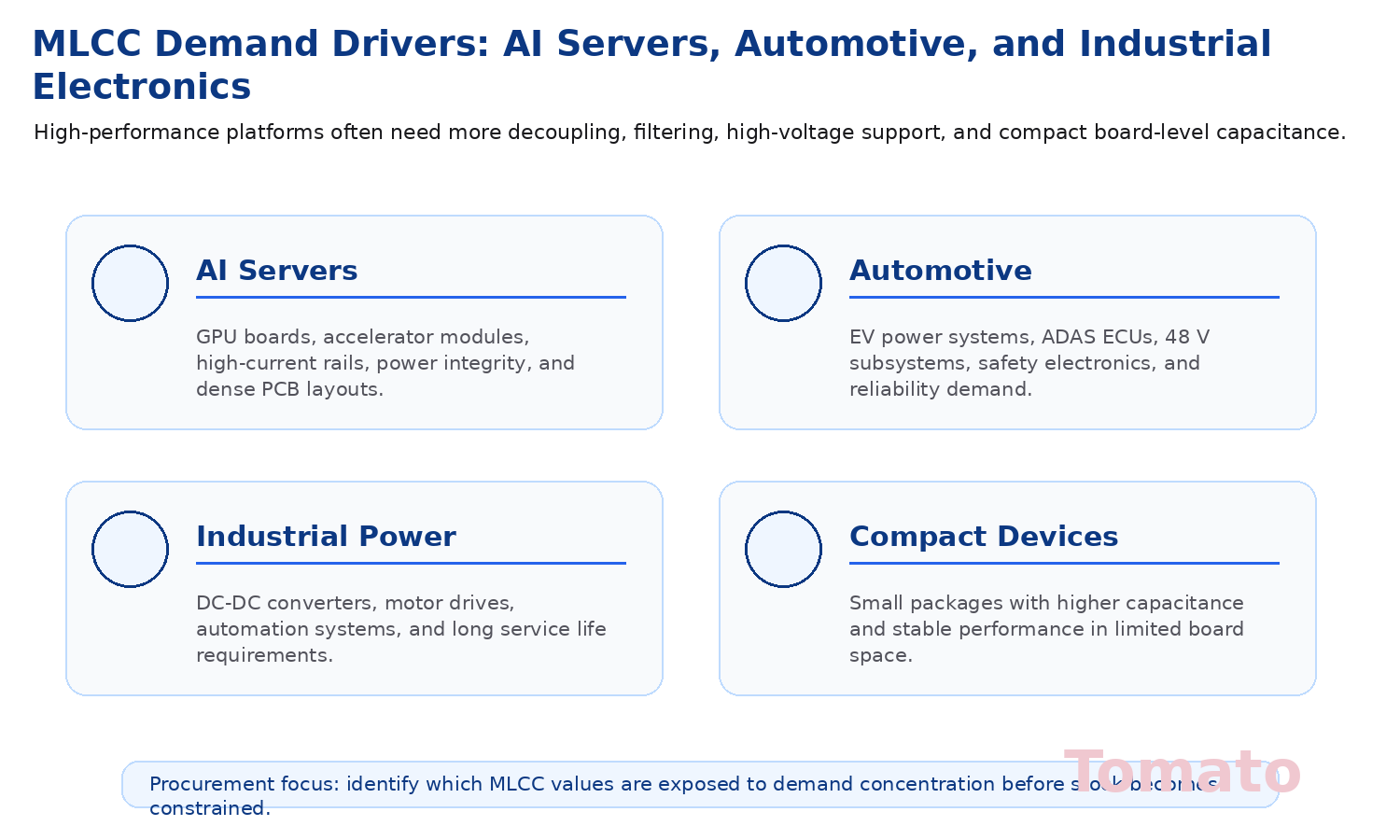
Industrial electronics also contribute to stable long-term demand. Power supplies, motor drives, automation controllers, communication equipment, and energy infrastructure often need MLCCs with reliable electrical performance and long product availability.
As a result, buyers should pay special attention to MLCCs used in high-density power designs, high-capacitance decoupling, compact automotive modules, and long-life industrial equipment.
3. Which MLCC Types May Face Tighter Availability
Not every MLCC will face the same level of supply pressure. In many cases, tighter availability is more likely to appear in values that are connected to high-growth applications or difficult manufacturing requirements.
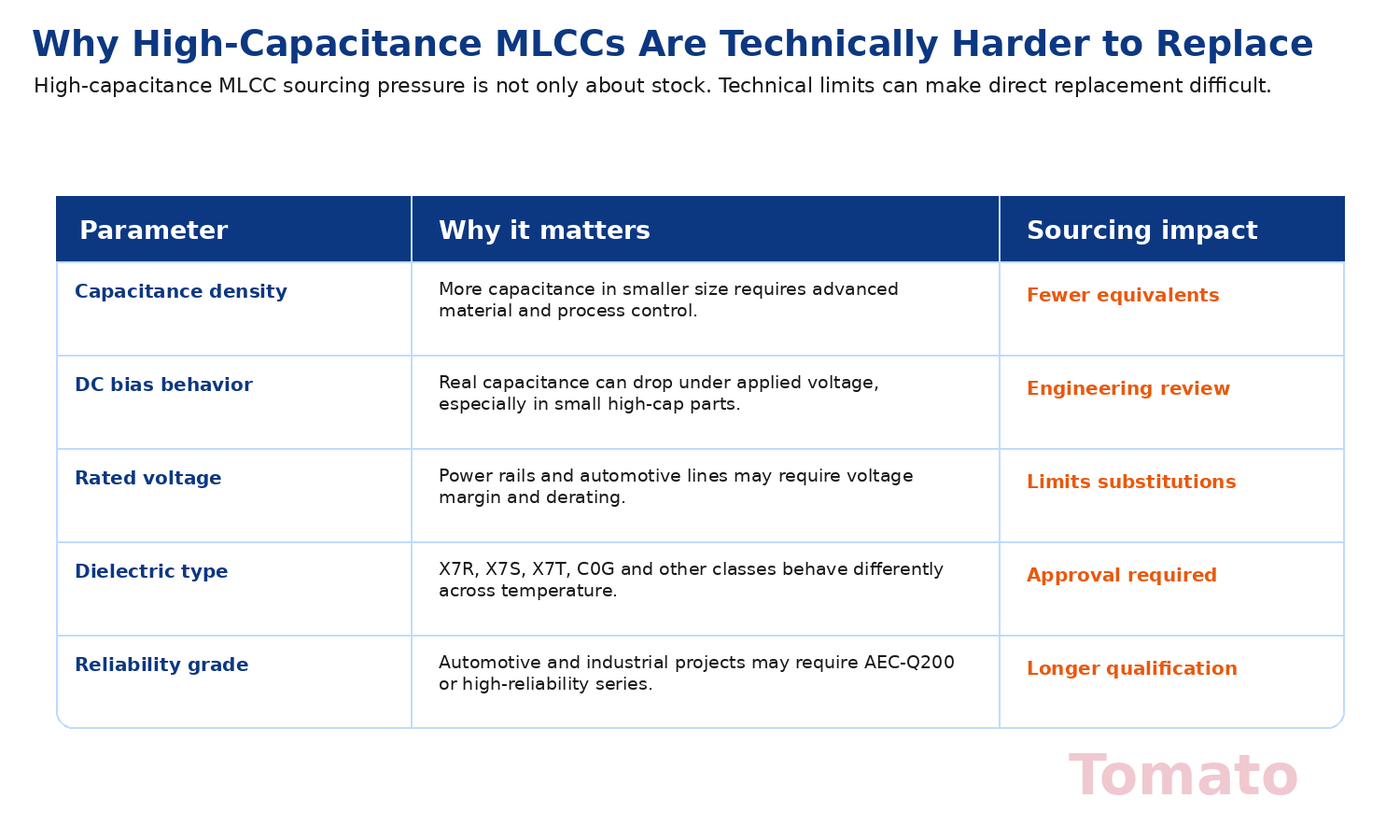
Buyers should watch high-capacitance MLCCs, high-voltage MLCCs, compact case sizes with high capacitance, automotive-grade MLCCs, soft-termination MLCCs, and parts used in AI server or power supply designs. These combinations often have fewer direct alternatives and may be more sensitive to demand changes.
Common review points include:
- High-capacitance MLCCs in compact sizes
- High-voltage MLCCs for power and automotive applications
- Automotive-grade or high-reliability series
- X7R, X7S, X7T, C0G, and other dielectric requirements
- Special termination, thickness, or package restrictions
- MLCCs used in AI servers, EVs, ADAS, and industrial power designs
If a BOM depends on one exact Murata or Samsung part number without an approved second source, the supply risk may be higher during periods of tight availability.
4. How Buyers Should Evaluate Lead Time and Availability
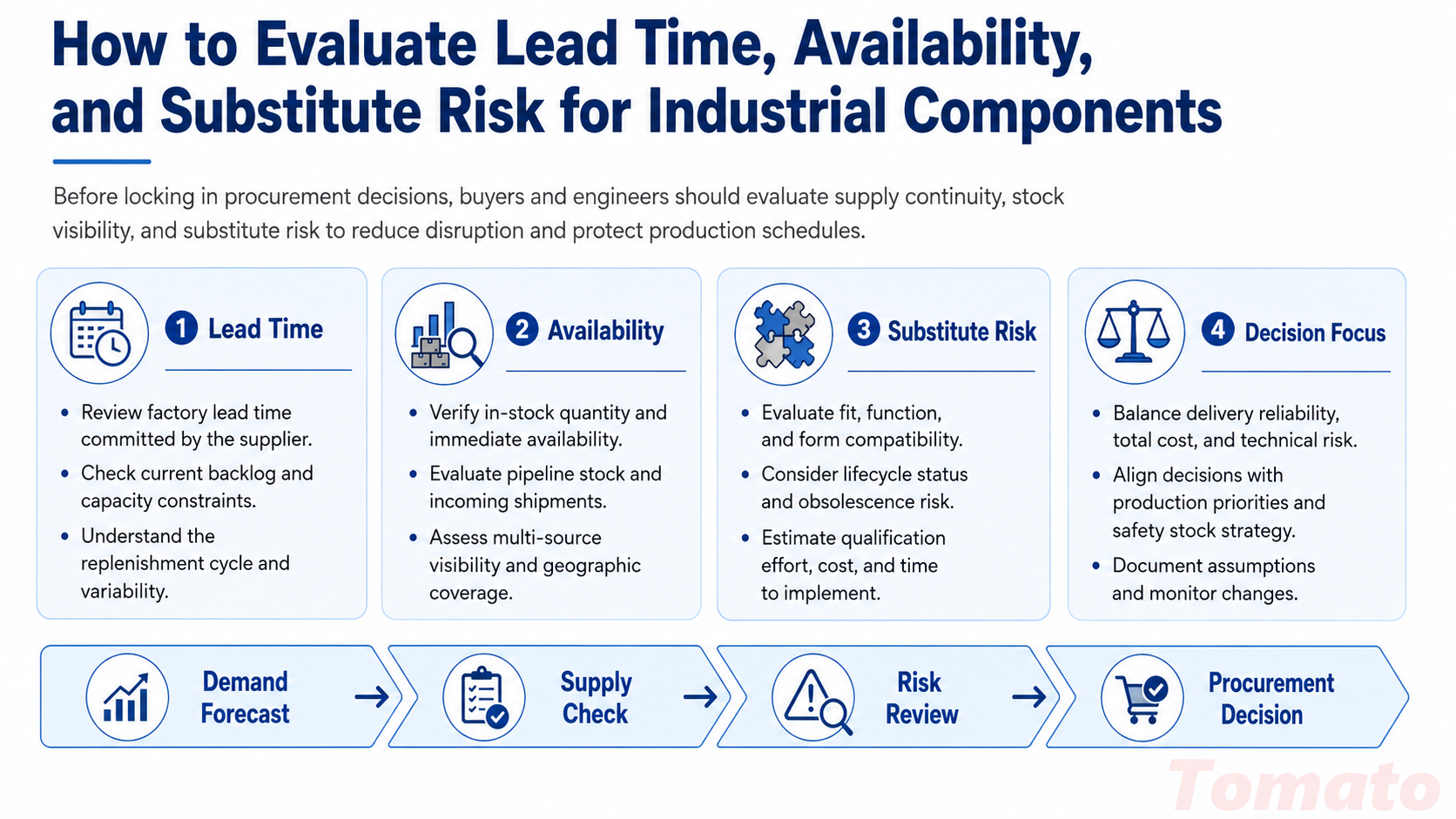
When reviewing Murata and Samsung MLCC supply, buyers should not rely only on a simple in-stock label. Availability should be evaluated together with sellable quantity, incoming supply, delivery schedule, regional stock, and whether the stock is reserved or immediately available.
Lead time should also be reviewed carefully. A quoted lead time may change if there is allocation pressure, backlog growth, or demand concentration in AI server, automotive, or industrial applications. The practical lead time may also include supplier handling time, logistics, customs, and inbound receiving.
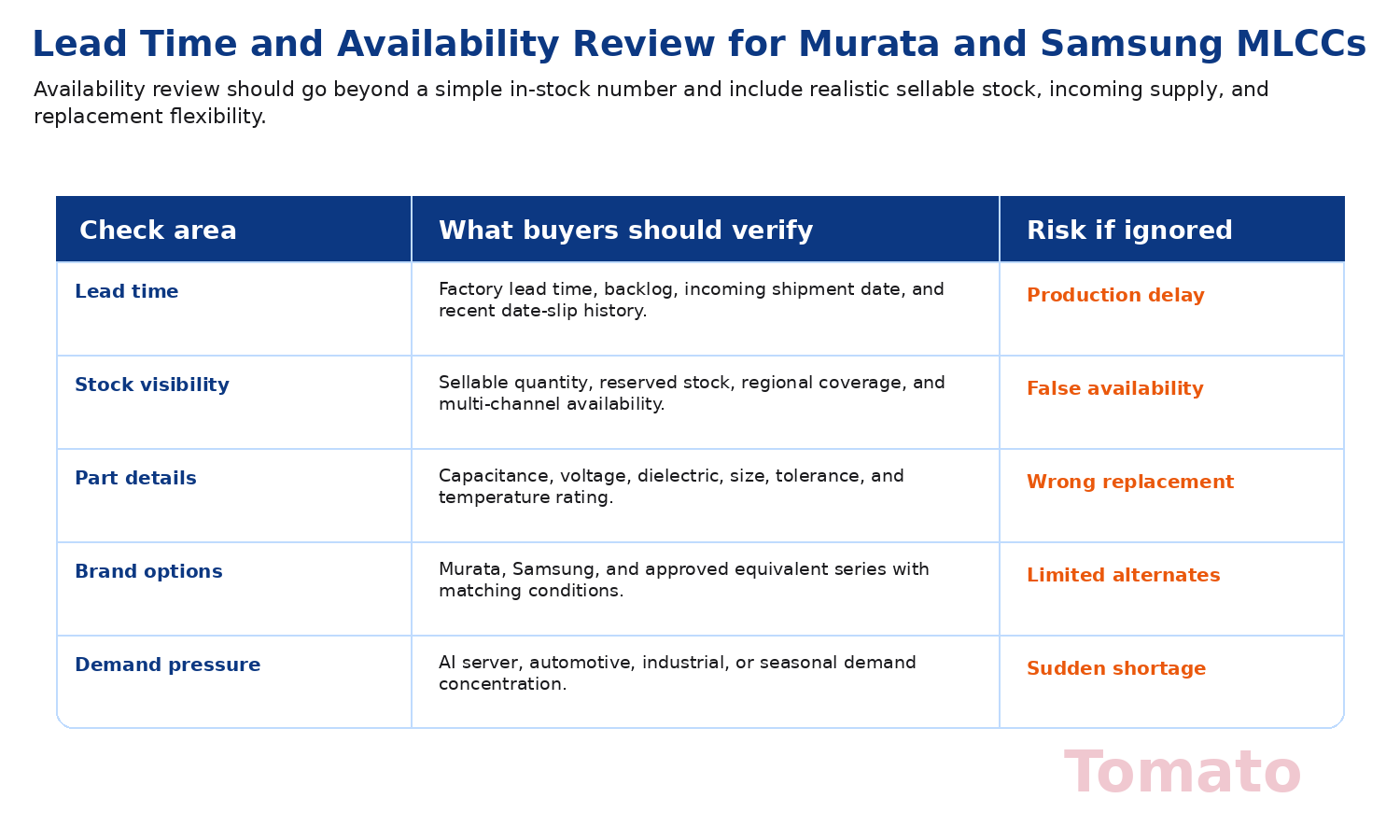
A stronger supply review should include:
- Current sellable stock quantity
- Factory lead time and recent delivery stability
- Incoming pipeline stock and estimated arrival date
- Minimum order quantity and packaging format
- Whether the part is widely available or limited to one channel
- Recent demand pressure from key application markets
This review helps buyers distinguish between real availability and temporary visible stock that may disappear quickly when multiple customers are chasing the same MLCC values.
5. How to Plan MLCC Alternatives
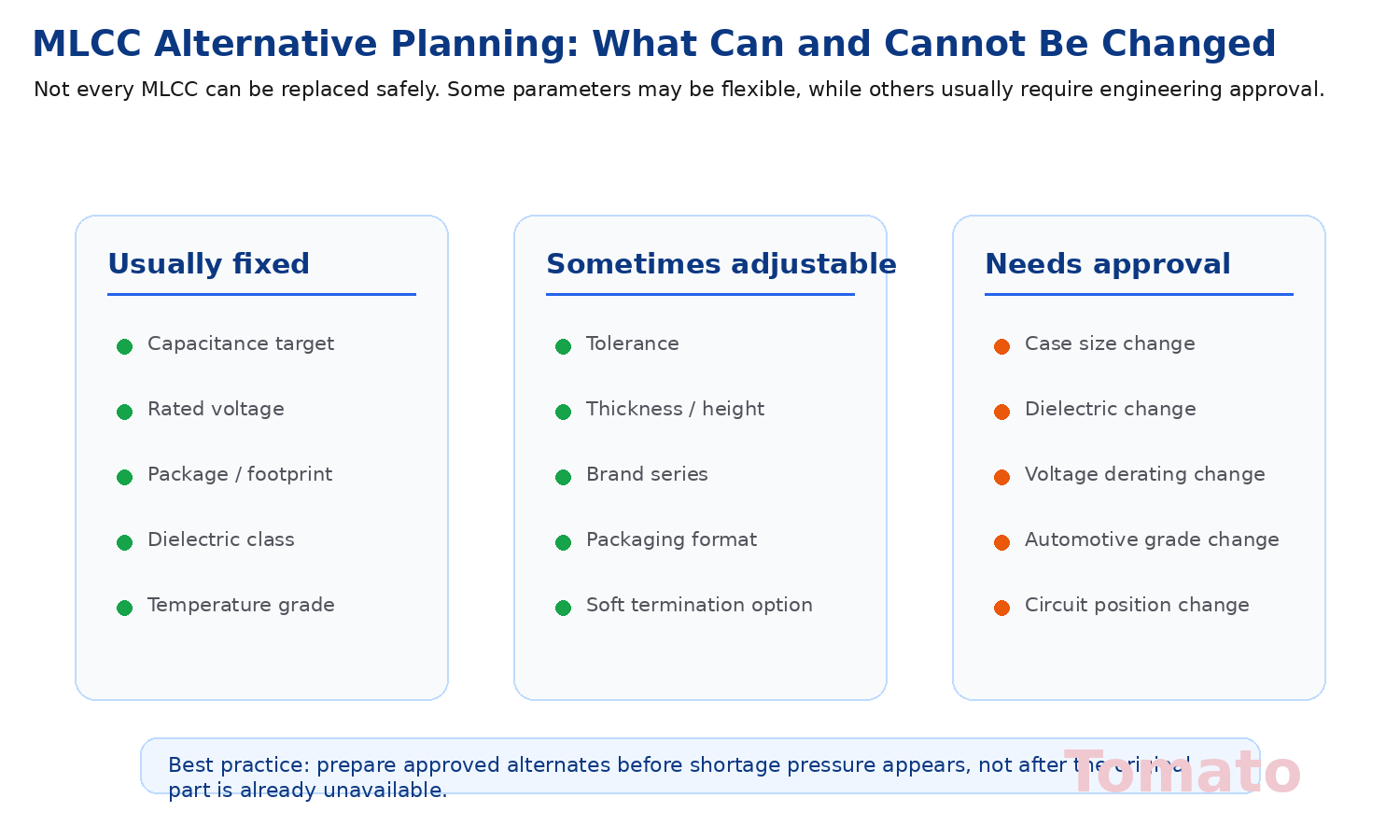
Alternative planning is important, but MLCC replacement should not be treated as a simple brand swap. Even if two capacitors have the same capacitance and voltage rating, they may differ in dielectric behavior, DC bias performance, temperature characteristic, size, thickness, termination, and reliability grade.
When comparing Murata, Samsung, or other equivalent MLCC options, buyers and engineers should first identify which parameters are fixed and which parameters may be adjustable. Package size, voltage rating, dielectric type, capacitance, and temperature grade usually need careful engineering review.
In some cases, a Samsung MLCC may be considered as an alternative to a Murata MLCC, or a Murata MLCC may be considered as an alternative to a Samsung part. However, the final decision should be based on the actual circuit position, application requirement, derating margin, and approval process.
For production BOMs, it is better to prepare approved alternatives before shortage pressure becomes serious. Waiting until the original part is unavailable can create production delays and force rushed qualification decisions.
6. Practical MLCC Buyer Checklist
Before purchasing Murata, Samsung, or equivalent MLCCs during tight supply conditions, review the following checklist:
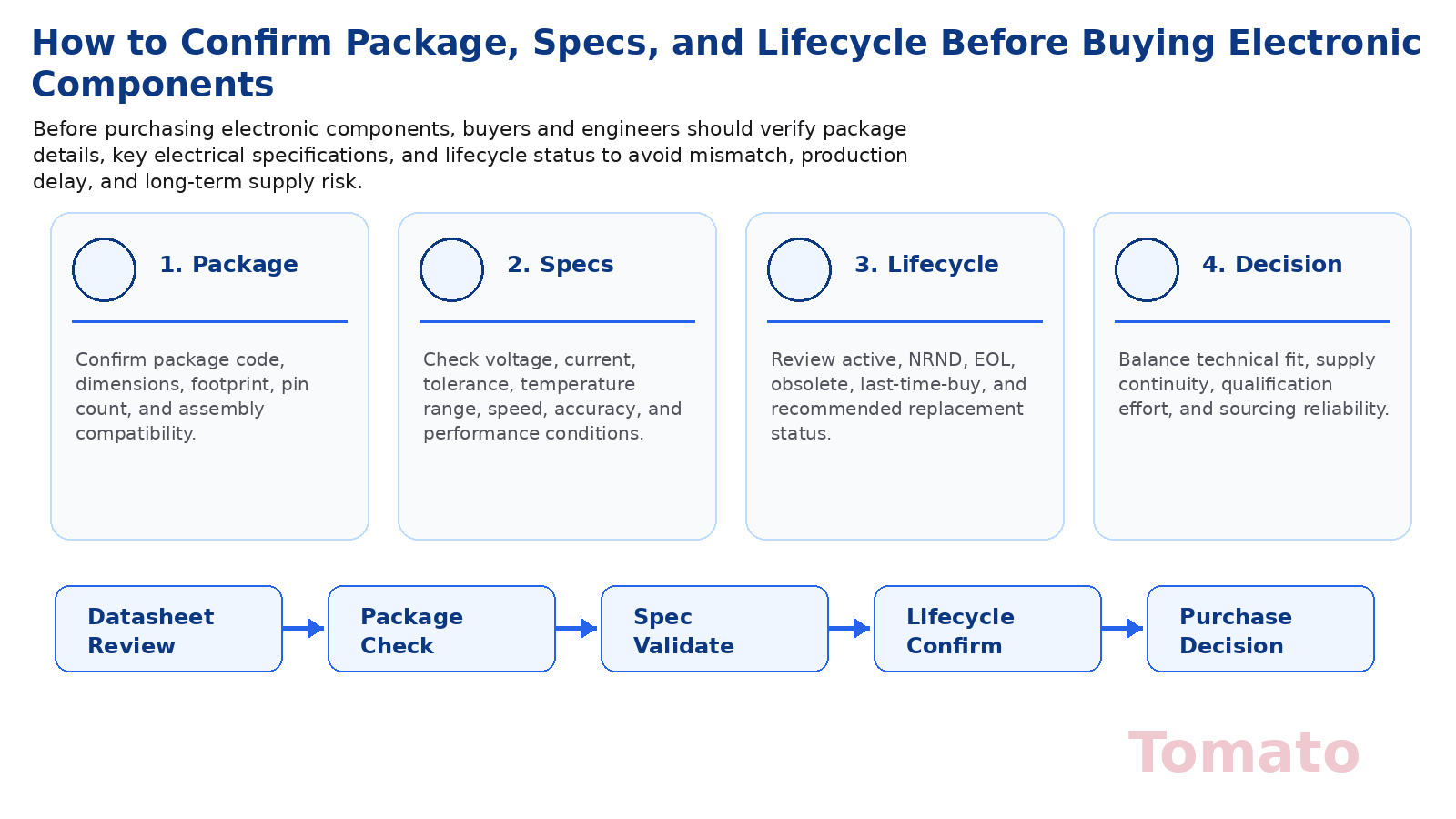
- Confirm the full manufacturer part number and package suffix.
- Check capacitance, voltage rating, dielectric, tolerance, and temperature characteristic.
- Review case size, thickness, footprint, and packing format.
- Verify whether the part is used in AI server, automotive, industrial, or power applications.
- Check current stock, incoming supply, lead time, and delivery stability.
- Compare approved Murata, Samsung, and other alternative options carefully.
- Evaluate substitute risk based on fit, form, function, derating, and qualification effort.
- Document assumptions and monitor lead time changes before placing repeat orders.
7. Conclusion
Murata and Samsung MLCC supply trends are important for buyers because MLCC demand is being supported by AI servers, automotive electronics, industrial power systems, and compact high-performance devices. While not every MLCC will become difficult to source, selected high-capacitance, high-voltage, automotive-grade, and small-size parts may require earlier planning.
Buyers should evaluate lead time, stock visibility, and approved alternatives before a shortage affects production. A careful review of package, capacitance, voltage, dielectric, lifecycle, and substitute risk can help reduce sourcing uncertainty and improve BOM continuity.
If you are reviewing Murata, Samsung, or equivalent MLCC sourcing options, visit the TomatoElec homepage or contact us through the contact page.