
Available 24/7 at
0755-82798135

How to Evaluate Lead Time, Availability, and Substitute Risk for Industrial Components
Before locking in sourcing decisions for industrial electronic components, buyers and engineers should look beyond price alone. In many industrial projects, supply continuity, delivery reliability, and technical replacement risk can have a much bigger impact on production than a small difference in unit cost.
When a component is hard to source, the problem is usually not limited to one factor. A part may appear available today, but still carry long replenishment cycles, uncertain incoming supply, or limited substitute options. That is why lead time, availability, and substitute risk should be evaluated together instead of separately.
This guide explains how to evaluate lead time, availability, and substitute risk for industrial components, and how to use that information to make more reliable procurement decisions. For more component sourcing support, visit TomatoElec.
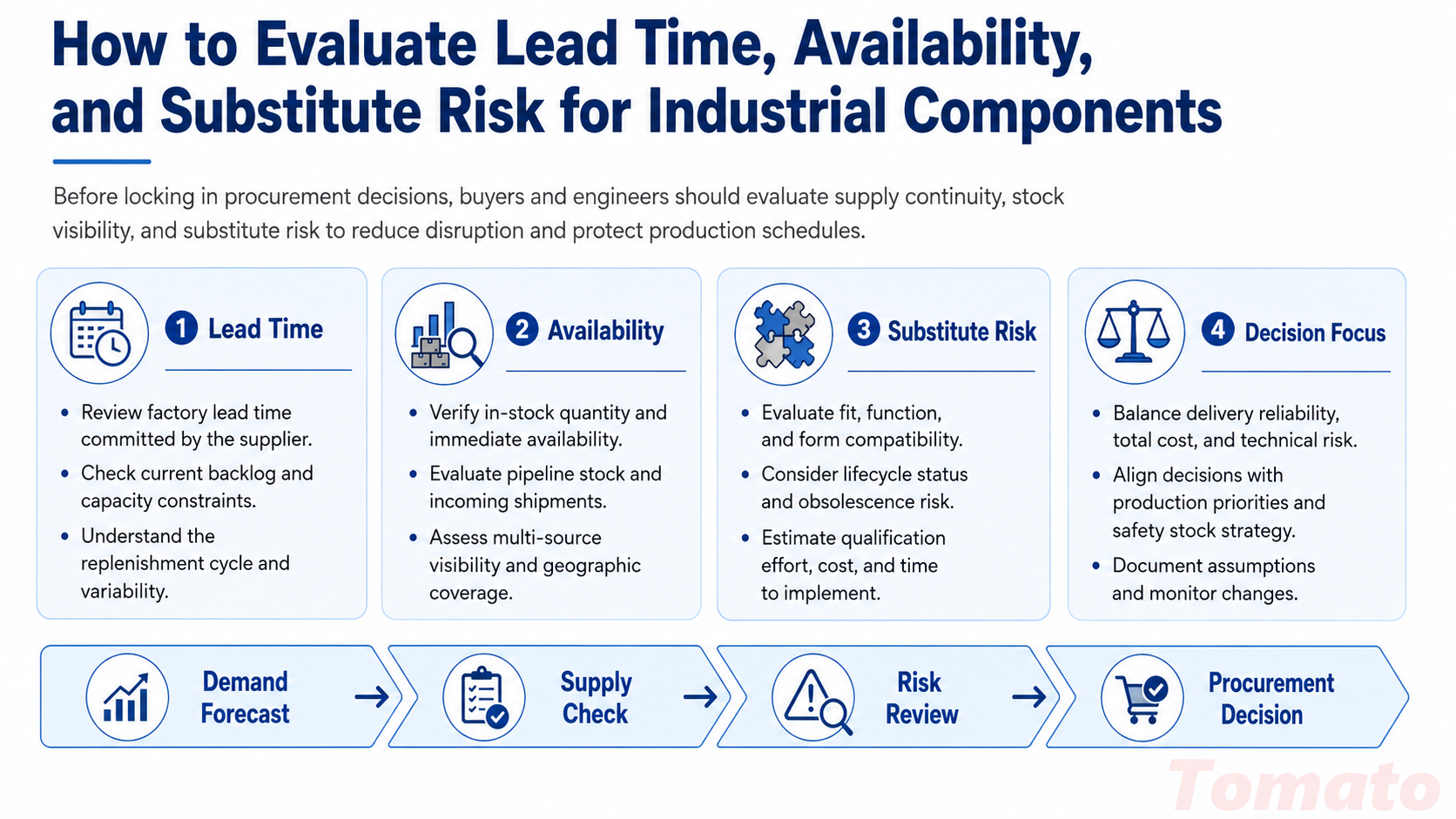
1. Why Lead Time, Availability, and Substitute Risk Matter
In industrial supply chains, a sourcing decision is only safe when the part can be delivered on time, supplied with reasonable continuity, and replaced with acceptable risk if conditions change. Looking at only one of these factors can create hidden problems later.
For example, a component may have stock in one channel today, but if factory lead time is long and there is no approved substitute, the project still carries meaningful supply risk. In the same way, a low-cost substitute may seem attractive, but if qualification time is high or compatibility is uncertain, the real procurement risk may increase rather than decrease.
This is why industrial procurement teams often combine supply review, engineering judgment, and risk planning before they finalize a sourcing strategy.
2. How to Evaluate Lead Time
Lead time should not be treated as a single quoted number. A more useful review starts by separating standard factory lead time, current backlog pressure, and practical replenishment timing including transit, customs, and inbound receiving delay.
Buyers should confirm whether the quoted lead time reflects normal production conditions or a constrained period. Engineers and procurement teams should also ask whether there are bottlenecks related to wafer allocation, packaging, assembly scheduling, or minimum production batch size.
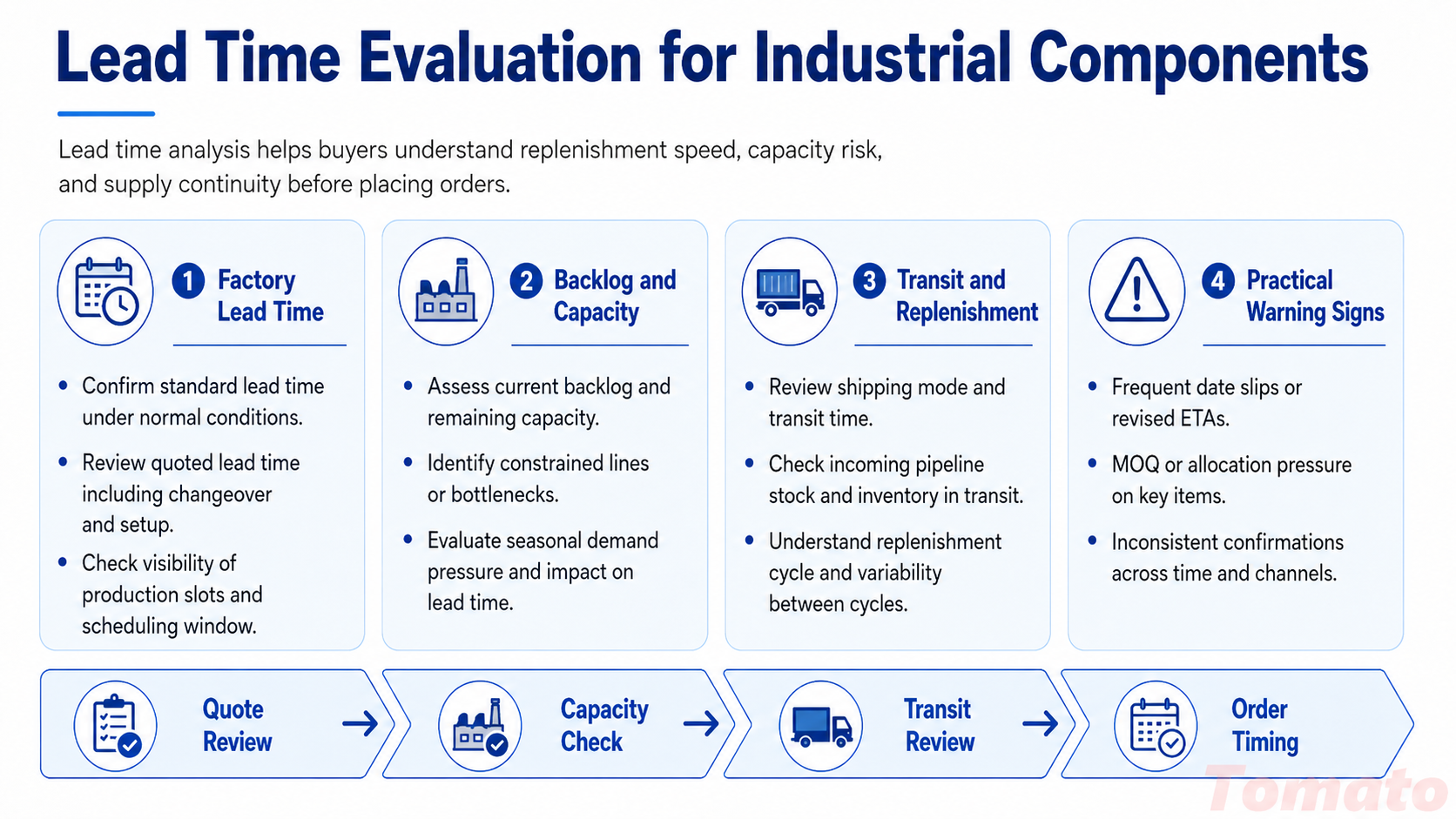
Another important point is lead time variability. A quoted eight-week lead time is very different from an eight-week lead time that frequently slips to twelve or fourteen weeks. In industrial production, variability often matters as much as the nominal number itself.
A better lead time assessment usually includes:
- Quoted factory lead time
- Current backlog and capacity situation
- Transit and inbound receiving time
- Historical date changes or revised ETA patterns
- Seasonal or project-based demand pressure
3. How to Evaluate Availability and Stock Visibility
Availability should also be reviewed more carefully than a simple in-stock label. Visible stock may include allocated inventory, customer-reserved quantities, or stock that cannot be shipped immediately to the required region.
A more reliable evaluation checks current sellable stock, incoming pipeline supply, open purchase orders, and the breadth of distributor or channel coverage. If the part is only available from one source or one location, the practical supply position may still be weak.
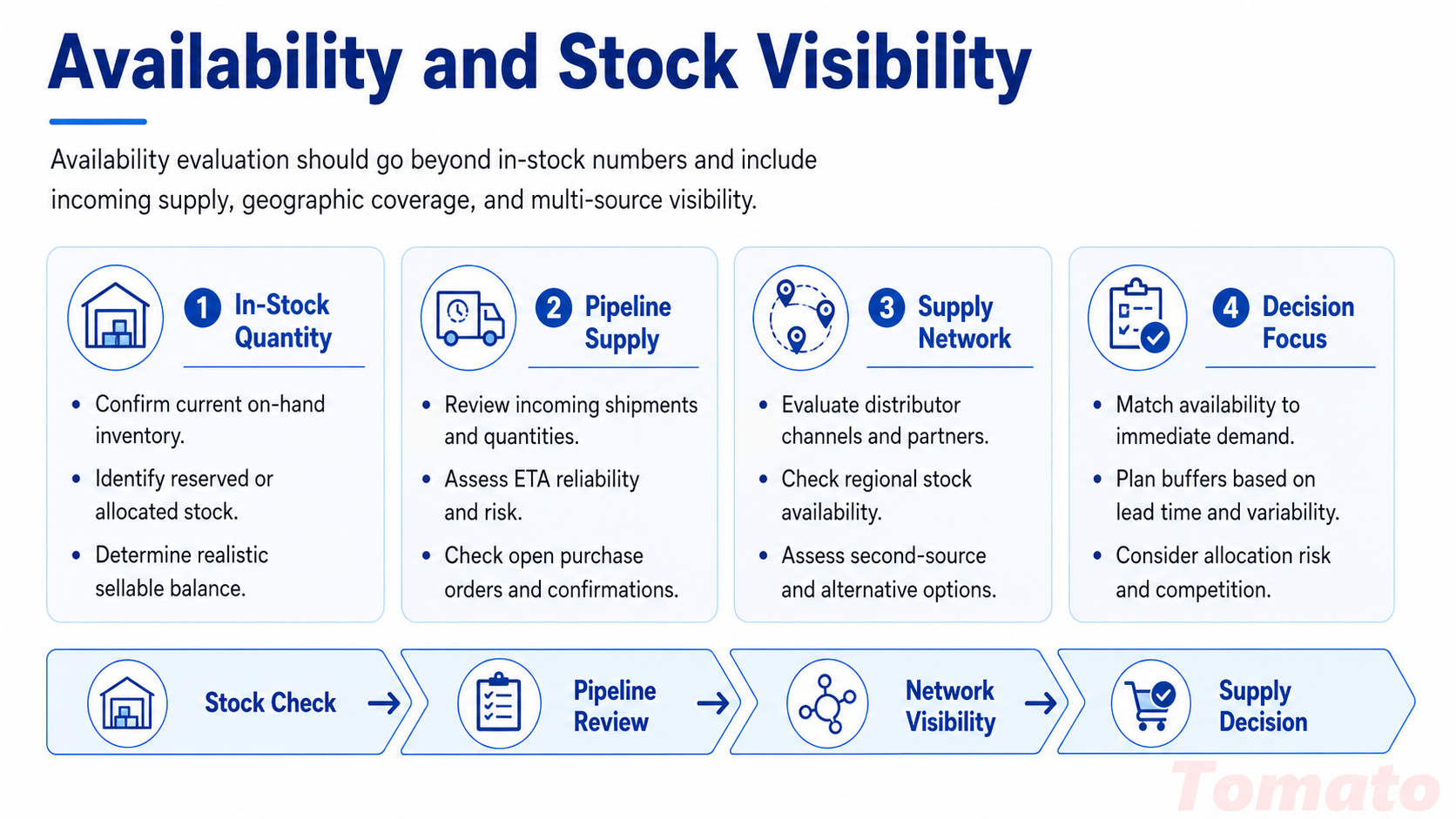
For industrial components, it is also useful to understand whether availability is stable or event-driven. Temporary stock can disappear quickly if there is allocation pressure, project concentration, or customer competition for the same material.
A strong availability review should include:
- Current on-hand sellable quantity
- Incoming pipeline stock and ETA reliability
- Regional or multi-channel stock visibility
- Allocation rules and backlog pressure
- Second-source or alternate-channel visibility
4. How to Assess Substitute Risk
Substitute risk is often underestimated. A replacement part may look similar on paper, but industrial applications usually require closer review of fit, form, function, lifecycle status, quality consistency, and qualification effort.
The first layer of evaluation is technical compatibility. Package, pinout, electrical ratings, tolerance, operating temperature, interface behavior, and performance margin should all be checked against the original part and the actual application environment.
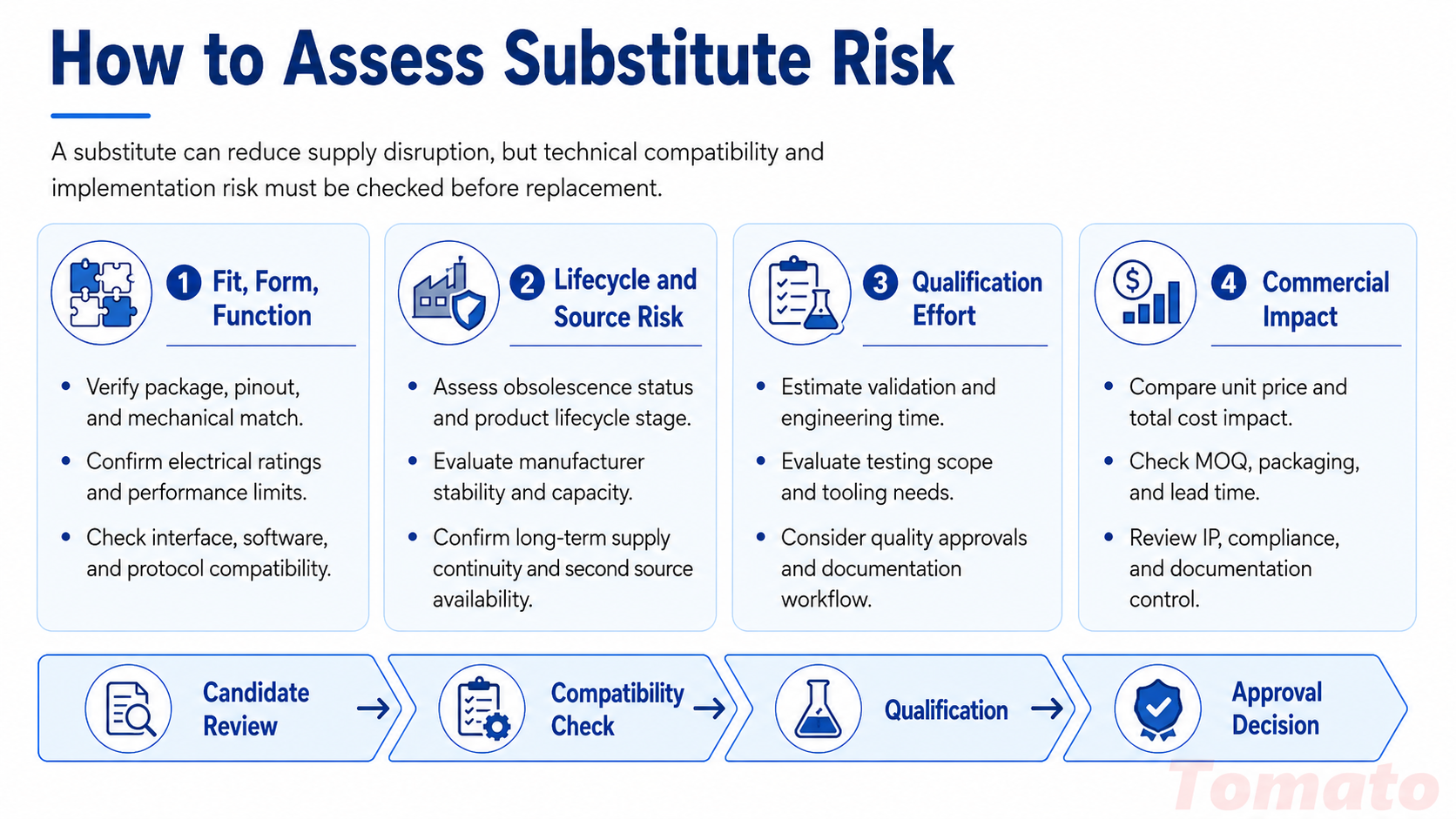
The second layer is implementation risk. Even when the substitute is technically acceptable, the project may still face validation work, approval cycles, documentation updates, compliance review, firmware or software changes, and production requalification.
A practical substitute-risk review usually includes:
- Fit, form, and function compatibility
- Lifecycle and long-term source stability
- Qualification time and engineering workload
- Commercial impact including MOQ and cost change
- Documentation, approval, and traceability requirements
5. How to Make a Better Procurement Decision
The best procurement decision is usually not the part with the lowest price, the shortest quoted lead time, or the most convenient current stock position by itself. The better decision is the one that balances delivery timing, stock certainty, technical risk, and business continuity.
In many industrial projects, teams use a simple decision logic: first confirm demand and production timing, then review actual supply visibility, then assess substitute risk, and finally compare sourcing paths based on overall risk rather than unit price alone.
In practice, this may mean choosing a part with slightly higher cost but stronger availability, or approving a substitute only after compatibility and qualification risk are clearly controlled.
6. Practical Checklist for Industrial Component Sourcing
Before finalizing an industrial component purchase, review the following checklist:
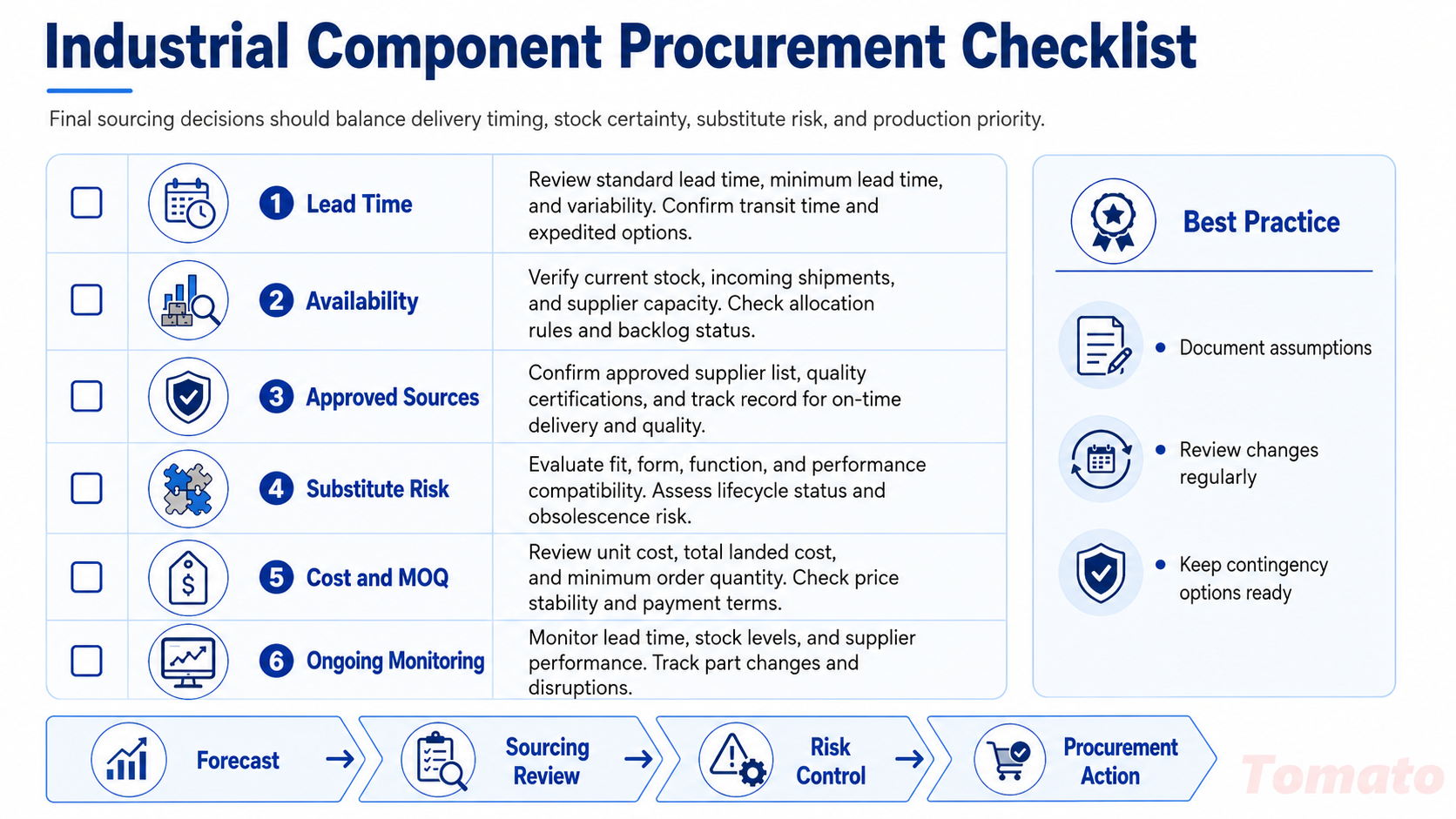
- Confirm standard lead time, minimum lead time, and recent schedule stability.
- Verify current stock, incoming supply, and sellable quantity.
- Review approved supplier channels and actual delivery performance.
- Assess substitute risk in terms of fit, form, function, and qualification effort.
- Check cost impact, MOQ, packaging, and commercial terms.
- Document assumptions and continue monitoring supply changes after order placement.
7. Conclusion
Evaluating lead time, availability, and substitute risk for industrial components is essential for stable sourcing and production planning. A good procurement decision should reflect not only price, but also delivery reliability, stock visibility, technical compatibility, and long-term supply continuity.
For industrial projects, the most reliable sourcing process usually combines demand review, supply visibility, substitute-risk assessment, and ongoing monitoring. If you are reviewing industrial component sourcing options, visit the TomatoElec homepage or contact us through the contact page.