
Available 24/7 at
0755-82798135

TVS Diode vs Varistor: What Is the Difference and How to Choose
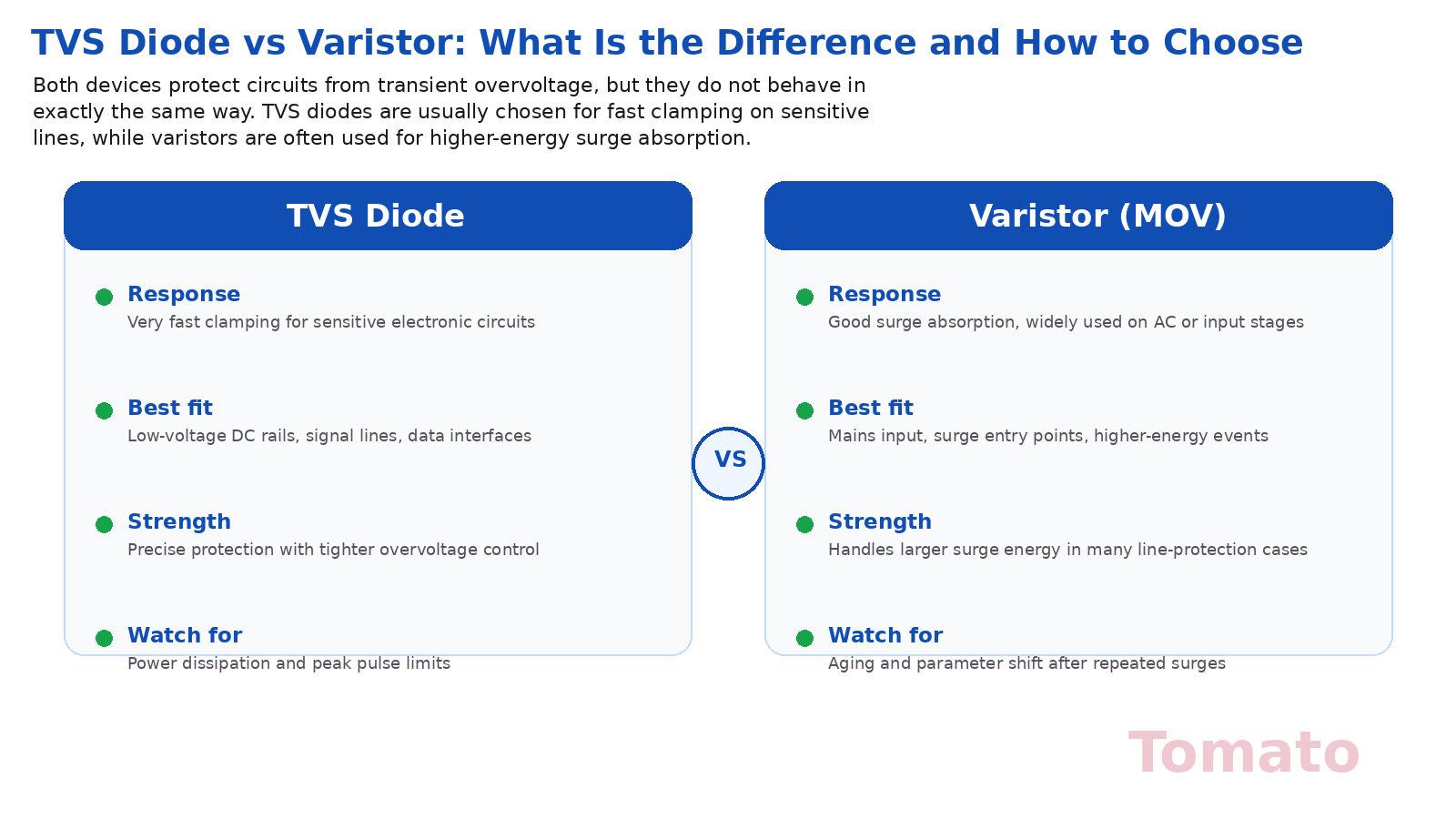
TVS diodes and varistors are both widely used for transient overvoltage protection, but they are not exactly the same device and they are not always selected for the same protection position.
In power supply design, engineers often compare TVS diodes and varistors when they need to protect sensitive circuits from surge, switching spikes, or external transient events. The correct choice depends on how fast the circuit must be protected, how much surge energy is expected, and where the protection device sits in the power path.
This guide explains the difference between TVS diodes and varistors, and shows how to choose the right protection solution for practical power supply design. For more electronic components and sourcing support, visit TomatoElec.
1. What TVS Diodes and Varistors Do
Both TVS diodes and varistors are used to protect circuits from transient overvoltage conditions. Their job is to react when voltage rises above a certain level and help prevent excessive stress from reaching downstream components.
Even though their protection goal is similar, their electrical behavior, response focus, and typical application positions can be different. This is why designers do not usually treat them as fully interchangeable parts.
In practical power supply design, the choice often depends on whether the target is a sensitive low-voltage rail, a board-level DC path, or a higher-energy surge entry point such as the AC input side.
2. Main Differences in Response and Protection Behavior
A TVS diode is usually preferred where fast clamping and tighter protection control are needed, especially around sensitive electronics. In many low-voltage or signal-related applications, designers use TVS diodes because they can react quickly and help keep transient voltage closer to a controlled level.
A varistor, especially an MOV, is often used where the circuit may be exposed to larger surge energy, such as at mains input or other surge-entry positions. In these cases, the design priority is often broader surge absorption rather than tightly controlled protection close to a sensitive IC rail.
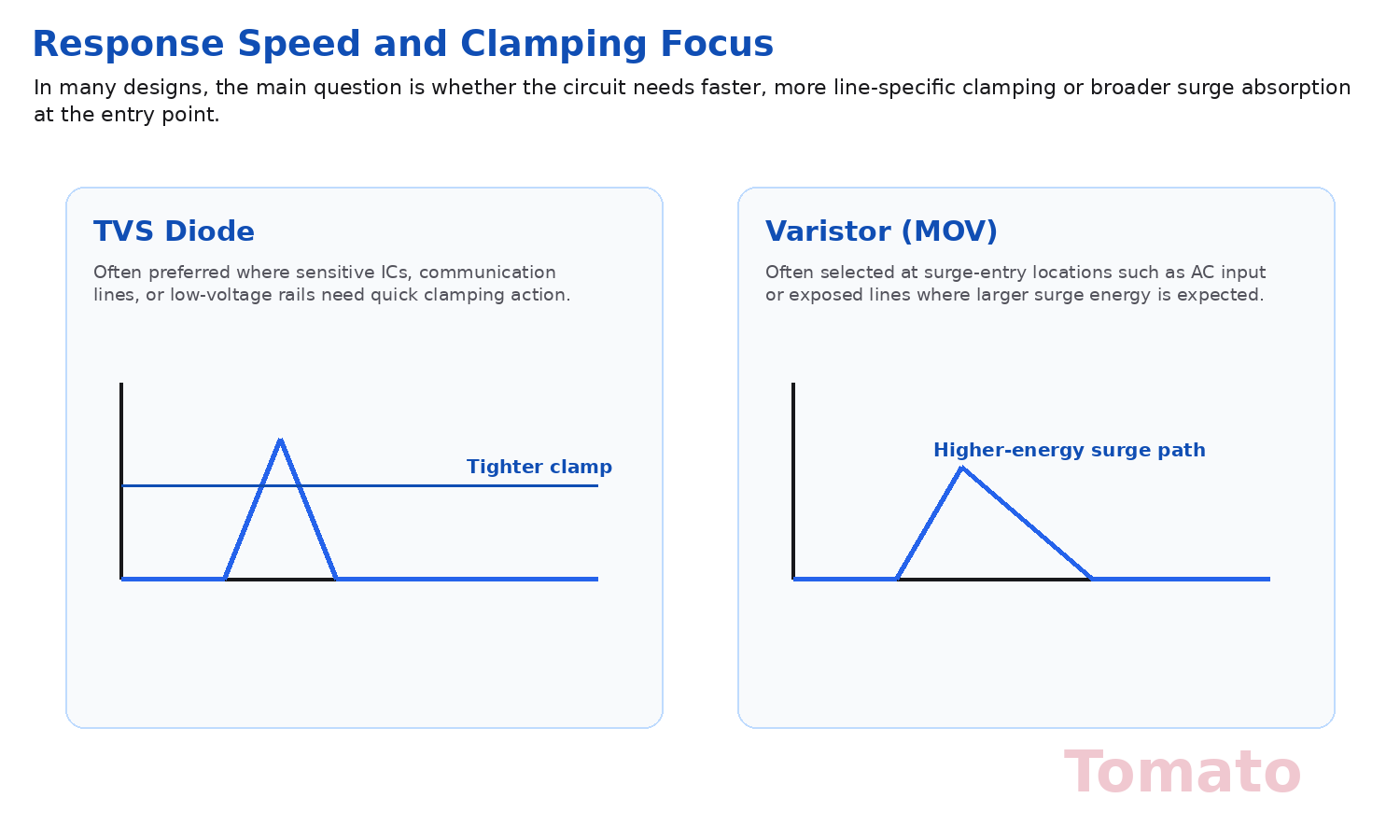
Another practical difference is that varistors are often reviewed more carefully for long-term aging under repeated surge stress, while TVS diodes are often reviewed more closely for pulse power limit, clamping suitability, and location near protected rails.
3. How to Choose by Voltage, Surge Path, and Application
A useful way to choose between a TVS diode and a varistor is to start with the protected rail and the surge path. If the design is protecting a low-voltage DC rail, signal line, or a sensitive electronic interface, a TVS diode is often the first device to evaluate.
If the design is protecting the AC input or another exposed surge-entry location where the surge energy can be much larger, a varistor is often the more common starting point. In some power supplies, the best solution is not an either-or choice, because MOV and TVS can be used in different locations as layered protection.
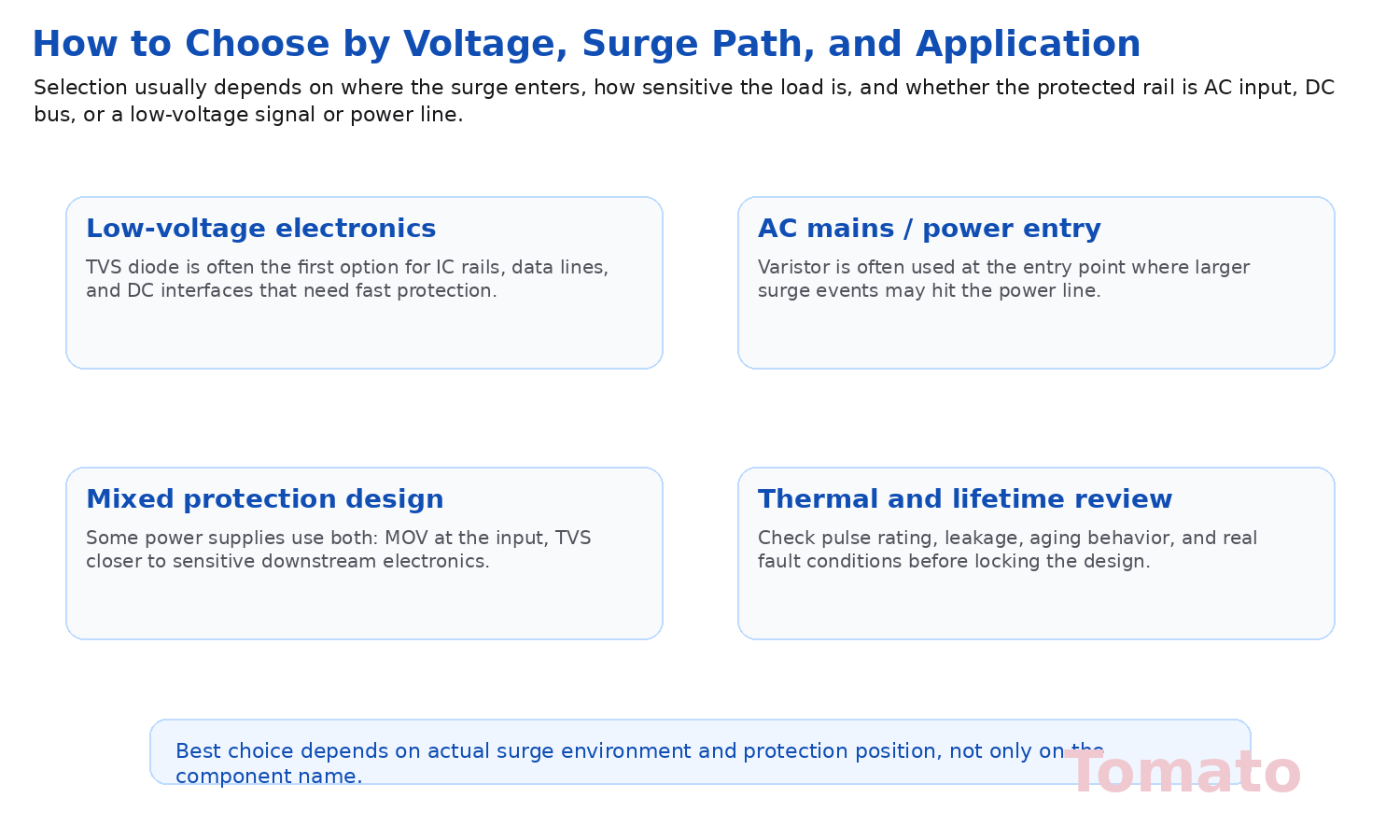
This means the real decision should be based on actual surge conditions, protection position, downstream circuit sensitivity, and overall power architecture rather than on component name alone.
4. Typical Positions in a Power Supply
In many power supply designs, varistors are commonly placed closer to the surge-entry side, such as the AC input or other exposed power entry points. Their role is often to absorb larger incoming surge events before those events propagate deeper into the system.
TVS diodes are commonly placed closer to sensitive downstream electronics, lower-voltage rails, or interface lines where faster and more controlled clamping is needed. This makes them especially relevant in board-level protection around regulators, controllers, communication lines, and protected DC rails.
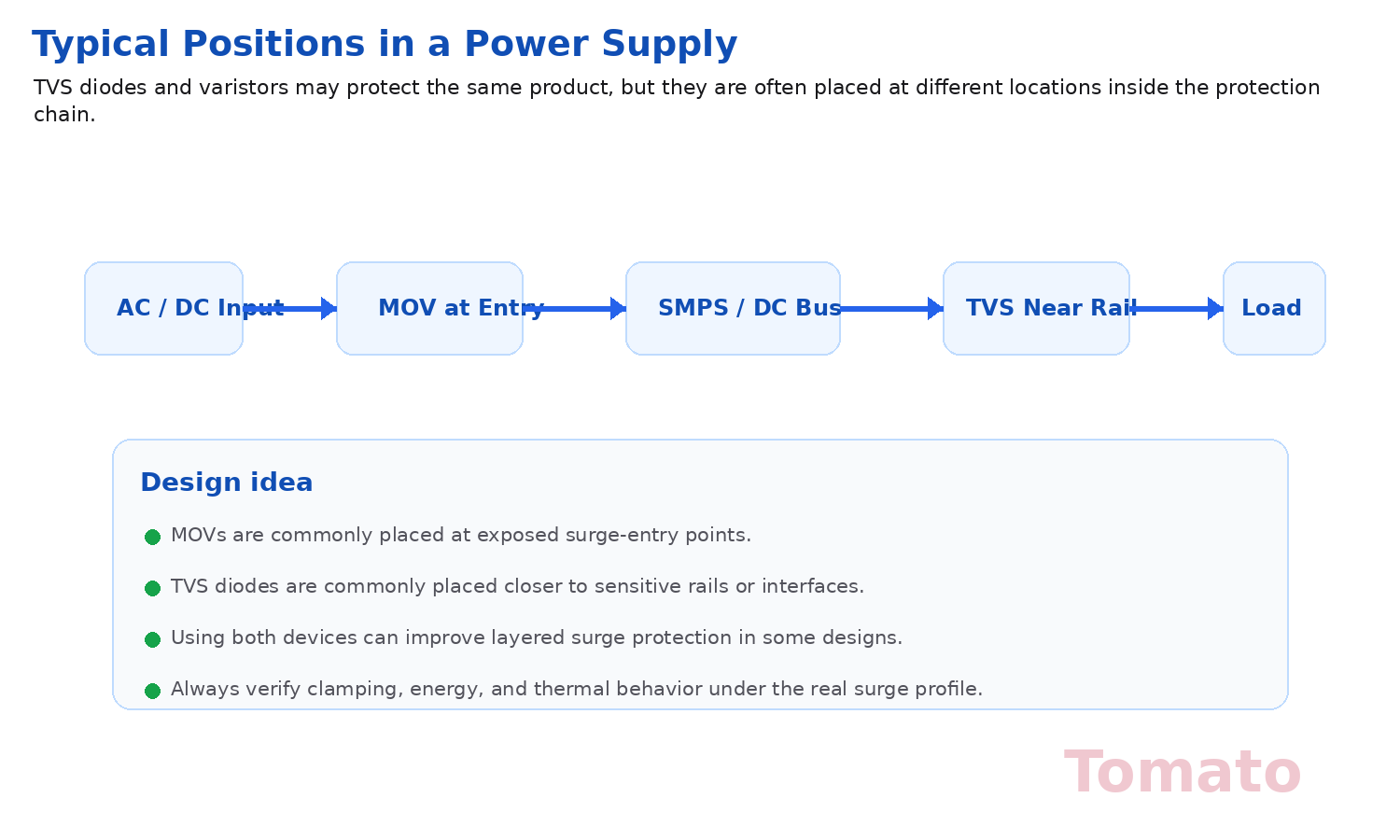
In layered protection strategies, MOV and TVS may both appear in the same product, but they usually do not perform the exact same job at the exact same point in the circuit.
5. Practical Selection Checklist
Before finalizing a TVS diode or varistor in a power supply design, review the following points:
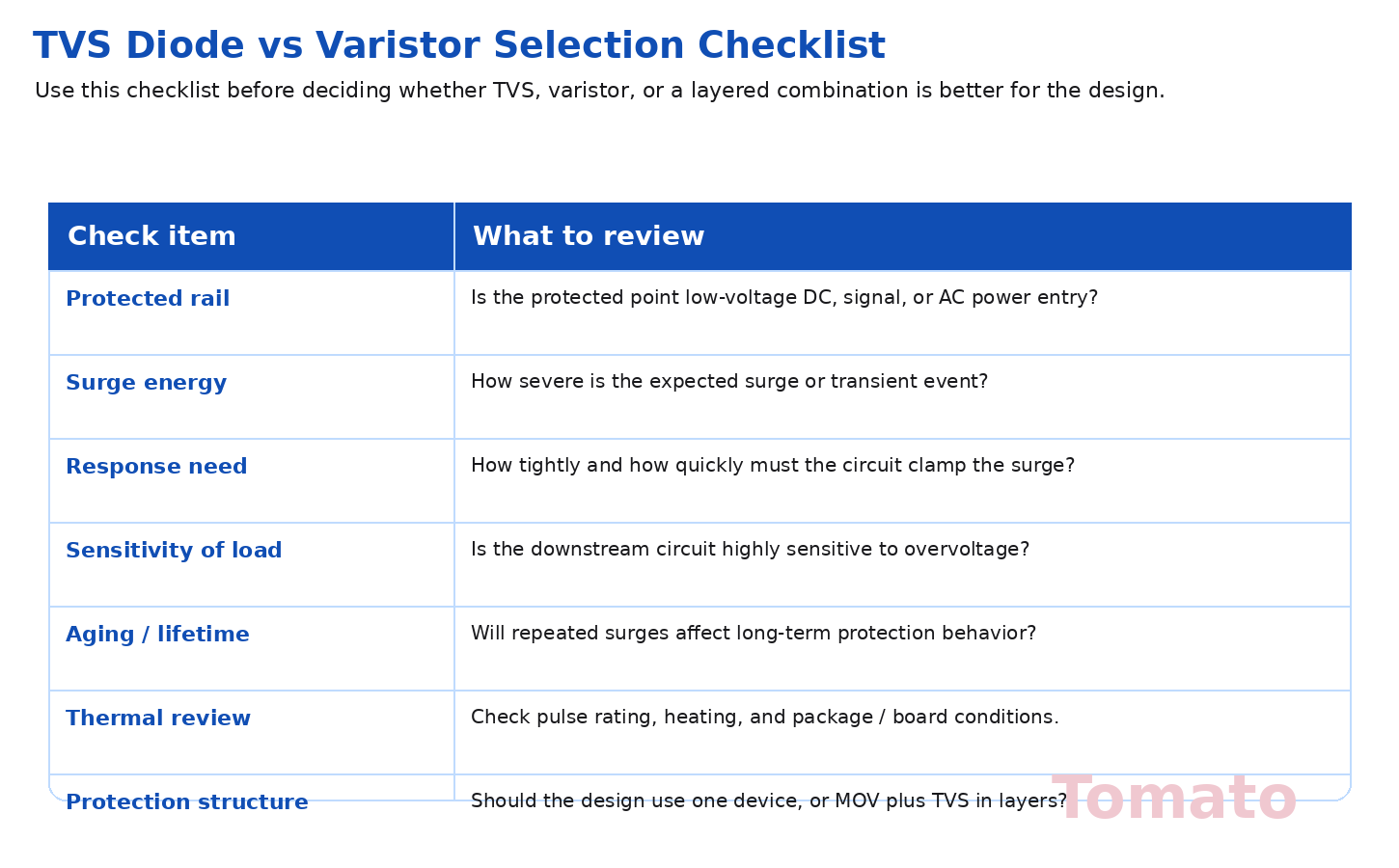
- Identify whether the protected point is AC input, DC bus, low-voltage rail, or signal line.
- Estimate how severe the expected surge or transient event will be.
- Decide how quickly and how tightly the circuit must clamp overvoltage.
- Review how sensitive the downstream electronics are to transient stress.
- Check long-term behavior under repeated surge conditions.
- Evaluate pulse rating, thermal condition, and real board environment.
- Consider whether a layered MOV plus TVS structure is more suitable than a single device.
Conclusion
TVS diodes and varistors both protect against transient overvoltage, but they are typically chosen for different protection roles inside a power supply. TVS diodes are often preferred for faster and more controlled protection near sensitive circuits, while varistors are often preferred at higher-energy surge-entry locations.
The best choice depends on surge energy, circuit sensitivity, protection position, and system architecture. If you are evaluating circuit protection components, visit the TomatoElec homepage or contact us through the contact page.