
Available 24/7 at
0755-82798135

Common Diode Types and Their Applications in Electronic Circuits
Diodes are essential semiconductor components in electronic circuits. They are widely used for rectification, voltage regulation, signal routing, protection, switching, and light emission. Although the word "diode" sounds simple, there are many different diode types designed for very different electrical tasks.
For engineers, purchasing teams, and maintenance professionals, understanding the main diode categories is important when choosing components for power supplies, interfaces, industrial systems, automotive electronics, and consumer products. Selecting the wrong diode type can affect efficiency, response speed, protection performance, or long-term reliability.
In this guide, we explain common diode types and their applications in electronic circuits, helping you understand where each type is most suitable. To explore more electronic components and sourcing solutions, visit TomatoElec.
What Is a Diode?
A diode is a two-terminal semiconductor device that allows current to flow mainly in one direction. This basic one-way behavior makes diodes useful in a wide range of circuit functions. However, different diode structures and materials create different electrical characteristics, so not all diodes are intended for the same purpose.
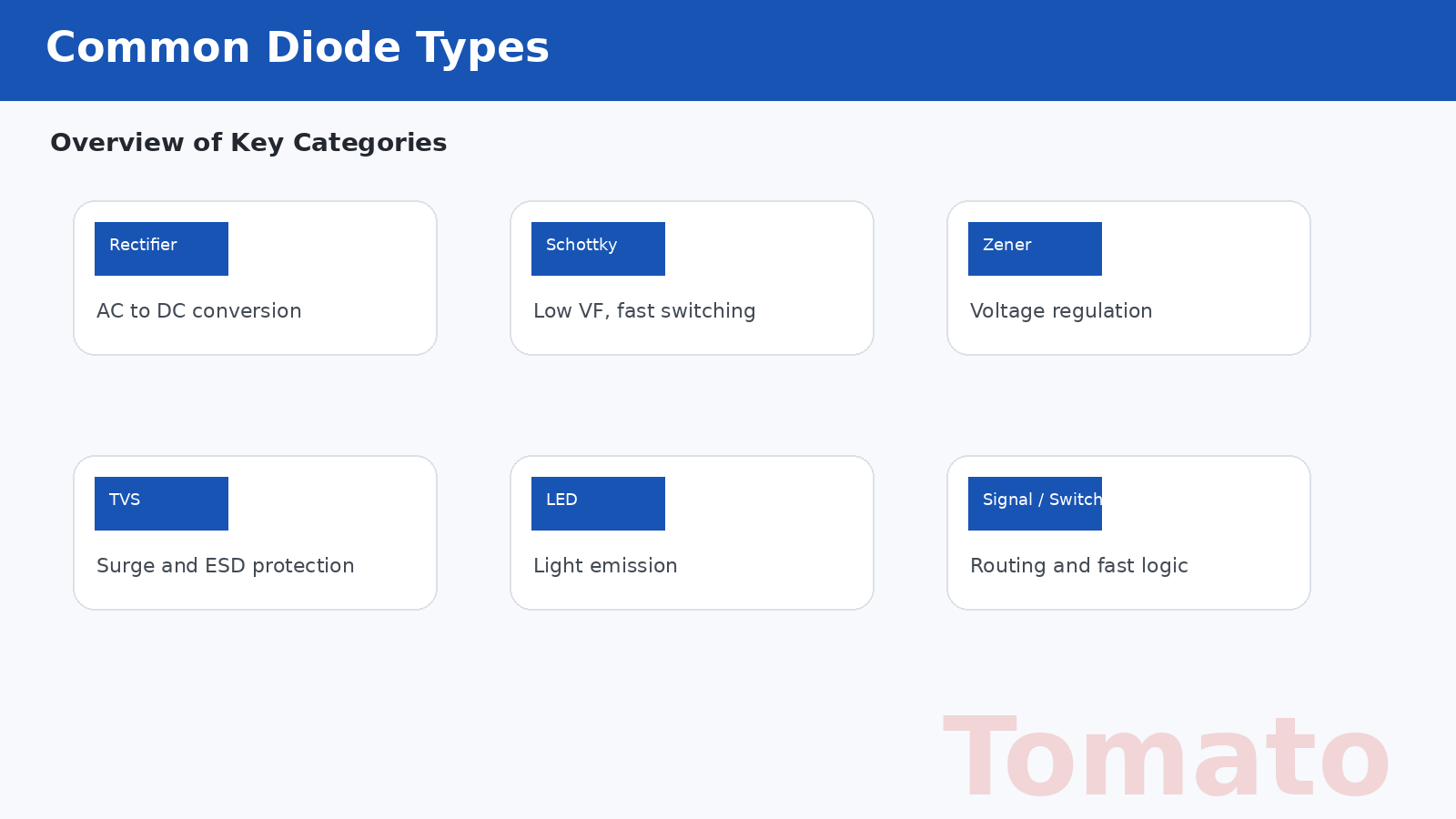
Some diodes are optimized for power rectification, some for fast switching, some for voltage regulation, and others for surge or ESD protection. LEDs are also a diode type, but they convert electrical energy into light.
Common Diode Types
1. Rectifier Diodes
Rectifier diodes are commonly used to convert AC to DC in power supply circuits. They are often selected for current handling capability and reverse voltage rating. These diodes are widely used in adapters, chargers, power entry stages, and many conventional rectification designs.
2. Schottky Diodes
Schottky diodes are known for low forward voltage drop and fast switching speed. They are commonly used in switching power supplies, DC-DC converters, output rectification, and reverse polarity protection. Their efficiency advantages make them useful in low-voltage power designs.
3. Zener Diodes
Zener diodes are used for voltage regulation and reference functions. When operated in reverse breakdown mode, they help maintain a more stable voltage level. They are widely used in simple voltage regulation circuits, reference circuits, and basic overvoltage protection designs.
4. TVS Diodes
TVS diodes, or transient voltage suppressor diodes, are designed for surge and ESD protection. They respond quickly to transient overvoltage events and help protect sensitive ICs, communication ports, and power interfaces.
5. LEDs
Light-emitting diodes convert electrical energy into visible or infrared light. They are widely used in indicators, displays, backlighting, signaling, and illumination products.
6. Signal and Switching Diodes
Small signal diodes and switching diodes are often used in high-speed signal routing, logic circuits, detector circuits, and small-signal applications. These diodes are chosen for fast response and lower current requirements.
Typical Applications of Different Diodes
Power Circuits
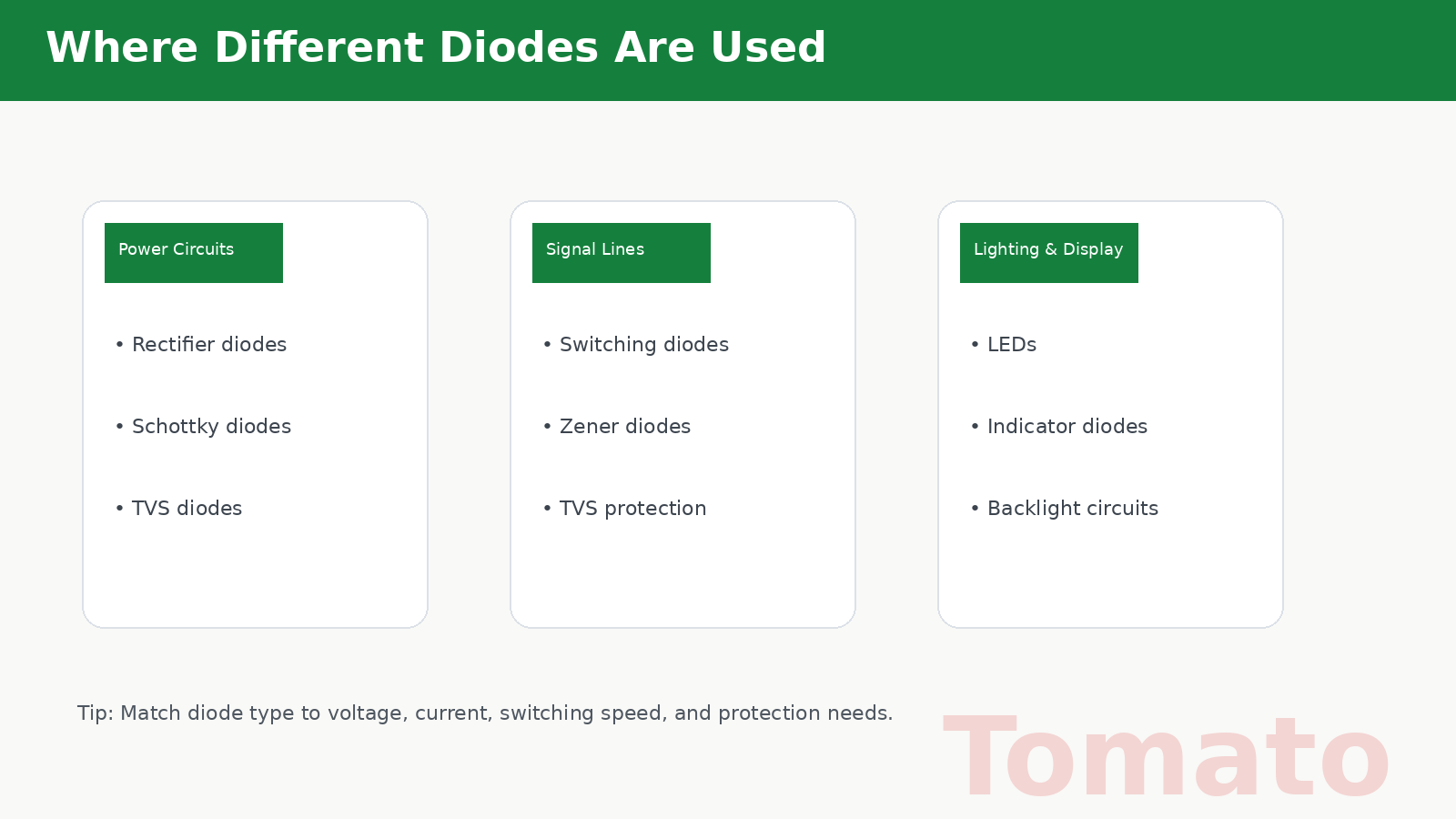
Rectifier diodes, Schottky diodes, and TVS diodes are common in power circuits. Rectifier diodes handle AC-DC conversion, Schottky diodes improve efficiency in switching circuits, and TVS diodes protect power inputs from surge damage.
Signal and Communication Lines
Switching diodes, Zener diodes, and TVS diodes are often used in signal paths and communication interfaces. They support signal routing, voltage limiting, and transient protection in ports such as USB, CAN, RS-485, and other data lines.
Automotive and Industrial Electronics
Automotive and industrial systems often use multiple diode types together. For example, TVS diodes protect against surge events, rectifier diodes support power sections, and Zener diodes may appear in reference or regulation circuits.
Lighting and Display Circuits
LEDs are the most visible diode category in lighting and display products. They are used in status indicators, display modules, backlight systems, and illumination designs.
How to Choose the Right Diode Type
Understand the Main Circuit Function
The first step is to understand what the diode needs to do. Rectification, switching, protection, voltage regulation, and light emission all require different diode types.
Check Voltage and Current Requirements
Forward current, reverse voltage, clamping voltage, breakdown voltage, or forward voltage drop may all matter depending on the application.
Review Speed and Frequency Needs
For switching and communication circuits, response speed can be critical. In these cases, standard rectifier diodes may not be the right choice.
Consider Thermal and Reliability Conditions
Power circuits, automotive electronics, and industrial systems may expose diodes to higher temperature, electrical stress, and longer service life requirements.
Match the Diode Type to the Real Use Case
The correct choice depends on real operating conditions, not just on general part labels. Engineers and buyers should consider the complete application environment before selecting a diode.
Common Selection Mistakes
Choosing by Current Only
Current rating is important, but it is not enough. Reverse voltage, speed, leakage, protection function, and thermal behavior also matter.
Ignoring Reverse Voltage Requirements
If reverse voltage rating is too low, the diode may fail under normal operating conditions or surge events.
Missing Switching Speed Needs
Using a slow rectifier diode in a high-frequency or fast switching circuit can create performance problems.
Using the Wrong Protection Type
For surge and ESD protection, standard diodes are not always a suitable replacement for TVS or other dedicated protection devices.
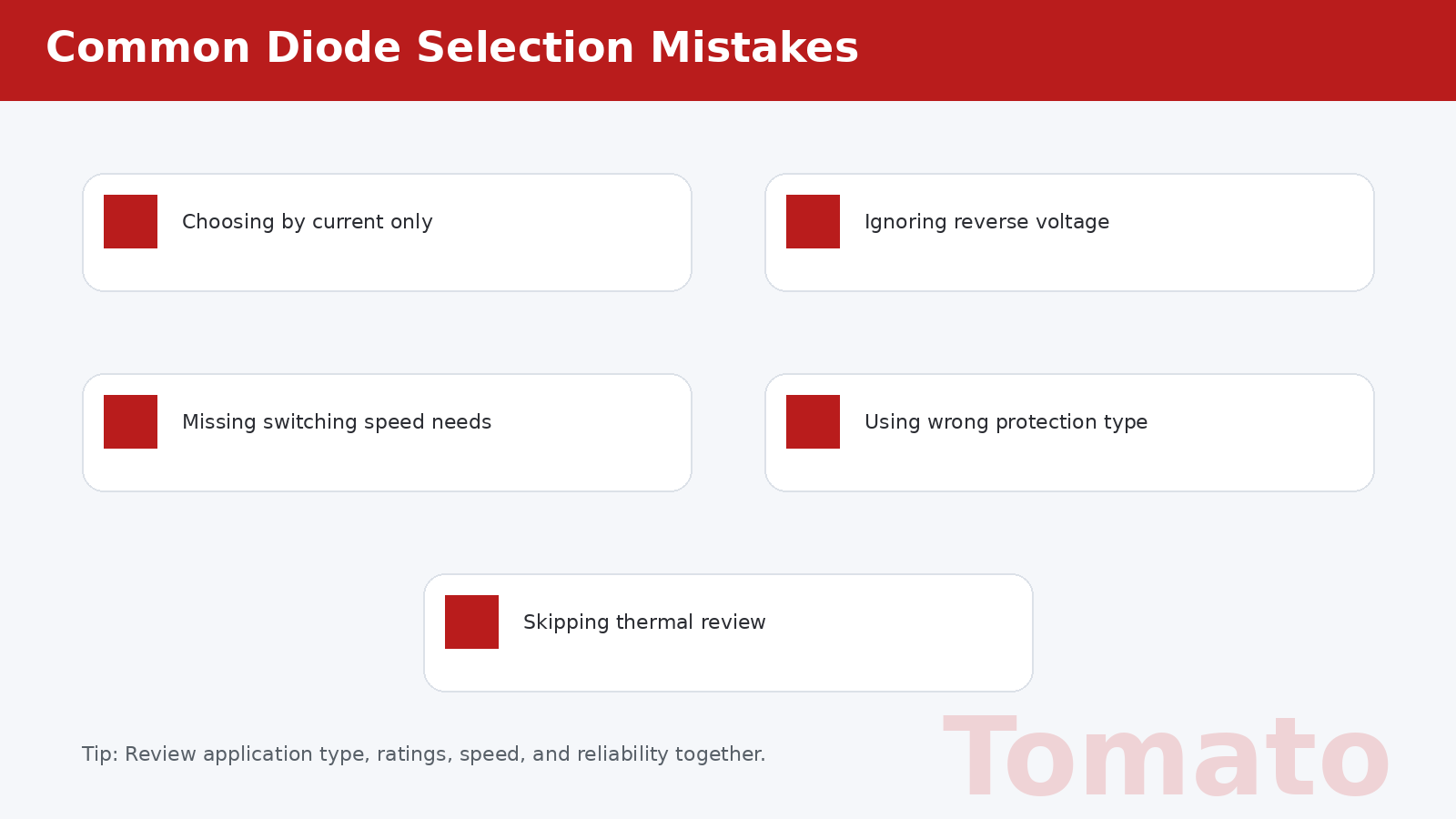
Skipping Thermal Review
Thermal behavior should always be reviewed in power and high-reliability applications.
Conclusion
Different diode types are designed for different circuit functions. Rectifier diodes, Schottky diodes, Zener diodes, TVS diodes, LEDs, and switching diodes each have their own strengths in electronic design. Understanding these differences helps engineers, buyers, and technicians make better component decisions.
If you are looking for diodes and other electronic components for your next project, visit TomatoElec to explore more diode products or reach out through the contact page.