
Available 24/7 at
0755-82798135

Surface Mount vs Radial Lead Aluminum Electrolytic Capacitors: Key Differences and How to Choose
Panasonic aluminum electrolytic capacitors are available in both surface mount and radial lead forms, and each type serves different design priorities. For engineers and buyers, the choice is not only about capacitance and voltage. It also involves PCB layout, assembly process, operating environment, reliability target, and production method.
In practical design work, surface mount capacitors are often preferred for compact PCB layouts and automated assembly, while radial lead capacitors remain important in through-hole applications, industrial equipment, and designs where mechanical robustness and broad general-purpose use still matter. For more electronic components and sourcing support, visit TomatoElec.
What Is the Difference Between Surface Mount and Radial Lead Capacitors?
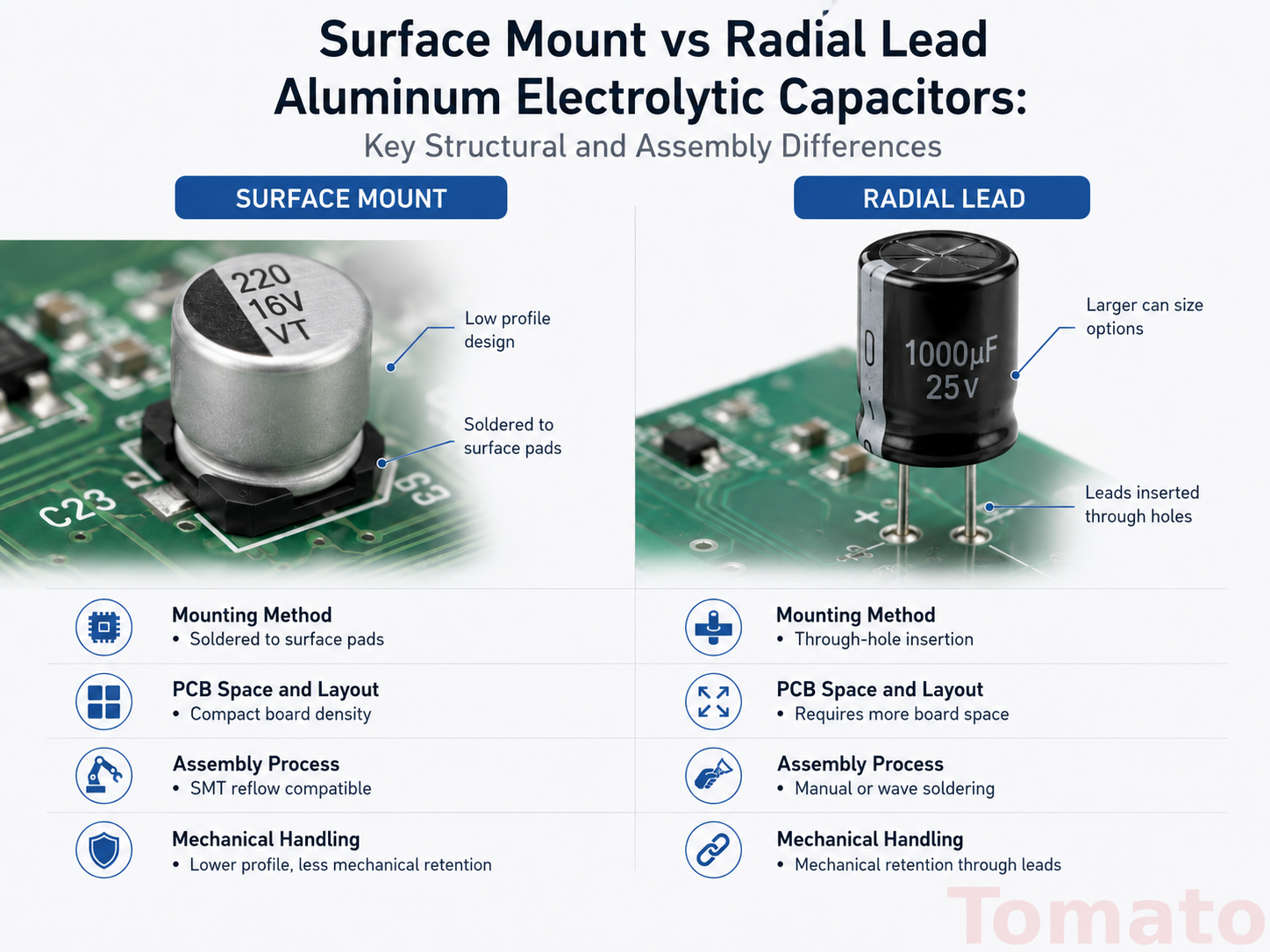
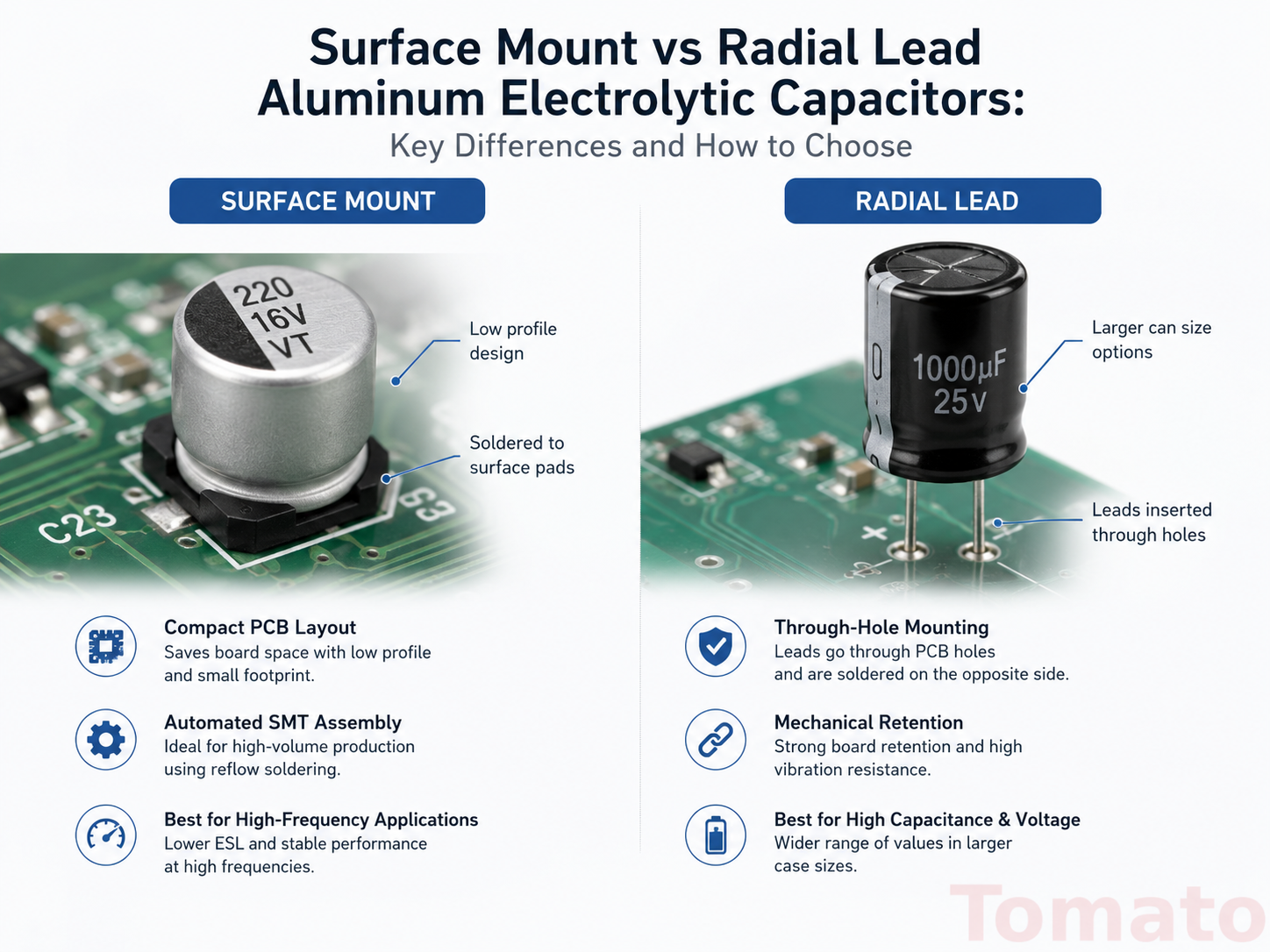
The most direct difference is the mounting style. Surface mount aluminum electrolytic capacitors are designed to be soldered directly onto the PCB surface, which makes them suitable for automated placement and compact board design. Radial lead capacitors use wire leads that pass through holes in the PCB, making them more suitable for through-hole mounting processes and applications where mechanical retention may be more important.
Although both types belong to the same broader aluminum electrolytic capacitor category, they are often selected for different assembly methods, layout strategies, and system priorities.
Key Structural and Assembly Differences
1. Mounting Method
Surface mount capacitors are installed directly onto PCB pads, making them more compatible with modern automated SMT production lines. Radial lead capacitors require drilled holes and lead insertion, which makes them better suited to through-hole assembly workflows.
2. PCB Space and Layout
For compact products, surface mount capacitors can help save board space and support higher assembly density. Radial lead capacitors generally require more vertical and mechanical planning, but they are still practical in larger boards, industrial controls, and traditional power designs.
3. Assembly Process
Surface mount capacitors are typically more aligned with reflow-compatible, automated assembly environments. Radial lead capacitors fit better into designs that use wave soldering, manual insertion, or mixed assembly methods. This difference can influence not only engineering choice, but also manufacturing cost and process stability.
4. Mechanical Handling
Radial lead parts often remain attractive where through-hole retention and familiar assembly structure are preferred. Surface mount types are more suitable where compact mounting and automated handling are priorities.
Performance and Application Considerations
Compact Electronics and Dense Layouts
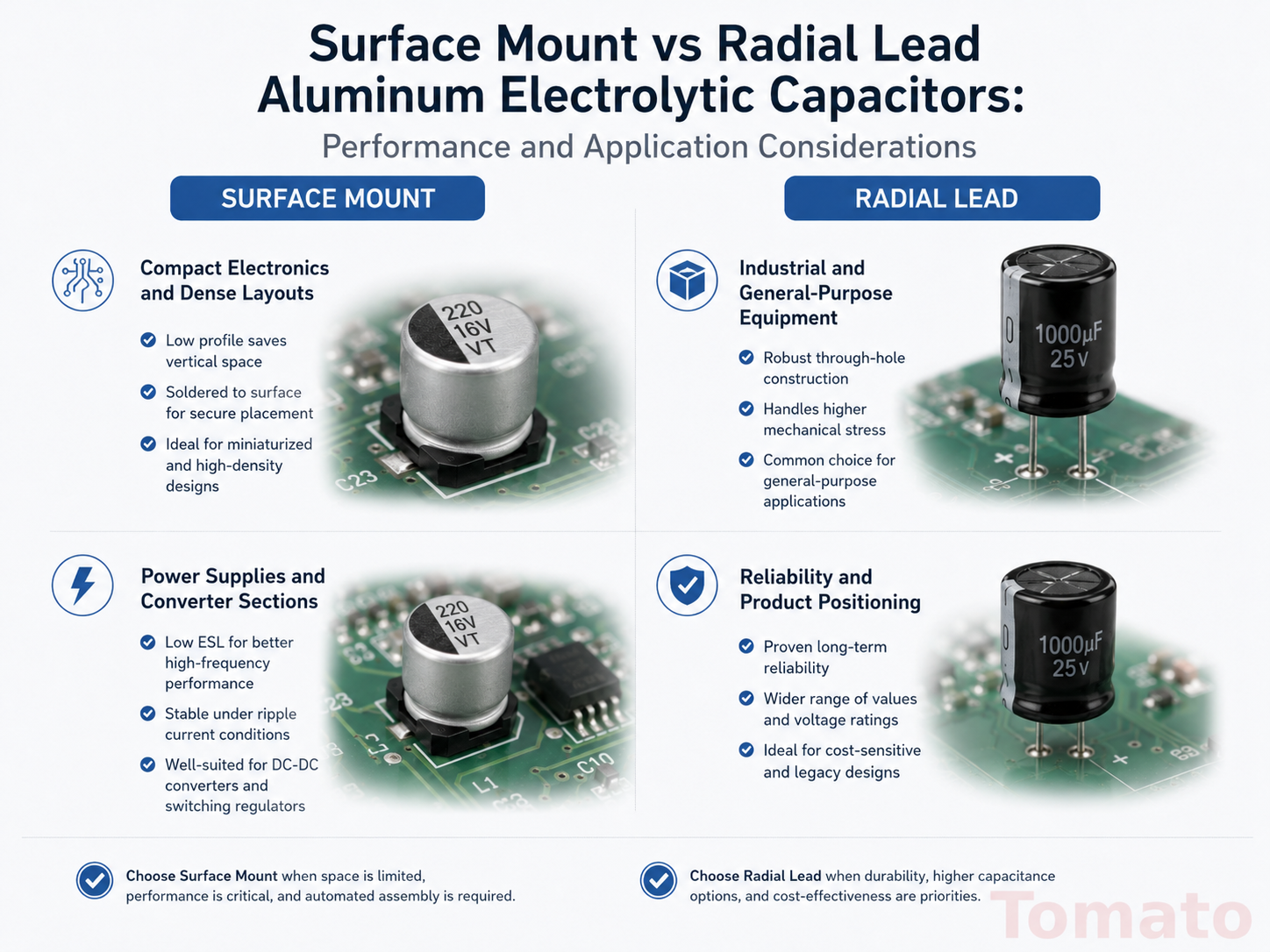
Surface mount aluminum electrolytic capacitors are often more suitable for compact layouts, embedded boards, consumer devices, and systems where SMT production is already the standard.
Industrial and General-Purpose Equipment
Radial lead capacitors remain highly relevant in industrial electronics, general-purpose power boards, and applications where proven through-hole implementation is still widely used.
Power Supplies and Converter Sections
Both types can be used in power supply circuits and converter-related designs, but the better choice often depends on board format, mechanical design, assembly route, and service environment rather than on capacitance alone.
Reliability and Product Positioning
In some projects, radial lead capacitors are chosen because the product architecture already supports through-hole design and favors established industrial assembly methods. In other projects, surface mount capacitors are preferred because smaller size, automation, and PCB density are the main priorities.
When to Choose Surface Mount Capacitors
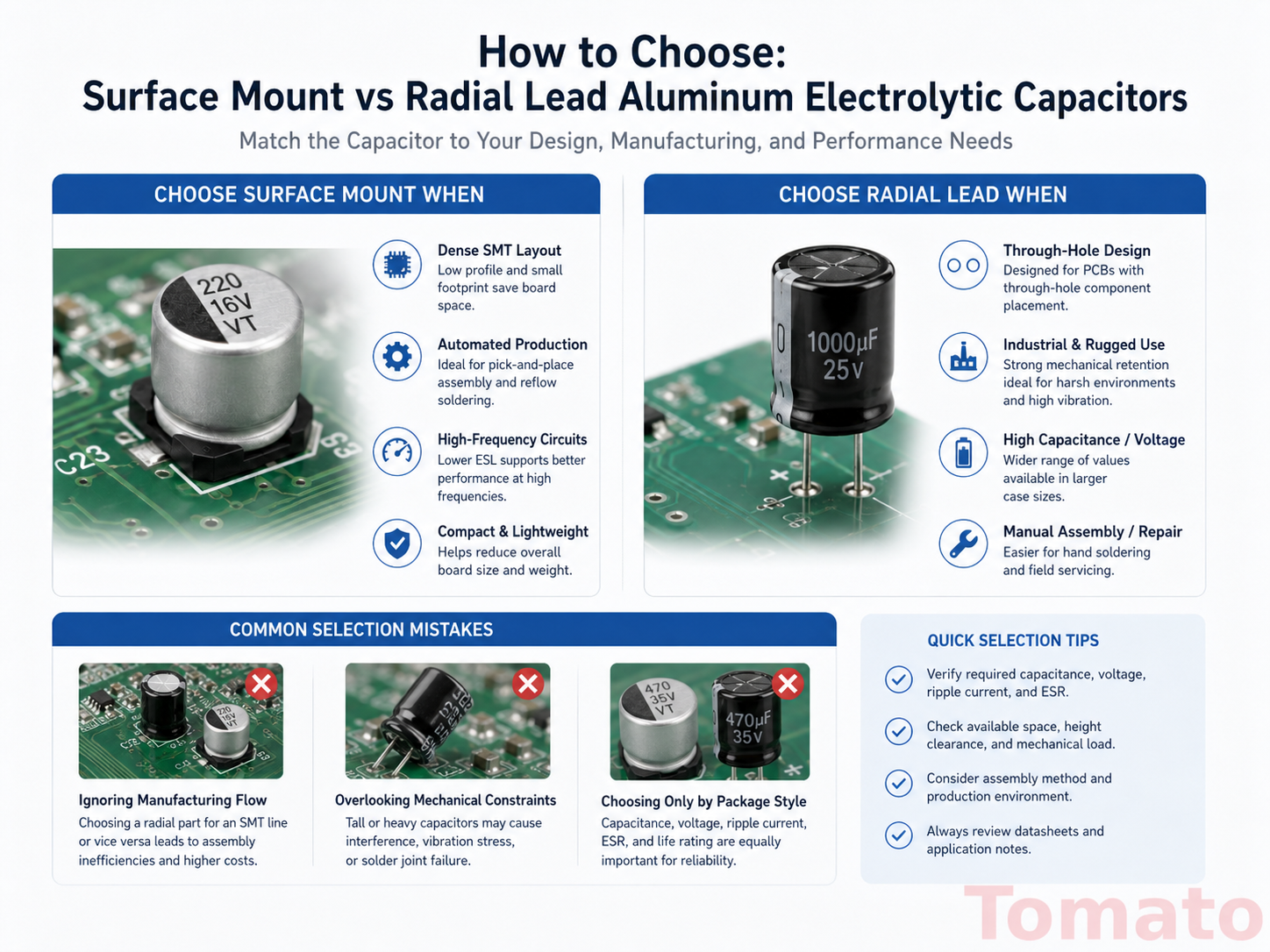
Surface mount aluminum electrolytic capacitors are often the better fit when the product is compact, the PCB is densely populated, and the production line is optimized for SMT assembly. They are also a practical choice when designers want to reduce board area usage and align with modern automated manufacturing.
They are especially suitable for embedded electronics, compact power modules, communication boards, consumer products, and other designs where space efficiency and assembly throughput matter.
When to Choose Radial Lead Capacitors
Radial lead aluminum electrolytic capacitors are often the better fit when the design already uses through-hole construction, the application is industrial or general-purpose, or the board format allows larger mechanical components. They are also practical when long-established assembly methods, broader general-purpose availability, and familiar power-board implementation are important.
In industrial instruments, power supply boards, control equipment, and many conventional converter systems, radial lead capacitors still remain a strong and relevant option.
Common Selection Mistakes
Choosing Only by Package Style
The package style matters, but it should not be the only factor. Engineers also need to review capacitance, rated voltage, ESR, ripple current, expected lifetime, and temperature range.
Ignoring Manufacturing Flow
Some capacitor choices look correct electrically but do not match the actual production process. If the board is designed for SMT efficiency, a radial solution may create unnecessary assembly complexity. If the design depends on through-hole structure, an SMD option may not be the best fit.
Overlooking Mechanical Constraints
Board height, hole spacing, pad design, and installation conditions all matter. A capacitor that fits electrically may still create layout or mounting problems if mechanical limits are not reviewed early.
Assuming One Type Is Always Better
Surface mount is not automatically better than radial lead, and radial lead is not automatically outdated. The correct choice depends on the real product architecture, manufacturing route, and application target.
Conclusion
Surface mount and radial lead aluminum electrolytic capacitors each have clear strengths. Surface mount types are often better for compact layouts and automated SMT production, while radial lead types remain highly relevant for through-hole assembly, industrial equipment, and broader general-purpose use.
For engineers and purchasing teams, the best decision comes from matching package style, electrical performance, assembly flow, and application environment to the real project requirement. If you are evaluating Panasonic capacitor options, you can also read Panasonic Aluminum Electrolytic Capacitors: Types, Features, and Applications, review Panasonic Hybrid Aluminum Electrolytic Capacitors: Benefits, Applications, and Selection Tips, visit the TomatoElec homepage, or contact us through the contact page.